Showing posts with label Darwin. Show all posts

Friday, 11 November 2016

Filming at Downe Bank

Irene Palmer and Tony Robinson being filmed on Downe Bank.  6 July 2016.
Irene Palmer and Tony Robinson being filmed on Downe Bank.  6 July 2016.
Back in July I watched Irene Palmer and Tony Robinson being filmed for a section of his "Britain's Ancient Tracks with Tony Robinson" series.  Now it has been broadcast, my photos are out of embargo.

Irene, our local orchid expert and also currently chair of the Orpington Field Club, was showing how Darwin investigated the way orchids are pollinated, and she was able to collect pollinia from a Common Spotted Orchid  using a pencil as Darwin did.  From this distance all you can see is the pencil, and in the film itself the little pollen packet was only just visible.

All the photos I took during the actual filming were taken from a distance – I was warned away so that my camera clicks didn't spoil the sound track.  Absolutely all of my photos suffered from the high contrast caused by the brilliant sunshine.  Look at the cameraman's arm in that first photo.  The sequence was filmed in the shade to avoid this contrast problem, and so that the participants wouldn't squint all the time.

Irene Palmer and Tony Robinson being filmed on Downe Bank.  6 July 2016.
Irene Palmer and Tony Robinson being filmed on Downe Bank.  6 July 2016.
I also took a few shots at the top of the bank before the filming, and there I was able to use Photoshop to tone down a lot of the contrast.  Raw photos taken on a good camera allow a lot of latitude for adjustments.

Irene Palmer and Tony Robinson before filming on Downe Bank.  6 July 2016.
Irene Palmer and Tony Robinson before filming on Downe Bank.  6 July 2016.
Here, Tony Robinson is apparently sorting out some sun-block.

But during the filming I also spent some time looking for butterflies on orchids.  I saw a lot of Marbled Whites on Pyramidal Orchids, which will have disappointed them as those orchids have no nectar.

Marbled White, Melanargia galathea, on Pyramidal Orchid, Anacamptis pyramidalis.  6 July 2016.
Marbled White, Melanargia galathea, on Pyramidal Orchid, Anacamptis pyramidalis.  6 July 2016.
This butterfly, with a golden band along the leading edge of its wings, is a female.

Marbled White, Melanargia galathea, on Pyramidal Orchid, Anacamptis pyramidalis.  6 July 2016.
Marbled White, Melanargia galathea, on Pyramidal Orchid, Anacamptis pyramidalis.  6 July 2016.
This one, browner and without the golden band, is a male.

I also spotted this pretty little Small Skipper on a Bird's-foot Trefoil. Much more rewarding!

Small Skipper, Thymelicus sylvestris, on Common Bird's-foot Trefoil, Lotus corniculatus.  6 July 2016.
Small Skipper, Thymelicus sylvestris, on Common Bird's-foot Trefoil, Lotus corniculatus.  6 July 2016.
That was the second time I have watched Irene being filmed explaining about orchids on Downe Bank.  The last time it was about the pollination of Fly Orchids, and as an assistant I got a whole 3 seconds of screen time (non-speaking) on The One Show!  So I'm a star.  But not as much of one as these butterflies.

Sunday, 26 June 2011

Downe Bank

Horse and foal near Downe.  Orpington Field Club outing to Orchis Bank, Downe.  Taken with EOS 450D and 100mm macro lens.  25 June 2011.
Horse and foal near Downe.  25 June 2011.
The Orpington Field Club met in the middle of Downe. It's full of reminders of Charles Darwin. Interestingly, there is a memorial sundial on the wall of the church where his children and servants are buried. I was browsing around the churchyard when I was met by Irene Palmer and her husband John. Irene is a Darwin enthusiast and was leading our walk to Downe Bank.

Downe Bank is in the middle of a beautiful area of countryside between Downe and Cudham, on the bank of Cudham Valley. It's a nature reserve and a Site of Special Scientific Interest, and part of it is open to the public.  We walked down to Orchis Bank and over the next couple of hours moved slowly along and back.

The walk was planned to look at the flora, but I always photograph any invertebrates and any other things of interest that will hold still long enough. This horse and foal were in a field on the path from Downe.
Bee orchid, Ophrys apifera, on Orchis Bank, taken from the side, showing pollinia.  Orpington Field Club outing to Orchis Bank, Downe.  25 June 2011. Taken with EOS 450D and 100mm macro lens.
Bee orchid, Ophrys apifera, on Orchis Bank, showing pollinia.
25 June 2011.

We went into the area labelled as Orchis Bank, Darwin's name for one of the areas he studied. Naturally, there was a focus on orchids, and even though the weather this year has not encouraged them, there were plenty of common spotted orchids and common twayblades, with pyramidals scattered among them. Several bee orchids were spotted, and later on, some fragrant orchids. But these showy specimens were only the tip of a wealth of plant life.

I was interested to see a lush black bryony, climbing an ash sapling, which had a shoot with dark purple leaves. I wonder if that is a somatic variation or a true reproducible variety. Other shoots of the same plant looked quite normal.

As usual, the group spread out and straggled. I was often at the back, taking photographs. I saw a few Helix pomatia, the large edible snails that were introduced by the Romans. They were sheltering in small hollows which seemed to be just their size. They did not seem to want to emerge from their shells.
Weevil, Apoderus coryli, on my hand, on Orchis Bank.  Orpington Field Club outing to Orchis Bank, Downe.  25 June 2011. Taken with EOS 450D and 100mm macro lens.
Weevil, Apoderus coryli, on my hand, on Orchis Bank.
25 June 2011.

The open area was full of yellow flowers, one of the many local species that resemble dandelions. It is interesting that all the local meadows seem to have one of these species predominent. Often it's cat's-ear, but in this case it was the rough hawkbit, Leontodon hispidus. There were also many specimens of hairy St. John's wort, which added to the general yellowness. Marmalade hoverflies were everywhere, often sitting on the yellow flowers and letting me get close up with the camera.

The line of people wound along the narrow path, singly and in groups, turned round at the end and moved back lower down the hill. A few returned the way they came, and others went on and back a different way. I went along to the track on the lower path and climbed the gate into Musk Orchid Bank, which I had visited once before on Ewa Prokop's primrose walk.

Back in March, the grass was short and primroses stood up above it. Now all the plants stood tall. I saw several marbled white butterflies flitting about, but I didn't want to chase them until they settled because it would have meant trampling down all the plant life. The one I came across that was already settled had lost a piece from both hind wings; perhaps it had a close encounter with a bird and was lucky to get away.

I was following the hint of a track that might have been made by a fox, or by one person going unseen ahead of me. There were a few large skippers and I also saw one large field scabious, its light blue flowers standing above all the rest.
Wandering along Orchis Bank.  The yellow flowers are mostly rough hawkbit, Leontodon hispidus.  Orpington Field Club outing to Orchis Bank, Downe.  25 June 2011.   Taken with EOS 450D and 100mm macro lens.
Wandering along Orchis Bank.  The yellow flowers are mostly rough hawkbit, Leontodon hispidus. 25 June 2011.

 
Ringlet butterfly, Aphantopus hyperantus, basking on Orchis Bank.  Orpington Field Club outing to Orchis Bank, Downe.  25 June 2011.  Taken with EOS 450D and 100mm macro lens.
Ringlet butterfly, Aphantopus hyperantus, basking on Orchis Bank.  25 June 2011.

Marmalade hoverfly, Episyrphus balteatus, on hairy St. John's wort, Hypericum hirsutum, on Orchis Bank.  Orpington Field Club outing to Orchis Bank, Downe.  25 June 2011.  Taken with EOS 450D and 100mm macro lens.
Marmalade hoverfly, Episyrphus balteatus, on hairy St. John's wort, Hypericum hirsutum, on Orchis Bank.  25 June 2011.

Fragrant orchid, Gymnadenia conopsia, on Orchis Bank.  Orpington Field Club outing to Orchis Bank, Downe.  25 June 2011.  Taken with EOS 450D and 100mm macro lens.
Fragrant orchid, Gymnadenia conopsia, on Orchis Bank.  25 June 2011.

Marbled white butterfly, Melanargia galathea, on Musk Orchid Bank; missing some pieces of wing.  Orpington Field Club outing to Orchis Bank, Downe.  25 June 2011.  Taken with EOS 450D and 100mm macro lens.
Marbled white butterfly, Melanargia galathea, missing some pieces of wing, on Musk Orchid Bank.  25 June 2011.

Florets of field scabious, Knautia arvensis, on Musk Orchid Bank.  Orpington Field Club outing to Orchis Bank, Downe.  25 June 2011.  Taken with EOS 450D and 100mm macro lens.
Florets of field scabious, Knautia arvensis, on Musk Orchid Bank.  25 June 2011.

Large skipper, Ochlodes venatus, male, feeding on selfheal, Prunella vulgaris, on Musk Orchid Bank.  Orpington Field Club outing to Orchis Bank, Downe.  25 June 2011.  Taken with EOS 450D and 100mm macro lens.
Large skipper, Ochlodes venatus, male, feeding on selfheal, Prunella vulgaris, on Musk Orchid Bank.  25 June 2011.

All the photos in this post were taken with a Canon EOS 450D and an EF 100mm macro lens. For the closeups I used a ring flash.

If this was interesting, you might like to see Irene Palmer's web presentation on Downe Bank: Darwin's 'Entangled Bank' at Downe, A Warden's Tale.

Tuesday, 29 March 2011

Primrose Walk from Cudham

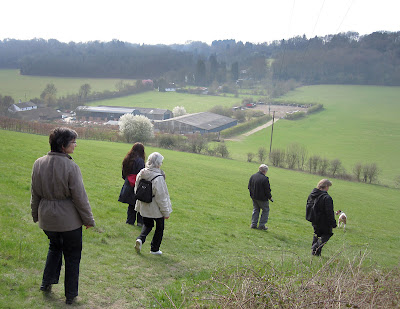
The group walking down into Cudham Valley past Bottom Barn Farm
Walking down into Cudham Valley past Bottom Barn Farm
Quite a short walk, really, but full of interesting plants and environments, led by Ewa Prokop of BCS, who knows all and tells all.

We started in Cudham and walked down into the valley, onto Cudham Road, up Hang Grove Hill and off down to Musk Orchid Bank, from where some of us accepted a lift back.

Much of this is on the Cudham circular walk. The whole area is of interest to historians of science, as it is part of the area walked and recorded by Darwin when he lived at the nearby Down House. This area is once again (for the third time) being proposed to Unesco as a world heritage site. And there is some beautiful countryside.
Walking across a field full of cowslips in Cudham Valley
A field full of cowslips in Cudham Valley

These Bromley valleys were formed by runoff from melting ice at the end of the last ice age; there is no water in them now. The plateaus are clay with flint, and the valleys themselves are chalk.

Walking down the side of the valley, we passed several laid hedges. The slope itself was covered with scrubby trees until ten years ago, when they were cleared and a few sheep were introduced to prevent regrowth. This was an attempt to re-establish the chalk downland which became overgrown when rabbits died off on the introduction of myxomatosis. It has re-grown naturally since then with the local mix of plant species and is now well populated, though there is plenty of low thorn and bramble scrub up to about a foot high.
Cowslips in Cudham Valley

Down at the bottom of the valley, a field belonging to Bottom Barn Farm is full of cowslips, introduced by re-seeding. We walked on to Cudham Road, a short section at the bottom of the valley between Downe Road and Hang Grove Hill. The coal-tax post there was erected to show a point at which tax could be levied on coal being brought into London.

At this point there is a privately owned field which was once a caravan site. It has regrown a lovely carpet of wild flowers; many primroses, lungworts, speedwells, and some less lovely ones like wild parsnips. There are some orchids here in season. There are also a few escapees from the old caravans, for example daffodils and goldenrod, which are less welcome.
Primroses on Primrose Bank, Cudham Valley

The field is known as "Primrose Bank" and this name is well justified.

On the high sides of the valley are ancient woodlands, including Blackbush Shaw and Twenty Acre Shaw, which are managed by the Woodland Trust. We walked up Hang Grove Hill, through Hang Grove, and saw some interesting plants by the roadside; townhall clock, an indicator species for ancient woodlands, and toothwort, a plant with no chlorophyll that is parasitic on hazel roots.

Up the hill, we turned off to a site known as Musk Orchid Bank. This area is not accessible to the public; it is owned by Bromley council and managed by a tenant farmer. There are no musk orchids there now, as there were in Darwin's time. But it is covered with primroses, with some patches of cowslips. It's adjacent to Downe Bank, a nature reserve owned by the Kent WIldlife Trust.

There I also found the shell of a Roman snail, a very large edible snail species which I have never seen alive. Much bigger even than the large garden snails. I will be watching ..

Just as we left we saw a buzzard fly out of the woods for a few moments.

Random fact: Lesser celandine is sometimes called pilewort, and was used as a cure. One of the walkers said that the roots resemble piles, so this might just be sympathetic magic.

Here are a few more images:
The coal tax post in Cudham Valley
Field Speedwell on Primrose Bank, Cudham Valley.  Later addition: I now think this might be germander speedwell.
Field Speedwell on Primrose Bank, Cudham Valley
Later addition: I now think this might be germander speedwell.
Townhall clock, with the flowers just beginning to open, on the edge of Hang Grove, ancient woodland in Cudham Valley
Townhall clock on the edge of ancient woodland in Cudham Valley
Lungwort on Primrose Bank, Cudham Valley
Wild flowers like these lungworts, and the primroses and cowslips, are very pretty. I saw the same plants in a garden centre the next day, so if you want one, there is no need to take one from the wild.

The group on Musk Orchid Bank, about to rest among primroses
Added later: There's a sign near the start of this walk that says access via the permissive footpaths ended in September 2009. I asked Ewa about this and she says the access has been renewed for a further ten years.

Saturday, 19 March 2011

Mosses on Keston Common

Mnium hornum in the old gravel pit on Keston Common

A moss walk around the common, on Saturday 19th March, was led by a local botanist, Jan Hendey, accompanied by the BCS ranger, Judith John.

It was sunny and fresh, so we didn't freeze as we had on the recent Hayes Commmon lichen walk. Jan is a real expert and we walked around examining the beautiful mosses with hand lenses loaned by Judy.

Most of the mosses could be identified with just the lens, and you really do need the lens. As with all specialisms, if you are really familiar with them you can see many differences at a glance. Jan was naming most of the mosses on sight, and only confrming the identification with the lens; but even Jan was wrong once.

Botanist Jan Hendey handing out a moss specimen on Keston Common
Keston Common is a fascinating and quite varied environment. Jan and Judy were both enthusiastic about the increase in the number of moss species found there, particularly on the trees, which used to be quite polluted. Jan thinks that we are still seeing the developing effects of the Clean Air Act of 1956, which I remember well as we had to change from coal to coke as a household fuel. She recommended old elders as a particularly good moss environment.

The moss species we looked at were common, which allowed for pieces to be passed out to everyone to examine.

We were on the southern part of the common, which is on Blackheath gravel and has acid soil. The rangers are gradually clearing trees and shrubs to allow it to revert to its previous heathland status; on the left we were on Ling heath (Calluna vulgaris) with Scots Pine and Silver Birch in the background. There is plenty of gorse just out of sight.

There are about 500 species of moss in Kent. We were shown 13: Mnium hornum, Dicranium scoparium, Hypnum cupressiforme, Rhytidiadelphus squarrosus, Brachythecium albicans, Campylopus flexuosus, Scleropodium purum, Pleurozium schreberi, Hypnum jutlandicum, Eurynchium praelongum (aka Kindbergia praelonga), Polytrichum commune, Sphagnum fallax and Fontinalis antipyretica. We learned something of how the names sometimes matched their appearance. If you see "common names" for mosses, they are nearly all recent inventions.

Sphagnum fallax in Keston bog
The Polytrichum and Sphagnum were growing in Keston Bog, sometimes called Darwin's Bog. The trees that were overgrowing it have been cleared in recent years and the bog is beginning to recover some of its former wonder, though there is still no sign of the sundews, which have been absent since 1987. They will certainly be spotted at once if they do reappear. Unfortunately, Darwin wrote nothing about the bog's mosses.

The last named, Fontinalis antipyretica, grows in the water of the Keston Ponds and looks like a water weed. One of the group had read that it was used in Scandinavia to put out chimney fires, which if true would account for its name.

Other sightings included a scarce hoary cinquefoil on the heath, and a Brimstone butterfly, fluttering through the car park as we left.

Fontinalis antipyretica picked out of Keston Pond

Saturday, 12 February 2011

Keston

Keston Bog in winter
Today there was a history walk around Keston, led by members of the Friends of Keston Common. A pleasant walk around the village and the common, with lots of background information on what we were seeing.

The village was very popular a century ago, and could have thousands of visitors in one day, coming in to Hayes station and then on foot over Hayes common or by bus. There were many tearooms, now all gone, though now there is a delicatessen (reopening soon after a fire) and one, soon to be two, new restaurants.

The common was once mostly privately owned but has expanded by purchase and gift. It has wet and dry meadows and also a bog, shown in the top photo. This bog is the only site in London where Sphagnum moss grows. It was much visited by Darwin, who was particularly interested in its insect-eating sundews, which no longer grow there. The trees that have been shading out the bog have been cut back recently, which might help it to recover.
Botany Bay in Keston

Above the common is an area of Blackheath gravel, once much quarried by the locals, and three ponds, great for wildlife and the haunt of Daubenton's bats. I have also seen terrapins in the lower pond; these intrusive predators appeared in many water habitats after the craze for Mutant Ninja Turtles in the 1980s, when they were bought as pets and later released into the wild.

The second photo is a small group of houses called Botany Bay, where the workers for Keston Mill used to live. The mill is an icon of Keston and has a Wikipedia entry which you can find from the link. Botany Bay is down the hillside and completely out of sight of the village and the road, so is little known even to the locals.