Showing posts with label Leaves Green. Show all posts

Wednesday, 4 January 2017

Three Fields from 2016

Hayes Street Farm with Sowthistles and Scented Mayweed.  5 July 2016.
Hayes Street Farm with Sowthistles and Scented Mayweed.  5 July 2016.
Here are three fields from a folder of things I thought I might put on the blog.  This one is a field on Hayes Street Farm, quite close to my house, which I think must have been sown for green manure.  It was harvested several times during the year.  These plants all occur naturally in this area, but so many similar types all together is not normal.

But because it wasn't fertilised or tended, this field produced a great crop of smaller wildflowers during the year, some of which are quite scarce.  Keep it up!


View of the valley behind Leaves Green, 16 May 2016.
This is one of several dry chalky valleys in the London Borough of Bromley, which extends well out into the countryside.  The yellow flowers are buttercups.

View across fields to the Enfield Road bridge over the River Medway, Leigh, 12 May 2016.
This spot near Leigh is a good area for botanists.  This particular field doesn;t seem to have anything unusual in it, but the display of dandelion flowers and seed heads makes it worth seeing.

But flowers are for the warmer months.  Next time, something more wintery.

Saturday, 24 May 2014

Near Saltbox Hill

Brimstone, Gonepteryx rhamni, male, on a dandelion.  Monad 4061, 19 May 2014.
Brimstone, Gonepteryx rhamni, male, on a dandelion.  Monad 4061, 19 May 2014.
So, I was out doing some botanising for the London Flora Project, but I couldn't resist some of the invertebrates that were also out there.  This butterfly looks very like a greenish leaf when it puts its wings up, though it's such a pure yellow from another angle that it has been said that this is where the "butter" part of the name came from.

Cream Wave, Scopula floslactata.  Monad 4061, 19 May 2014.
Cream Wave, Scopula floslactata.  Monad 4061, 19 May 2014.
To my surprise, I saw three different moths along one short path between a small wood and the Saltbox Hill Local Nature Reserve.  This subtly marked Cream Wave, which is rare in light traps, was just resting near the ground.   I caught another smaller and brighter moth in my hand as it fluttered and photographed it in a plastic tube that I usually carry with me for such a possibility.

Alabonia geoffrella.  Oecophoridae.  Caught in my hand in a hedgerow in monad 4061.  19 May 2014.
Alabonia geoffrella.  Oecophoridae.  Caught in my hand in a hedgerow in monad 4061.  19 May 2014.
But it's not all lepidoptera.  I took this last one because it looked good.  It's the developing berry head of a Cuckoo-pint, which I showed the flower of as recently as the end of April.  By now, the leaves are dying back, and these berries will be bright red and vermilion later on.

Developing berries of Cuckoo-pint, Arum maculatum, and blue flowers of Germander Speedwell,  Veronica chamaedrys.  Monad 4061, 19 May 2014.
Developing berries of Cuckoo-pint, Arum maculatum, and blue flowers of Germander Speedwell,
Veronica chamaedrys.  Monad 4061, 19 May 2014.
The blue Germander Speedwell is a common and pretty grassland flower, here joining the Cuckoo-pint under a hedgerow.

Saturday, 5 April 2014

Three Hellebores

Green Hellebore, Helleborus viridis.  High Elms Country Park, 13 March 2014.
Green Hellebore, Helleborus viridis.  High Elms Country Park, 13 March 2014.
Hellebores make excellent garden plants.  The tolerate shady, dry conditions and flower there when very few other plants will, and they flower early to give a cheerful start to the year.  There are many colour varieties in cultivation.  In the wild, you can usually only expect to see two species, though occasionally others pop up as garden escapes or purposeful introductions. 

There is a good stand of Green Hellebores at High Elms, visible from the road near Cuckoo Wood car park.  They look fresh and light green because the leaves are new each Spring.  These have nearly finished flowering.  The flowers are concealed inside those green sepals, and in most of these there is only the developing fruit.

Corsican Hellebore, Helleborus argutifolius, beside the railway track at Hayes Station.  2 February 2014.
Corsican Hellebore, Helleborus argutifolius, beside the railway track at Hayes Station.  2 February 2014.

There's a Corsican Hellebore beside the track on Hayes Station, visible from where I am typing this now, which is certainly a garden escape. 


Stinking Hellebore, Helleborus foetida.  Behind Leaves Green, 19 March 2014.
Stinking Hellebore, Helleborus foetida.  Behind Leaves Green, 19 March 2014.
This is the other native species, rather less common.  The darker, thinner leaves on this plant are evergreen.  It was good to come across a patch here during a walk with the Orpington Field Club, but there is a lingering doubt over how natural this patch is.  Nearby there is a whole cluster of other species that are only found as garden escapes.  Maybe this area was used to dump garden waste.

Stinking Hellebore, Helleborus foetida.  Behind Leaves Green, 19 March 2014.
Stinking Hellebore, Helleborus foetida.  Behind Leaves Green, 19 March 2014.
This closeup shows the distinctive purple lip to the sepals, and the young fruit within.

Saturday, 28 December 2013

Leaves Green, December

The valley behind Leaves Green on a misty morning.  10 December 2013.
The valley behind Leaves Green on a misty morning.  10 December 2013.
There are already a couple of posts from Leaves Green at this time of year (in 2011) which you can find if you search the blog.  So here are just a couple of shots of the valley behind the village on a misty morning.  The first one was on my way into the valley, no sunshine, so the colours are subdued.

The horses are standing at an angle to the vertical - maybe that's more comfortable for a four-legged animal than trying to stand vertically.  But it makes the photo look rather odd! 

There is a small fire in the valley and its smoke adds solidity to the low mist.

The valley behind Leaves Green on a misty morning.  10 December 2013.
The valley behind Leaves Green on a misty morning.  10 December 2013.
Almost the identical view later on, when the sun was shining through the mist, shows the fire clearly.

These photos were taken with a 100mm macro lens on my EOS 6D, because that's what I had with me.  You can see that it's good for long shots as well as closeups.

Monday, 16 December 2013

Male Fern and Soft Shield Fern

Male Fern, Drypoteris filix-mas.  In my garden in Hayes, 5 December 2013.
Male Fern, Drypoteris filix-mas.  In my garden in Hayes, 5 December 2013.
The Male Fern is probably Britain's commonest fern.  This one grew unasked in my carnivorous plant tray, and has thrives since I transplanted it to a shady spot in my garden.

It is bipinnate; the pinnae branch into pinnules.  This puts it in between the simply pinnate ferns like the Polypodies and the tripinnate Broad Buckler Fern, both of which I have posted recently.

Soft Shield Fern, Polystichum setiferum.  Near Leaves Green, 15 December 2012.
Soft Shield Fern, Polystichum setiferum.  Near Leaves Green, 15 December 2012.
It looks superficially similar to this Soft Shield Fern that I saw in a small wood near Leaves Green a year ago.  But if you compare the pinnae close up, like this:

Male Fern, Drypoteris filix-mas, and Soft Shield Fern, Polystichum setiferum.  Pinnules compared.
Male Fern, Drypoteris filix-mas, and Soft Shield Fern, Polystichum setiferum.  Pinnules compared.
You can see that the Soft Shield Fern is almost tripinnate, and has "thumbs" at the base of its pinnules.

Saturday, 22 December 2012

Tree Patterns

Sawn deadwood near Leaves Green, 15 December 2012.
These patterns are caused by fungal infections in the tree while it was still standing.

Wednesday, 19 December 2012

Snail Graveyard

Garden Snail, Helix aspersa, near Leaves Green, 15 December 2012.
All the signs are that this is not a lucky place for a snail to rest. 

Wednesday, 7 December 2011

The Valley Behind Leaves Green

The diagonal track into the valley from Ashmore Farm. Leaves Green, 3 December 2011.
This is another view of our walk on 3rd December. This valley is lovely in the summer. I walked down here in the middle of the year and there were interesting plants even right by the path, including Pyramidal Orchids just about where I was standing when I took this photo. That's so even though you can see that the area is thoroughly farmed and has power lines overhead.

But I don't want to suggest that it wasn't interesting last Saturday, well after the end of summer. For example, this large fungus, growing on the village green.

Parasol fungus.  Leaves Green, 3 December 2011.
Parasol fungus.  Leaves Green, 3 December 2011.
It's a parasol fungus - I don't know the species. Those darker flaps attached to the top, that give it its distinctive appearance, are the remains of a veil that encloses the whole cap when it is small.

Parasol fungus.  Leaves Green, 3 December 2011.
Parasol fungus.  Leaves Green, 3 December 2011.
And here, underneath the cap, you can see the lower part of that veil halfway up the stem. Some fungi have veils that enclose the stem as well, and some of those are very poisonous, so this is a good thing to watch for.

I was looking at the plants, but some of the group were birdwatchers, who enjoyed seeing buzzards circling above the trees. We also saw some Rose-ringed Parakeets, raucous and colourful birds that have recently become naturalised here.

Five Rose-ringed Parakeets, Psittacula krameri, in a tree on the straight path down into the valley from Ashmore Farm. Leaves Green, 3 December 2011.
Five Rose-ringed Parakeets, Psittacula krameri, in an oak tree on the straight path down from Ashmore Farm.
Leaves Green, 3 December 2011.
The bird-lovers are rather dismissive of these invaders, but I used to enjoy watching them come to my garden peanut feeder when I lived in West Wickham.

We also saw mosses and lichens. Here's one:

Lichen, Parmelia sulcata, on a tree.  Leaves Green, 3 December 2011.
Lichen, Parmelia sulcata, on a tree.  Leaves Green, 3 December 2011.
I think this is Parmelia sulcata, though I am quite prepared to be corrected. It's very common, so I really should know it ... There were mosses, too. This one was fruiting and gave a good view of its distinctive spore capsules.

Moss, Rhynchostegium confertum.  Leaves Green, 3 December 2011.
Moss, Rhynchostegium confertum.  Leaves Green, 3 December 2011.
But the most suprising thing we saw was this, seen through a hedge. At first there were a couple of horse riders, then suddenly a flock of sheep appeared! It is not at all usual for people to herd sheep on horseback here, though apparently it is in some parts of the world, so it's not likely that this was a flock that really needed herding.  Apparently some of them escaped into the woods, so if they are serious about this, they do need the practice!

Herding sheep on horseback.  The valley behind Leaves Green, 3 December 2011.
Herding sheep on horseback.  The valley behind Leaves Green, 3 December 2011.

Monday, 5 December 2011

Leaves Green

Orpington Field Club walking down into the valley from below Ashmore Farm.  Leaves Green, 3 December 2011.
Orpington Field Club walking down into the valley from below Ashmore Farm.  Leaves Green, 3 December 2011.
Another outing for the Orpington Field Club! This time we were led on a walk from Leaves Green, across one of Bromley's dry chalk valleys. We walked down a lane with banks of clay soil, up and down grassy chalk slopes, and through woods.

Two of us also go to Sue Buckingham's weekly wildflower classes, so we were taking the opportunity to look for plants actually in flower. We found more than 30 different species, mostly single plants flowering out of season. I will write more about this later.

But we also saw the sort of thing you would expect to find at the beginning of winter.

Fruiting heads of Hogweed, Heraclium sphondylium, behind the car park in Leaves Green, 3 December 2011.
This is what Hogweed looks like in December. In summer, the white flower heads attract hordes of beetles and flies.  The fields in the valley were full of this sort of thing; dried heads of Wild Carrot, Yarrow, Ribwort Plantain and some others that we failed to identify.  But the grass was green below them, and full of the young leaves of other plants that should grow to maturity next year.

Ferns do not flower, of course; they reproduce with spores.  In the lane we passed a large and healthy Hart's-tongue Fern. They like it dark and damp.

Undersurface of a frond of Hart's-tongue Fern, Asplenium scolopendrium.  Leaves Green, 3 December 2011.
Undersurface of a frond of Hart's-tongue Fern, Asplenium scolopendrium.  Leaves Green, 3 December 2011.
On the second half of our walk, on a path through a wood, we saw quite a few fungi.  The woods were suitably dark and damp; we have had plenty of light rain, the days are short, and the sunlight is weak.
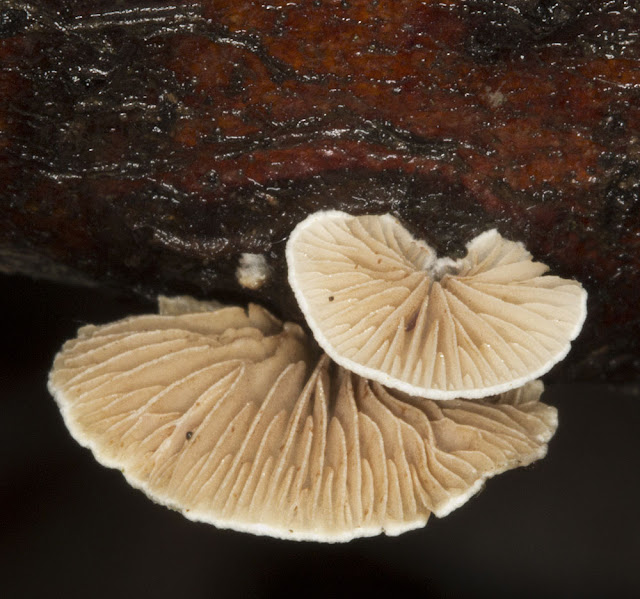
Fungus, Crepidotus species, probably mollis, growing on a rotting fallen branch.  This fungus is quite soft.  Near Leaves Green, 3 December 2011.
Fungus, Crepidotus species, probably mollis, growing on a fallen branch.  Near Leaves Green, 3 December 2011.
This is the underside of one that was growing on a piece of rotten wood. It was quite soft and flexible.

Fungus, Candlesnuff, Xylaria hypoxylon, growing on a rotting fallen branch.  aka Stag's-horn Fungus. Near Leaves Green, 3 December 2011.
Fungus, Candlesnuff, Xylaria hypoxylon, near Leaves Green, 3 December 2011.
Candlesnuff, sometimes called the Stag's-horn fungus, is common in the woods round here, and it, too, grows on rotting wood.  We saw a lot of it on our recent morning at Blackbush Shaw, but none of my photos of it from that day came out right.  High contrast subjects taken with a flash are tricky!  These shoots are only an inch or two long. 

Fungus, Marasmius epiphyllus, growing on a dead beech leaf, near Leaves Green, 3 December 2011.
These tiny fragile umbrellas were growing on a single fallen beech leaf, helping it to rot back down into the earth.

I will finish this post with one of the flowers we found, a delicate pink bud of the wild dog rose.  An unexpected sight, completely out of season.  But there is more to tell about this trip; it will be in the next post.

Bud of Dog-rose, Rosa canina, near Leaves Green, 3 December 2011.