Showing posts with label spiders. Show all posts

Wednesday, 6 July 2016

One Morning

Grey Heron, Ardea cinerea.  Husseywell Park, Hayes, 25 June 2016.
Grey Heron, Ardea cinerea.  Husseywell Park, Hayes, 25 June 2016.
I go out most days to look for plants or invertebrates to photograph.  This post documents a couple of hours of one recent morning. 

The weather forecast was a bit iffy so I just walked up to a local farm field, which I am monitoring to log all the plant species in its monad (1-km square) for the London Flora Project.  On the way I walked through Husseywell Park, a small park with a small pond.  The name is a contraction of  "Housewife's Well." 

The pond is small, but big enough to interest a heron.  My lovely 100mm macro lens lets me take long-distance shots as well as closeups, and the sensor in my camera (EOS 5DS) allows me to crop down to just a small part of the picture and still make it look good.

Yellow Corydalis, Pseudofumaria lutea.  Hayes churchyard wall, 25 June 2016.
Yellow Corydalis, Pseudofumaria lutea.  Hayes churchyard wall, 25 June 2016.
I photograph common plants if I see a particularly photogenic specimen. The wall of Hayes churchyard is clearly very welcoming for plant life.  As well as this Yellow Corydalis, there are four other species just within this photo.

Pellitory-of-the-Wall, Parietaria judaica.  Hayes churchyard wall, 25 June 2016.
Pellitory-of-the-Wall, Parietaria judaica.  Hayes churchyard wall, 25 June 2016.
This is one of them.  Pellitory-of-the-Wall is in the same family as stinging nettles, but is harmless to touch.  Though, according to Wikipedia it is very allergenic.

Pellitory-of-the-Wall, Parietaria judaica.  Hayes churchyard wall, 25 June 2016.
Pellitory-of-the-Wall, Parietaria judaica.  Hayes churchyard wall, 25 June 2016.
It has tiny white flowers clustered in the leaf axils.

Toad Rush, Juncus bufonius.  Hayes Street Farm, 25 June 2016.
Toad Rush, Juncus bufonius.  Hayes Street Farm, 25 June 2016.
Finally at the farm, which is only 15 minutes walk from my house, I photographed mostly species I had not spotted here before. This Toad Rush is not rare, but usually likes damp places.

Toad Rush, Juncus bufonius.  Hayes Street Farm, 25 June 2016.
Toad Rush, Juncus bufonius.  Hayes Street Farm, 25 June 2016.
The flowers are more interesting in close-up.

Smooth Sowthistle, Sonchus oleraceus.  White-petalled form.  Hayes Street Farm, 25 June 2016.
Smooth Sowthistle, Sonchus oleraceus.  White-petalled form.  Hayes Street Farm, 25 June 2016.
I've seen these before, but this is a nicely placed specimen of a white-petalled form of the Smooth Sowthistle, so I thought it was worth a photo.  The prickles are quite soft, unlike those of its close relative the Prickly Sowthistle, or, indeed, the true thistles.

Rush Veneer, Nomophila noctuella.  Hayes Street Farm, 25 June 2016.
Rush Veneer, Nomophila noctuella.  Hayes Street Farm, 25 June 2016.
I was distracted by this moth, which I chased until it settled in a photographable pose.  Rush Veneers are usually darker than this one.  They are known to come in to the country over the channel.  Of course, that will have to stop if we leave the EU.

Nursery Web Spider, Pisaura mirabilis.  Hayes Street Farm, 25 June 2016.
Nursery Web Spider, Pisaura mirabilis.  Hayes Street Farm, 25 June 2016.
Spiders that hunt their prey usually carry their egg sacs with them, like this Nursery Web Spider.  They are hard to photograph because they only hold still for a few moments before dashing off into cover, so I get a lot of random unfocused shots of grass stems.  Luckily, this one is not too bad. 

I also had a couple of photos of unidentified plants, which I won't show this time.


Monday, 13 June 2016

Riddlesdown Quarry, Early Summer

Riddlesdown Quarry, 9 June 2016.


Walking into Riddlesdown quarry in summer is a completely different experience from a winter visit. It is a few years since I had seen it in this season.  I was invited to join Andrew, one of the rangers, for a butterfly walk.  My aim was to photograph anything interesting, not just butterflies!  We did see some of the scarce Small Blues, the main reason for this walk, which I managed not to photograph.

Even before the walk I had taken a couple of shots on a nearby bank. This is Crested Dog's-tail, Cynosurus cristatus.  It's a common grass, but very showy.


Burnet Companion, Euclidia glyphica.  Riddlesdown quarry, 9 June 2016.
Burnet Companion, Euclidia glyphica.  Riddlesdown quarry, 9 June 2016. 
Inside the quarry we soon saw lots of these moths, Burnet Companions, common day-fliers in grassland.  I was pleased to get a close photo, which I had not managed before.  

I saw a couple of spiders ..

Crab spiders, Misumena vatia.  Riddlesdown quarry, 9 June 2016
Crab spiders, Misumena vatia.  Riddlesdown quarry, 9 June 2016
In the middle of this Oxeye Daisy is a crab spider, Misumena vatia.  Crab spiders are ambushers.  They wait in a flower until an insect comes along, then pounce.  This species can change its colour to yellow, but I have only ever seen white ones, whatever colour flower they are on.  Of course that might just mean that I have missed some well-camouflaged specimens!

The larger one is a female.  The small striped one is a male, which I found wandering around on a different flower.

Jumping spider, Heliophanus species, with prey. Riddlesdown quarry, 9 June 2016
Jumping spiders creep up on their prey and then jump at them.  They are fast.  This Heliophanus has what looks like a small fly.

Brimstone caterpillar, Gonepteryx rhamni, on Common Buckthorn, Rhamnus cathartica.  Riddlesdown quarry, 9 June 2016
Brimstone caterpillar, Gonepteryx rhamni, on Common Buckthorn, Rhamnus cathartica.  Riddlesdown quarry, 9 June 2016
Andrew pointed this out to us.  It's the caterpillar of a Brimstone butterfly, lying along the leaf of a small Buckthorn.  This and the related Alder Buckthorn are its only food plants.  The caterpillars were hard to see until we were right up close to them.  Soon afterwards, we watched a female Brimstone lay a single egg on a Buckthorn leaf.   That's it inset into this photo.

Weevil, Tychius schneideri.  Riddlesdown quarry, 9 June 2016.
As well as white Oxeye Daisies, the quarry was full of yellow flowers.  All up the slopes were masses of Kidney Vetch, the food plant of the Small Blue butterfly.  

We looked inside a few of the flower heads, searching for caterpillars, but didn't find any.  It was only a quick look, not a proper investigation.  But I did see this little weevil, Tychius schneideri, which is known to favour Kidney Vetch.

There were many yellow-flowered dandelion lookalikes, and the floor of the quarry had a healthy population of Rock Rose.
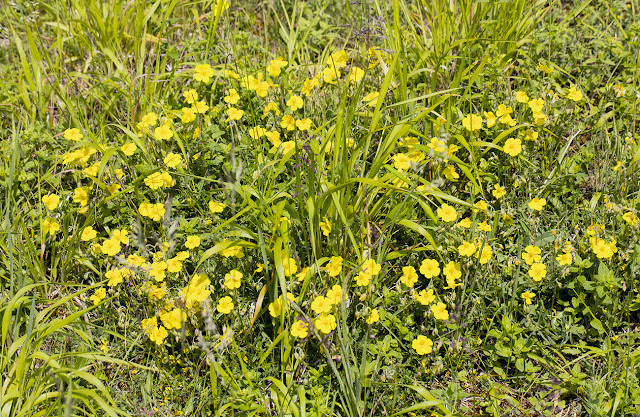

Common Rock-rose, Helianthemum nummularium.   Riddlesdown quarry, 9 June 2016.
Common Rock-rose, Helianthemum nummularium.   Riddlesdown quarry, 9 June 2016.
And, of course, there were many other things.  I have carefully avoided repeating things featured in the previous summertime post linked to at the top.  


Monday, 12 October 2015

Sharp Invertebrates

Volucella zonaria on an ivy bank.  Gates Green Road, Coney Hall, 2 October 2015.
Volucella zonaria on an ivy bank.  Gates Green Road, Coney Hall, 2 October 2015.
These are just a couple of particularly sharp photos that my new camera provided for me.  The first is a large hoverfly, a hornet mimic, eating ivy pollen.  Banks of ivy like this provide the last big feast before the winter for both pollen and nectar lovers.  This hoverfly is going for pollen.  Look at the way her proboscis wraps the ivy's anther.

You don't see how furry these creatures are with the naked eye.  This one looks like a stripy teddy bear.

Garden Spider, Araneus diadematus.  West Wickham Common, 1 October 2015
Garden Spider, Araneus diadematus.  West Wickham Common, 1 October 2015
This Garden Spider does not look like any kind of bear.  It's our commonest orb web spinning spider, and the females are quite large at this time of year.  Here, she is wrapping her prey.  The front legs are spinning it around on an axis formed by the thich nearly-vertical threads.  With one back leg she is guiding a spray of strands from her spinnerets to complete the wrapping.  These spiders always wrap very thoroughly.  The post office would be happy with the result.

EOS 5DS, a camera to enjoy.  Both of these were taken with my normal setup; hand-held with a 100mm macro lens and a ring flash.

Friday, 25 September 2015

Little Oak Tree Creatures

Chalcicoid wasp, family Ormyridae, perhaps genus Ormyrus.  West Wickham Common, 23 September 2015
Chalcicoid wasp, family Ormyridae, perhaps genus Ormyrus.  West Wickham Common, 23 September 2015
Here are three tiny creatures I found on an oak tree on West Wickham Common en route to doing a butterfly transect.  The first photo has a little bit of motion blur because the insect was moving around and feeling the acorn with its antennae; I have now speeded up my standard setting to allow for this sort of thing.

It's a little iridescent wasp.  There are lots of small parasitic wasps, some of which, for example, lay their eggs in creatures that live inside oak galls.  This one doesn't seem to have the right ovipositor for that sort of thing - it would be long and thin - but I don't think it's investigating this acorn in search of a nice vegetarian meal.

It's quite showy, though you can see from the size of the acorn it is walking on that it is really small.

Acorn Weevil (probably), Curculio glandium.  Curculionidae.  West Wickham Common, 23 September 2015
Acorn Weevil (probably), Curculio glandium.  Curculionidae.  West Wickham Common, 23 September 2015
This is a nut weevil.  There are several similar species, and calling this an acorn weevil is just a guess based on it being on an acorn at the time.  Other weevils have also been seen on acorns.  But it's definitely a Curculio species.

These weevils have very weird jointed antennae emerging part way down their proboscis.   Thejoint is mobile, and the arms of the antennae can be brought back to lie parallel to and touching the proboscis.

Araniella species.  Araneidae.  West Wickham Common, 23 September 2015
Araniella species.  Araneidae.  West Wickham Common, 23 September 2015
The third invertebrate is a little green orb web spider, an Arianella. (There are two very similar species.)  Its web is small enough to fit across a single oak leaf and its colour disguises it well.  I think it is a pretty little creature.  Here it was not moving, so I got a sharp image!

Tuesday, 10 February 2015

Last Summer's Predation

Spider, Tegenaria species, predating Pale Mottled Willow, Paradrina clavipalpis. Near my garden light trap in Hayes on 21 June 2014.
Spider, Tegenaria species, predating Pale Mottled Willow, Paradrina clavipalpis.
Near my garden light trap in Hayes on 21 June 2014.
Some of last summer's spiders were quite active.  This Pale Mottled Willow moth had been resting in the crack between the garage door and its jamb.  When I opened the door, it fell to the ground, right into a few strands of web that this Tegenaria spider had spun just under the door opening.  Sensing that something had fallen in, it ran out and grabbed the moth.

Well, the spider was happy, and this also shows off the very light underwings that are typical of the moth.

Jersey Tiger, Euplagia quadripunctaria, being eaten by Garden Spider, Araneus diadematus.  Near my garden light trap in Hayes on 16 August 2014.
Jersey Tiger, Euplagia quadripunctaria, being eaten by Garden Spider, Araneus diadematus.
Near my garden light trap in Hayes on 16 August 2014.
Jersey Tigers are large and colourful moths that used to be scarce here, but now arrive in some numbers over a period of three to four weeks every year.  This orb web spider clearly appreciates the way they come to the light of my trap.

Harvestman, Leiobunum rotundum.  Male.  In my garden light trap in Hayes on 7 June 2014.
Harvestman, Leiobunum rotundum.  Male.  In my garden light trap in Hayes on 7 June 2014.
I also get Harvestmen in my trap.  They are arachnids, related to spiders, but different in several important ways.  I am showing this one because ..

Nursery Web Spider, Pisaura mirabilis.   Male.  Eating a Harvestman, a male Leiobonum rotundum. In my garden light trap in Hayes on 19 May 2014.
Nursery Web Spider, Pisaura mirabilis.   Male.  Eating a Harvestman, a male Leiobonum rotundum.
In my garden light trap in Hayes on 19 May 2014.
Spiders like them too.  A trap full of insects naturally attracts predators, but some of them are more at risk than they would probably like, were they capable of liking things.

(This Nursery Web Spider would have started with eight legs, but has lost two.  I quite often see spiders with missing legs.  The spider at the top of the page and the harvestman in the photo above have both lost a leg.  It doesn't seem to slow them down.)

Wednesday, 4 February 2015

Last Summer's Spiders

Wolf Spider, Trochosa species.  On my back wall in Hayes on the morning of 5 June 2014.
Wolf Spider, Trochosa species.  On my back wall in Hayes on the morning of 5 June 2014.
And now the spiders I found in and around my moth trap last year.  As a group, I think these are the prettiest apart from the moths themselves.  They are also quite varied.  This wolf spider chases down its prey, and has big eyes to see it and muscular legs to run fast.

Garden Spider, Araneus diadematus.  Near my garden light trap in Hayes on 14 September 2014.
Garden Spider, Araneus diadematus.  Near my garden light trap in Hayes on 14 September 2014.
This is our most familiar orb web spider.  The colouration varies from this medium brown to almost black.

Enoplognatha species,  probably.  Juvenile coloration.  In my garden light trap in Hayes on 18 May 2014.
Not quite sure what this one is because it is still a juvenile, but it looks like a web spinner with those long tactile legs.

Spider on the thermometer.  Probabkly Metellina merianae.  In my back garden in Hayes, 1 October 2014.
Spider on the thermometer.  Probabkly Metellina merianae.  In my back garden in Hayes, 1 October 2014.
This species lives around the mouth of caves, so feels quite at home under my balcony near my garage door!  I see the juveniles in my trap quite often.

Noble False Widow, Steatoda nobilis.  In my garden light trap in Hayes on 3 September 2014.
Noble False Widow, Steatoda nobilis.  In my garden light trap in Hayes on 3 September 2014.
This one was interesting, as well as being pretty.  Wikipedia says " it has a reputation as one of the few local spider species which is capable of inflicting a painful bite to humans, with most bites resulting in symptoms similar to a bee or wasp sting."  There was a media fuss about this Noble False Widow, sometimes just called a False Widow, in 2014.  It's not really rare, but it doesn't go about biting people, even though it could if it wanted to.

More spiders next time.

Thursday, 6 November 2014

Ivy Feeders


Honey Bee, Apis mellifera, in flight.  Gates Green Road, Coney Hall, 21 September 2014.
Honey Bee, Apis mellifera, in flight.  Gates Green Road, Coney Hall, 21 September 2014.
Again, tidying up my photo folders, here are some insects feeding on ivy in September.  Ivy is the last big feast for many insects, and a bank in flower on a sunny day can always be relied on for an array of photogenic creatures.

I was pleased to catch this bee hovering, so that its body is sharp even though its wings are moving so fast as to be almost invisible.  This was taken at 1/180th of a second.  It has pollen baskets full of yellow pollen but still seems to be after some more. 

Some say that the honey-bee's role as a pollinator is exaggerated because the pollen it collects is packed away in a solid wet lump, and that much is true, as you can see here.  But you can also see how much dry pollen is scattered over its head, body and legs.  That is perfectly good for future pollinations.

Hoverfly, Eristalis pertinax.  Gates Green Road, Coney Hall.  31 August 2014.
Hoverfly, Eristalis pertinax.  Gates Green Road, Coney Hall.  31 August 2014.
This Eristalis pertinax is a Dronefly, so called because of its similarity to a male honey bee.  In fact it's a hoverfly, and completely harmless.  Here it is working over one of the ivy's anthers.  Compare this to the honey-bee and you can see that this fly has only a few grains of pollen on its legs.

Hoverfly, Eristalis tenax.  Gates Green Road, Coney Hall, 21 September 2014.
Hoverfly, Eristalis tenax.  Gates Green Road, Coney Hall, 21 September 2014.
Though this one, also a pollen-eater, seems to be a bit more messy!  It's a closely related species, Eristalis tenax, that is distinguished by its darker lower legs and the vertical row of hairs on its eye.  The eye of the other species is hairy all over.
Hoverfly, Myathropa florea.  Gates Green Road, Coney Hall.  31 August 2014.
Hoverfly, Myathropa florea.  Gates Green Road, Coney Hall.  31 August 2014.
Another hoverfly, the photogenic Myathropa florea.  This fly has more of an overall honey colour and has a distinctive pattern on its thorax that looks like the Batman logo.  (That small white ring in the middle of its thorax is a reflection of my camera's ring flash.  The ring flash a great tool and has let me take many good shots, but it has this one drawback.)

You can see the looped vein towards the end of its wing that is the mark of the Eristalini.  You can see the same loop on the Eristalis pertinax two pics up, once you know where to look.

Hoverfly, Syritta pipiens.  Gates Green Road, Coney Hall.  31 August 2014.
Hoverfly, Syritta pipiens.  Gates Green Road, Coney Hall.  31 August 2014.
Another hoverfly, the smaller Syritta pipiens, from a different group and with quite a different look.  It is distinguished by its fat thighs.  This one is after the nectar produced by the ivy.  Although ivy does not have petals, it produces nectar from a dome-shaped hypanthium.

Nursery Web Spider, Pisaura mirabilis.  Gates Green Road, Coney Hall, 21 September 2014.
Nursery Web Spider, Pisaura mirabilis.  Gates Green Road, Coney Hall, 21 September 2014.
While I was photographing the insects on the ivy, I was pleased to see this very smart Nursery Web Spider on the nettles below.  As with all spiders, this creature has interesting and often startling mating habits, and the male will sometimes pretend to be dead to get close enough to mate.

Saturday, 27 September 2014

Hayes Common Insects, August


Kite-tailed Robber Fly, Machimus atricapillus. Hayes Common, 24 August 2014.
If I take my camera while out for a local walk I can usually spot a few things to photograph.  There were several of these predatory flies in the northern grassy square on Hayes Common.  In fact they turn up in my photos from several places.  I don't really see the resemblance of its tail to a kite, but it is an easily distinguished shape.

Green Shieldbug, Palomena prasina.  Hayes Common, 24 August 2014.
Green Shieldbug, Palomena prasina.  Hayes Common, 24 August 2014.
  A well disguised true bug that sucks the sap from plants.  It's one of a handful of shield bug species that are easy to find in this area.

Spider, Linyphia triangularis.  Female.  Hillside Lane, Hayes, 24 August 2014.
Spider, Linyphia triangularis.  Female.  Hillside Lane, Hayes, 24 August 2014.
This spider spins a hammock-like web with strands leading upwards, and waits for little insects to hit the strands and fall onto the hammock.  It runs around underneath its web and catches them.  I had to lie on my back to get a shot at this angle.

Common Grass-veneer, Agriphila tristella.  Crambidae.   Hayes Common, 24 August 2014.
Common Grass-veneer, Agriphila tristella.  Crambidae.   Hayes Common, 24 August 2014.
There were dozens of these grass moths flitting about in the grass.  It's not that they normally fly by day, but they are very easily disturbed and move off to another piece of dry grass, where they are very well disguised when they land.  Their underwings are light grey and when they close them, they seem to disappear.

Wolf Spider, Pardosa species.  Possibly Pardosa amentata.  Hillside Lane, Hayes, 24 August 2014.
Wolf Spider, Pardosa species.  Possibly Pardosa amentata.  Hillside Lane, Hayes, 24 August 2014.
On a discarded piece of newspaper I spotted this wolf spider.  Unlike the previous one, this spider does not spin a web, but runs after its prey, hence the sturdy legs and bigger eyes.

Friday, 4 July 2014

Sevenoaks Walks

Common Blue Damselfly, Enallagma cyathigerum.  Female, with prey.  Sevenoaks Wildlife Reserve, walk with a warden (Susanna Clerici), 1 June 2014.
Common Blue Damselfly, Enallagma cyathigerum.  Female, with prey.
Sevenoaks Wildlife Reserve, walk with a warden, 1 June 2014.
It was interesting to go round parts of the Sevenoaks Wildlife Reserve with one of the wardens.  Her interest is mostly on the birds, which is what the reserve was set up for in the first place, but on the way I took several photos of plants and insects and that is what I have here.

Damselflies are predatory fliers, and this one is munching an aphid.

Tetragnatha species.  Female.  Sevenoaks Wildlife Reserve, walk with a warden (Susanna Clerici), 1 June 2014.
Tetragnatha species.  Female.  Sevenoaks Wildlife Reserve, walk with a warden, 1 June 2014.
This prettily decorated creature is also predatory.  Tetragnathas are often called Stretch Spiders, for obvious reasons.

Nettle-tap, Anthophora fabriciana.  Sevenoaks Wildlife Reserve, walk with a warden, 1 June 2014.
Nettle-tap, Anthophora fabriciana.  Sevenoaks Wildlife Reserve, walk with a warden, 1 June 2014.
There were many of these small day-flying moths in the hedgerows.  I only saw one last year; this year I have seen dozens.

Common Stork's-bill, Erodium cicutarium.  Sevenoaks Wildlife Reserve, walk with a warden,1 June 2014.
Common Stork's-bill, Erodium cicutarium.  Sevenoaks Wildlife Reserve, walk with a warden,1 June 2014.
There were some areas of dry ground where small ground-covering plants flowered.  This Common Stork's-bill is related to Geraniums.  The name comes from the shape of its seed pods.

Blue Water-speedwell, Veronica anagalis.  Sevenoaks Wildlife Reserve, walk with a warden, 1 June 2014.
Blue Water-speedwell, Veronica anagalis.  Sevenoaks Wildlife Reserve, walk with a warden, 1 June 2014.
This Blue Water-speedwell was a surprise.  It's known to grow on this site, but it is normally a waterside plant, and here it was growing on dry ground near stonecrops and other plants that thrive in a dry environment.  Perhaps our rainy spring allowed it to get established.  It is rather stunted for its species.

Monday, 2 June 2014

High Elms, May 2014

Dingy Skipper, Erynnis tages.  High Elms Country Park, 15 May 2014.
Dingy Skipper, Erynnis tages.  High Elms Country Park, 15 May 2014.
A few more photos from High Elms in May.  (The Friends of High Elms are putting some of my photos on their web site.)  This one is a Dingy Skipper which I had to get right down on the ground to take.  It was basking, and quite happy not to fly off as I got close.  I don't know why, but they are much more nervous when they are skipping between the greenery and feeding.

Cantharis Rustica, mating pair.  High Elms Country Park, 15 May 2014.
Cantharis Rustica, mating pair.  High Elms Country Park, 15 May 2014.
That dark blotch on the orange pronotum of these Cantharids looks like a heart from above, and that view might make a good valentine card if people liked beetles at all.  But generally they don't!

This is also another illustration of something I've said before, that many shiny beetles are actually quite hairy close to.

Green Hairstreak, Callophrys rubi, on Crosswort, Cruciata laevipes.  High Elms Country Park, 15 May 2014.
Green Hairstreak, Callophrys rubi, on Crosswort, Cruciata laevipes.  High Elms Country Park, 15 May 2014.
Our greenest butterfly.  Those wing scales are very reflective, and it will not open its wings when resting.  The top surface of them is actually brown.  Its other annoying habit is that it turns to face anyone who gets near.  It makes it easy to get this sort of mug shot, hard to get any other sort of photo!

Finally ...

Jumping Spider, Salticidae.  High Elms Country Park, 15 May 2014.
Jumping Spider, Salticidae.  High Elms Country Park, 15 May 2014.
Jumping spiders are very alert little creatures.  They have excellent eyesight and they move in quick little jerks.  It can be quite disturbing to see one suddenly whip round and stare right back at you.  It makes your interaction seem a lot more personal.

As well as the forward-facing eyes you see here, they have two on the outer side edges of their cephalothorax, so they can easily see movement to their sides and above.