Showing posts with label Sevenoaks Wildlife Reserve. Show all posts

Friday, 7 September 2018

A Rare Treat

Clifden Nonpareil, Catocala fraxini.  Crowborough, 4 September 2018.
Clifden Nonpareil, Catocala fraxini.  Crowborough, 4 September 2018.
This is a Clifden Nonpareil, sometimes called Blue Underwing. It was once resident in the UK, but died out, and was then seen only as an occasional immigrant.  It is re-establishing itself, but still is only seen a few times a year away from the coast.  So I was lucky that this specimen appeared on my garden fence above the light of my moth trap.

I saw it from my kitchen window before dawn and thought I might have a Red Underwing.

Red Underwing, Catocala nupta.  West Wickham Common, 8 September 2016.
Red Underwing, Catocala nupta.  West Wickham Common, 8 September 2016.
That would have been good because although these are not scarce, they rarely come to light, and I have only seen two, both at West Wickham Common.  But no!  It was bigger and better than that.

Clifden Nonpareil, Catocala fraxini.  Crowborough, 4 September 2018.
Clifden Nonpareil, Catocala fraxini.  Crowborough, 4 September 2018.
And it is big, one of our biggest moths.   The Old Lady is quite sizeable:

Old Lady, Mormo maura. Kelsey Park, 28 August 2015.
.. But it's not as big, and it lacks the flashy underwings.  For size, you might consider Hawk-moths; they are pretty big, like this Privet Hawk-moth that some trappers brought to Sevenoaks.

Privet Hawkmoth, Sphinx ligustri.  Sevenoaks Wildlife Reserve, 7 July 2013.
Privet Hawkmoth, Sphinx ligustri.  Sevenoaks Wildlife Reserve, 7 July 2013.
I saw one at Hayes the next year.  These were very impressive.  Incidentally, blue is a rare colour among moths.  I only know one other in Britain with some blue, and it's another Hawk-moth:

Eyed Hawk-moth, Smerinthus ocellata.  Crowborough, 3 July 2017.
Eyed Hawk-moth, Smerinthus ocellata.  Crowborough, 3 July 2017.
All of these were a real pleasure to see and handle.  But the Clifden nonpareil is the rarest.

Clifden Nonpareil, Catocala fraxini.  Crowborough, 4 September 2018.
Clifden Nonpareil, Catocala fraxini.  Crowborough, 4 September 2018.


Saturday, 1 September 2018

Sevenoak Moths August 2018

Acleris emargana.  Sevenoaks Wildlife Reserve, 29 August 2018
Acleris emargana.  Sevenoaks Wildlife Reserve, 29 August 2018
There was a reasonable collection of late Summer moths in the trap at Sevenoaks Wildlife Reserve this month.  One moth was sitting on top of the trap - this one, Acleris emargana.

Acleris emargana.  Sevenoaks Wildlife Reserve, 29 August 2018
Acleris emargana.  Sevenoaks Wildlife Reserve, 29 August 2018
It's a species I have not seen before.  There is a confusion species, Acleris effractana, but as that lives in Scotland I think this identification is pretty safe.

Most of the others were quite common types.  This one:

Snout, Hypena proboscidalis.  Sevenoaks Wildlife Reserve, 29 August 2018
Snout, Hypena proboscidalis.  Sevenoaks Wildlife Reserve, 29 August 2018
Does not look the way we normally expect because it is a second generation specimen, darker than the first generation and lacking some of the normal markings. 

Square-spot Rustic, Xestia xanthographa.  Sevenoaks Wildlife Reserve, 29 August 2018
Square-spot Rustic, Xestia xanthographa.  Sevenoaks Wildlife Reserve, 29 August 2018
The Square-spot Rustic is an autumnal species, basically brown but often with rich reddish undertones.  It's well named for its distinctive straight-edged spots.

Spectacle, Abrostola tripartita.  Sevenoaks Wildlife Reserve, 29 August 2018
Spectacle, Abrostola tripartita.  Sevenoaks Wildlife Reserve, 29 August 2018
Spectacles crop up during most of the summer.  This side view shows the prominent crests, formed of long scales.

European corn-borer, Ostrinia nubialis.  Sevenoaks Wildlife Reserve, 29 August 201
European corn-borer, Ostrinia nubialis.  Sevenoaks Wildlife Reserve, 29 August 2018
This European Corn-borer is one I don't see very often so I was glad of the chance to get a good clear photo.  I took a mug-shot as well.  It was just an occasional migrant until the 1930s but is gradually getting established in the UK.  Over here, it actually lives on Mugwort rather than being a crop pest.

European corn-borer, Ostrinia nubialis.  Sevenoaks Wildlife Reserve, 29 August 201
European corn-borer, Ostrinia nubialis.  Sevenoaks Wildlife Reserve, 29 August 201

Saturday, 31 March 2018

Sevenoaks Moths for March

Oak Beauty, Biston strataria.  Sevenoaks Wildlife Reserve, 24 March 2018.
Oak Beauty, Biston strataria.  Sevenoaks Wildlife Reserve, 24 March 2018.
Once a month (usually) I go to Sevenoaks Wildlife Reserve to unpack a moth trap that has been set out behind the visitor centre the evening before.  (These traps are harmless and the moths and any other visitors are all released.)

Here are some from the March catch that are all different from those I have had so far in Crowborough.  First, an Oak Beauty, one of the prettier early moths.

Early Thorn, Selenia dentaria.  Sevenoaks Wildlife Reserve, 24 March 2018.
An Early Thorn.  Thorns are my favourite moths for looks.  This species sits with its wings clasped above its body, like a butterfly.

Yellow Horned, Achlya flavicornis.  Sevenoaks Wildlife Reserve, 24 March 2018.
Yellow Horned, Achlya flavicornis.  Sevenoaks Wildlife Reserve, 24 March 2018.
These are Yellow Horned.  They look only faintly yellow to the naked eye, and not really very horned, but enough of both for a good name to be found.  The one on the left is only showing its underwings because it has been disturbed.

Twin-spotted Quaker, Anorthoa munda.  Sevenoaks Wildlife Reserve, 24 March 2018.
Twin-spotted Quaker, Anorthoa munda.  Sevenoaks Wildlife Reserve, 24 March 2018.
A Twin-spotted Quaker.  This moth is common in areas of deciduous woodland.

Brindled Beauty, Lycia hirtaria.  Sevenoaks Wildlife Reserve, 24 March 2018.
Brindled Beauty, Lycia hirtaria.  Sevenoaks Wildlife Reserve, 24 March 2018.
A Brindled Beauty, showing off its antennae like huge eyebrows.

We also had this visitor in the trap:

A ground beetle, Carabus nemoralis.  Sevenoaks Wildlife Reserve, 24 March 2018.
A ground beetle, Carabus nemoralis.  Sevenoaks Wildlife Reserve, 24 March 2018.
A large ground beetle, Carabus nemoralis.  This is a carnivore, and although moths are not its normal diet (it likes slugs and worms) it will happily eat them if they come down to ground level.  I am pleased to say that I did not find any half-eaten specimens or discarded wings.  In my Hayes trap I often found left-over wings in the summer.  That was down to the local ants, which came in through cracks in my trap.  Lots of small creatures can be as dangerous as one large one.

Thursday, 31 August 2017

August Moths at Sevenoaks

Common Wave, Cabera exanthemata.  Sevenoaks Wildlife Reserve, 26 August 2017.
Common Wave, Cabera exanthemata.  Sevenoaks Wildlife Reserve, 26 August 2017.
A whole bunch of light-coloured moths turned up this month at Sevenoaks Wildlife Reserve, in the trap set behind the visitor centre and all around it.  This is a nice side view of a Common Wave, which does not usually rest with its wings up like this.

Common Wave, Cabera exanthemata.  Sevenoaks Wildlife Reserve, 26 August 2017.
Common Wave, Cabera exanthemata.  Sevenoaks Wildlife Reserve, 26 August 2017.
This is a more usual view.  It's very similar to the Common White Wave:

Common White Wave, Cabera pusaria.  Sevenoaks Wildlife Reserve, 26 August 2017.
Common White Wave, Cabera pusaria.  Sevenoaks Wildlife Reserve, 26 August 2017.
This one was in the greenery near the trap.  The Common Wave is usually darker and more speckled, but that's variable.  The best way to tell them apart is to look at the outer dark cross-band on the forewing.  On the Common Wave, it has a distinct curve, whereas on the Common White Wave it is straight.

Two Light Emeralds, Campaea margaritaria.  Sevenoaks Wildlife Reserve, 26 August 2017.
Two Light Emeralds, Campaea margaritaria.  Sevenoaks Wildlife Reserve, 26 August 2017.
There were lots of Light Emeralds around too.

Here are some of the good lookers.  A Blood-vein, the first I have seen at Sevenoaks, though it's not scarce:

Blood-vein, Timandra comae.  Sevenoaks Wildlife Reserve, 26 August 2017.
Blood-vein, Timandra comae.  Sevenoaks Wildlife Reserve, 26 August 2017.
A Pebble Hooktip, on the outside of the trap.


Pebble Hook-tip, Drepana falcataria.  Sevenoaks Wildlife Reserve, 26 August 2017.
Pebble Hook-tip, Drepana falcataria.  Sevenoaks Wildlife Reserve, 26 August 2017.
And I can't miss out this Purple Thorn ...  I love Thorns ...

Purple Thorn, Selenia tetralunaria.  Sevenoaks Wildlife Reserve, 26 August 2017.
Purple Thorn, Selenia tetralunaria.  Sevenoaks Wildlife Reserve, 26 August 2017.

Sunday, 14 May 2017

Hawthorns

Midland Hawthorn, Crataegus laevigata, and Common Hawthorn, Crataegus monogyna.  Sevenoaks Wildlife Reserve, 25 April 2017.
Midland Hawthorn, Crataegus laevigata, and Common Hawthorn, Crataegus monogyna.
Sevenoaks Wildlife Reserve, 25 April 2017.
Most of the hawthorn bushes we see in the south of England are the Common Hawthorn, Crataegus monogyna.  The bush in the middle distance of this photo is one.  In the foreground is a less common species, a Midland Hawthorn.  Its flowers are just a little more showy than the common sort.  Also, the leaves are in general much less divided.  But this is not the best way to tell them apart.

Midland Hawthorn, Crataegus laevigata, and Common Hawthorn, Crataegus monogyna.  Flowers compared.  25 April 2017.
Midland Hawthorn, Crataegus laevigata, and Common Hawthorn, Crataegus monogyna. Flowers compared.  25 April 2017.
Common Hawthorns have just one stigma in the centre of each flower, and just one seed in the berry later on.  Midland Hawthorns have two or sometimes three stigmas, and two or three seeds in the berry.

Counting stigmas or pips is the only real way to be sure of these.  Because, as is so often the case, you might also come across a hybrid between these two species, Crataegus x media, which has leaves and flowers intermediate between them.  So on the hybrid, the flowers have mostly one, but sometimes two stigmas, and the pips in the berries follow suit.  Here is one we found in May last year:

Hybrid Hawthorn, Crataegus x media.  C. monogyna x C. laevigata. Near Jail Lane, 21 May 2016
Hybrid Hawthorn, Crataegus x media.  C. monogyna x C. laevigata. Near Jail Lane, 21 May 2016
They're common in some places, but often under-reported in the wild because not everyone goes around counting stigmas on hawthorn bushes.  I am told that they have been used in hedging because they are robust, but I have never found the common C. monogyna to be less than vigorous. 

Counting stigmas is MUCH easier than counting the pips, so this is the time of year to look for Midland or hybrid hawthorns them if you are so inclined.  Coloured and double-petaled forms of the hybrid are sold as garden shrubs. 

Wednesday, 10 May 2017

Tentacular Spectacular

Bogbean, Menyanthes trifoliata. Sevenoaks Wildlife Reserve, 25 April 2017.
I had to post this photo of the flowers of Bogbean, a water plant in a small pool in Sevenoaks Wildlife Reserve.  The plant looks unexceptional for most of the year.

Bogbean, Menyanthes trifoliata. Sevenoaks Wildlife Reserve, 25 April 2017.
It has a short flowering season, so normally you just see these leaves.  But those petals covered with tentacles are amazing.

You can see some of the plant in the background of this photo I took of the same pond in September last year:

New Zealand Pigmyweed, Crassula helmsii.  Sevenoaks Wildlife Reserve, 2 September 2016.
New Zealand Pigmyweed, Crassula helmsii.  Sevenoaks Wildlife Reserve, 2 September 2016.
This photo is of an invasive foreign plant, New Zealand Pigmyweed, which covers most of the edge of the pond.  It has pretty little flowers:

New Zealand Pigmyweed, Crassula helmsii.  Sevenoaks Wildlife Reserve, 2 September 2016.
New Zealand Pigmyweed, Crassula helmsii.  Sevenoaks Wildlife Reserve, 2 September 2016.
But unfortunately it chokes and outgrows any native plant that likes the same habitat.  Here's a quote from the Non-native Species Secretariat:

"Introduced in 1911 as an oxygenating plant for ponds and, since the 1970s, has spread rapidly. Forms dense mats and can impede drainage, causing flooding. Displaces other aquatic plant species and reduces amenity use of the waterbody.

New Zealand Pigmyweed is listed under Schedule 9 to the Wildlife and Countryside Act 1981 with respect to England, Wales and Scotland. As such, it is an offence to plant or otherwise cause this species to grow in the wild."

Saturday, 29 April 2017

Sevenoaks Light Trap

Green Carpet, Colostygia pectinataria.  Sevenoaks Wildlife Reserve, 25 April 2017.
Green Carpet, Colostygia pectinataria.  Sevenoaks Wildlife Reserve, 25 April 2017.
This was the first trap of the year at Sevenoaks Wildlife Reserve.  We have been having cold weather, particularly at night, so I didn't expect to see much, but there were 9 life forms in or around the trap.  Four of them were moths .. including this petty Green Carpet, which was resting on the woodwork near the trap.  It's always worth having a careful look around.  Not everything that has been attracted to the light actually goes in.

As well as the moths there was a dead-looking Parent Bug,

Alder Fly, Sialis species. (There are 3 very similar.)   Sevenoaks Wildlife Reserve, 25 April 2017.
Alder Fly, Sialis species. (There are 3 very similar.)   Sevenoaks Wildlife Reserve, 25 April 2017.
an Alder Fly (a type of Caddis fly),

Honey Bee, Apis mellifera.  Sevenoaks Wildlife Reserve, 25 April 2017.
Honey Bee, Apis mellifera.  Sevenoaks Wildlife Reserve, 25 April 2017.
this handsome honey bee, and

Ichneumonid wasp, Ophion species.  Sevenoaks Wildlife Reserve, 25 April 2017.
Ichneumonid wasp, Ophion species.  Sevenoaks Wildlife Reserve, 25 April 2017.
this scary-looking Ichneumonid wasp.  These can deliver a sting, apparently, though I have never been stung by one nor heard from anyone who has.

The other moths were a Brimstone Moth (which I didn't see but which was spotted behind some wiring when the trap was put away), a Common Quaker, a Clouded Drab and this beauty:

Pale Tussock, Calliteara pudibunda.  Sevenoaks Wildlife Reserve, 25 April 2017.
Pale Tussock, Calliteara pudibunda.  Sevenoaks Wildlife Reserve, 25 April 2017.
A Pale Tussock.  They always rest like this with furry front legs outstretched. 

Saturday, 2 April 2016

Moths are Back!

Dotted Chestnut, Conistra rubiginea.  Sevenoaks Wildlife Reserve, 26 March 2016.
Dotted Chestnut, Conistra rubiginea.  Sevenoaks Wildlife Reserve, 26 March 2016.
I have the pleasure of opening the monthly moth trap at Sevenoaks Wildlife Reserve.  And sometimes I get thanked for it!  It's like giving someone a piece of chocolate and thanking them for accepting it.

Anyway, after the moth shortage that is winter, the early Spring species have arrived.  Here are just a few.  The Dotted Chestnut was particularly good to see because it is a scarce species.  I saw another one at West Wickham last year. 

Oak Beauty, Biston strataria.  Sevenoaks Wildlife Reserve, 26 March 2016.
Oak Beauty, Biston strataria.  Sevenoaks Wildlife Reserve, 26 March 2016.
Most of the early moths are brown or grey, but the Oak Beauty is nicely marked.  This one was sitting on the outside of the trap and shows up nicely against the black netting.

Yellow Horned, Achlya flavicornis.  Sevenoaks Wildlife Reserve, 26 March 2016.
Yellow Horned, Achlya flavicornis.  Sevenoaks Wildlife Reserve, 26 March 2016. 
This species, the Yellow Horned, has the more typical muted coloration of the season.  The name comes from the colour of its antennae, which in this pic it is carefully concealing.  Actually, they are more orange than yellow.

Twin-spotted Quaker, Anorthoa munda.  Sevenoaks Wildlife Reserve, 26 March 2016
Twin-spotted Quaker, Anorthoa munda.  Sevenoaks Wildlife Reserve, 26 March 2016.
Last for today, a Twin-spotted Quaker.  The reason for at least part of this name is clear.

There are representatives of three different moth families here; Noctuidae, Geometridae and Drepanidae.  The third and fourth pics are species I have not seen before.  So on the whole I thought this catch was very satisfactory, even though there were only 15 moths of 7 species.  (The others?  Either I didn't get a very good photo, or I am just hoping to get a better one later on.)

Sunday, 24 January 2016

Non-Moths of 2015 - Flies from Sevenoaks

Unidentified fly in the light trap at Sevenoaks Wildlife Reserve, 5 July 2015
I haven't been taking pains with flies, mostly because I know so little about them.  Some of my fly photos, inclusing a couple of these, are still unidentified, even this one, though it looks quite distinctive.  If any viewer does know any of these anonymous flies, please leave a comment!

This post shows some flies from the light trap behind Sevenoaks Wildlife Reserve visitor centre.

Unidentified fly in the light trap at Sevenoaks Wildlife Reserve, 24 September 2015
Another unidentified specimen, this time perhaps because the photo does not show many helpful features.
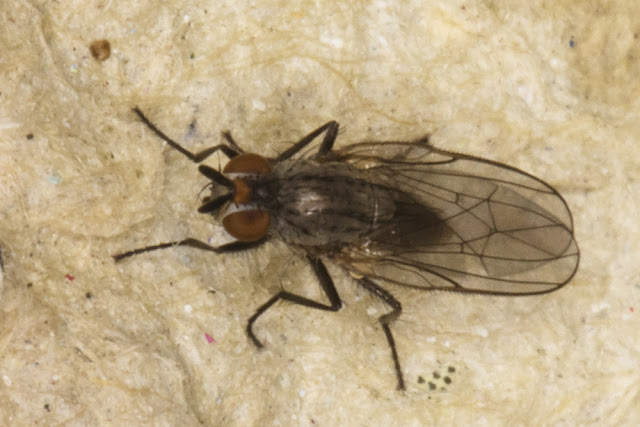
Fly, family Anthomyiidae, in the light trap at Sevenoaks Wildlife Reserve, 24 December 2015
For some reason, some of the photos taken with my marvellous new camera are still blurred.  I have not worked out why.  Am I moving the camera relative to the subject, perhaps?  These are all taken with a heavy camera held in one hand, holding an egg box in the other, which is not a particularly steady arrangement, so I might try a faster shutter speed.

This and the next fly were identified to family on iSpot, and the final one is one of the few I can identify myself.  These last three were all in the light trap on a December day when there were no moths, so they were all I had to photograph!

Lesser Dung Fly, family Sphaeroceridae, in the light trap at Sevenoaks Wildlife Reserve, 24 December 2015
 Another slightly blurry shot.  At least this last one (below) is sharp enough.  These Yellow Dung Flies are quite pretty.

Yellow Dung Fly, Scathophaga stercoraria, in the light trap at Sevenoaks Wildlife Reserve, 24 December 2015
This post is probably rather samey to most viewers, so I will try something different next time.


Monday, 4 January 2016

More Late Moths

Barred Sallow, Xanthia aurago.   Hayes, 4 October 2015.
Barred Sallow, Xanthia aurago.   Hayes, 4 October 2015.
This colourful moth came to my computer room window early in October.  I have not seen a live one in this area before, though I did find a dead specimen on the woodland floor on Hayes Common last November.  This one's wing was damaged before it arrived.

Dark Chestnut, Conistra ligula.   Hayes, 28 November 2015.
Dark Chestnut, Conistra ligula.   Hayes, 28 November 2015.
The Dark Chestnut is a likely winter catch.  Its dark glossy scales and, particularly, its squared-off wing-tips distinguish it from the ordinary Chestnut.

November Moth agg, Epirrita dilutata agg.  Sevenoaks Wildlife Reserve, 29 October 2015.
November Moth agg, Epirrita dilutata agg.  Sevenoaks Wildlife Reserve, 29 October 2015.
One of a small group of species impossible to distinguish just from a photo, known collectively as November Moths.  This was actually an October catch at Sevenoaks Wildlife Reserve.

Satellite, Eupsila transversa.   Hayes, 24 October 2015.
Satellite, Eupsila transversa.   Hayes, 24 October 2015.
The Satellite is named for the two small light dots on either side of the larger wing marking, like satellites orbiting a planet.  I'm surprised it was not called Mars, for that planet's two small moons Phobos and Diemos.

You can see that the moths that are likely to be around during leaf-fall have autumnal colours, whereas the true winter species are quite dowdy in comparison.