Showing posts with label moss. Show all posts

Friday, 27 January 2017

Things Grow on Trees.

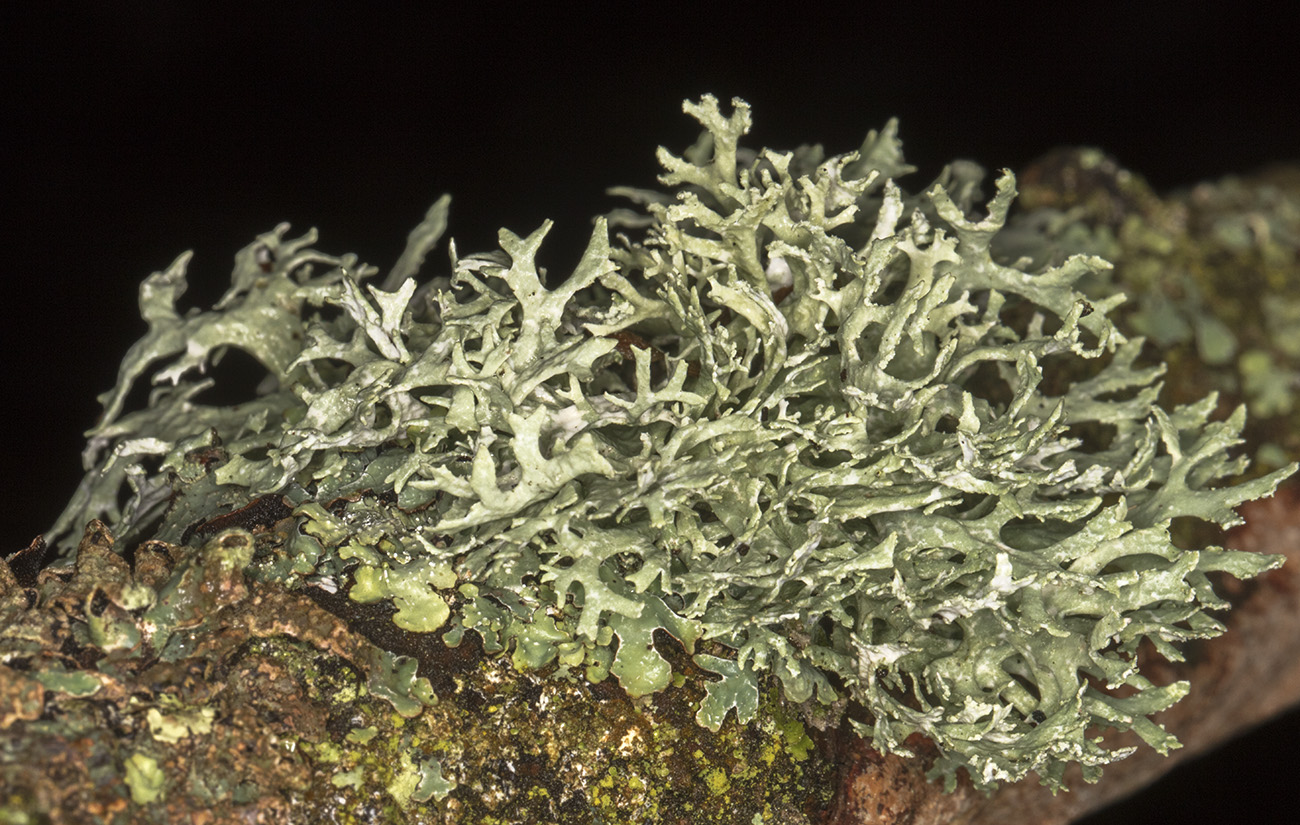
Oak with Flavoparmelia caperata.  Hayes Common, 30 December 2016.
Oak with Flavoparmelia caperata.  Hayes Common, 30 December 2016.
Things grow on trees, and I don't mean just fungi, which grow on trees because they are eating the trees.  I mean things that just use the trees as a place to rest, where they can get some light, and stand less chance of being grazed or trodden on.

In the UK, it's mostly lichens, mosses and liverworts.  Other countries with different biota and climates can have a much more extensive range of plants that behave like this.  The tree in the top photo has some moss and some large patches of a distinctive bluish-green lichen, Flavoparmelia caperata.  As you can see, you don't need to go far from a road to find something like this.

Usually, they are high up in the trees, but it is possible to find spots like this where they are arrayed near the ground where you can get a good look.

Oak branch with a range of mosses and lichens.  Hayes Common, 30 December 2016.
Oak branch with a range of mosses and lichens.  Hayes Common, 30 December 2016.
As here; some of it is high up, but there's also that long, long low branch covered with greenery.

Evernia prunastri, Oakmoss.  On an oak branch on Hayes Common, 2 January 2017.
Evernia prunastri, Oakmoss.  On an oak branch on Hayes Common, 2 January 2017.
In oak woods, there is a great deal of this shrubby Oakmoss, actually a lichen despite its common name.  You can see lots of clumps that have fallen to the ground, perhaps disturbed by squirrels.  It grows on the small branches and twigs.  There are also many other species that are easy to find.

On the trunks you find more of the leafy lichens like the one in the top photo.  Also, things like this:
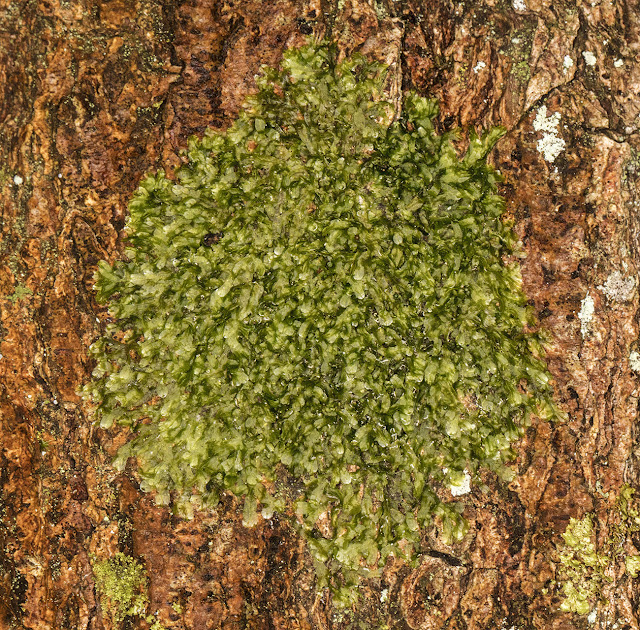
Metzgeria furcata, Forked Veilwort, on oak.  Hayes Common, 30 December 2016.
Metzgeria furcata, Forked Veilwort, on oak.  Hayes Common, 30 December 2016.
This is on an oak trunk.  You might think it looks mossy, but close up:

Metzgeria furcata, Forked Veilwort, on oak.  Hayes Common, 30 December 2016.
Metzgeria furcata, Forked Veilwort, on oak.  Hayes Common, 30 December 2016.
Those delicate flat forked straps are not moss leaves at all, but the thallus of a common liverwort, Metzgeria furcata. 

You don't need to go into the woods to see this sort of thing.  Here's a local street tree.

Tree on Bourne Vale, Hayes, 13 January 2017.
The marker shows where I spotted a tiny clump of moss.

Syntrichia laevipila, Small Hairy Screw-moss, on the bark of a tree trunk on Bourne Vale, Hayes, 13 January 2017.
I have rotated the photo to put the moss in a more familiar orientation, but you can see it's growing on rough bark.  There are also several lichens nearby.  There are not many records of Syntrichia laevipila in this area, so this was a good find.

From a distance, this tree might look quite bare without its leaves, but if you look at the higher branches from a bit closer:

Lichens on a tree on Bourne Vale, Hayes, 13 January 2017.
You can see that it is absolutely covered with, not only lichens, but there will also be mosses, liverworts and algae.  And that's on a busy suburban street. 

I haven't mentioned algae before, but only because they are so small that I can't produce decent photos of them.  They are there alright.

Wednesday, 13 April 2016

Mosses Again - And Liverworts


Rhytidiadelphus squarrosus, Springy Turf-moss.  Hayes Common, 9 March 2016.
Rhytidiadelphus squarrosus, Springy Turf-moss.  Hayes Common, 9 March 2016.
Another couple of mosses, because they are pretty.

With its reddish stems and green leaves set at an angle, Rhytidiadelphus squarrosus is quite distinctive.  It grows among grass, and in sometimes it forms the main ground cover.

Rhytidiadelphus squarrosus, Springy Turf-moss.  Hayes Common, 9 March 2016.
Rhytidiadelphus squarrosus, Springy Turf-moss.  Hayes Common, 9 March 2016.
This patch is at the edge of a grassy clearing.  The moss threads its way among the grass all over one side of the clearing, and at the edge it takes over completely.  It is wet here, because it has just been raining, but it can also grow in much drier grassland.

Bryum argenteum, Silver-moss.  Ridgeway, Hayes.  9 March 2016.
Bryum argenteum, Silver-moss.  Ridgeway, Hayes.  9 March 2016.
This moss, Bryum argenteum, seems to prefer the drier places.  It forms silvery patches on walls.  It is pretty and is also easily recognisable.

Closely related to mosses are liverworts.  Some are leafy, like mosses, but others form a green layer over wet ground.

Marchantia polymorpha subsp. ruderalis, Common Liverwort.   Ridgeway, Hayes, 9 March 2016.
Marchantia polymorpha subsp. ruderalis, Common Liverwort.   Ridgeway, Hayes, 9 March 2016.
As its common name suggests, Marchantia polymorpha is easy to find.  It grows on the untrampled edges of roads and pavements, and this patch is on the ground behind a street name sign.

The circular features are cups containing gemmae, little asexual reproductive buds which can be splashed out by raindrops.

Marchantia polymorpha subsp. ruderalis, Common Liverwort.   Gemmae in cups.  Ridgeway, Hayes, 9 March 2016.
Marchantia polymorpha subsp. ruderalis, Common Liverwort.   Gemmae in cups.  Ridgeway, Hayes, 9 March 2016.
This simple system allows the liverwort to spread very easily. 

Here's a related species:

Lunularia cruciata, Crescent-cup Liverwort.  Husseywell Park, Hayes, 8 April 2016.
Lunularia cruciata, Crescent-cup Liverwort.  Husseywell Park, Hayes, 8 April 2016.
This Crescent-cup Liverwort is on a water inlet pipe in a small park.  As you can see, this one has gemmae in crescent-shaped organs:

Lunularia cruciata, Crescent-cup Liverwort.  Gemmae in crescents.   Husseywell Park, Hayes, 8 April 2016.
Lunularia cruciata, Crescent-cup Liverwort.  Gemmae in crescents.   Husseywell Park, Hayes, 8 April 2016.
 These serve exactly the same function as the round cups on Marchantia polymorpha.

Monday, 21 March 2016

Wood Ground Mosses

Pseudoscleropodium purum, Neat Feather-Moss.  Keston Common, 3 March 2016
Pseudoscleropodium purum, Neat Feather-Moss.  Keston Common, 3 March 2016

Pseudoscleropodium purum, Neat Feather-Moss.  Keston Common, 3 March 2016
In the woods are some mosses that form branching mats on the ground.

This one, Pseudoscleropodium purum, likes a bit of light, and covers the ground beside paths or at the edge of a wood.

The vernacular name  suggests the neat tips to the stems and branches.

As with many plants, the key to correct identification of mosses is learning which features make them different from other similar species.  Those plump stems coming to a point are the key to this one.


Kindbergia praelonga, Common Feather-moss.  Keston Common, 3 March 2016
Kindbergia praelonga, Common Feather-moss.  Keston Common, 3 March 2016
Kindbergia praelonga, Common Feather-moss.  Keston Common, 3 March 2016

This one, Kindbergia praelonga, is superficially rather similar, covering - in this case - a low stump with feathery branches.

But it is rather smaller and finer than Pseudoscleropodium purum, looks more feathery, and does not have those plump tips.

A close inspection shows that the leaves on the main stem are much wider than those on the branches.  That's a useful distinguishing feature for this species, but you will probably need a hand lens (or magnified photo) to see it.


Mnium hornum, Swan's-neck Thyme-moss.  Keston Common, 3 March 2016
Mnium hornum, Swan's-neck Thyme-moss.  Keston Common, 3 March 2016
Mnium hornum covers large patches of ground in one section of Keston Common, a path through an old gravel pit.  In habit it is more like the wall mosses I showed recently than the branching mats of the other two shown here.  It is growing among beeches, as you can see from the piece of beech mast in the photo.

Last for today ..

Dicranum scoparium, Broom Fork-moss.  Keston Common, 5 March 2016
Dicranum scoparium, Broom Fork-moss.  Keston Common, 5 March 2016
I came across some patches of this pretty moss whole on my way to photograph something else, so I was pleasantly surprised.  It's a common woodland moss, but that does not mean you see it everywhere.  It has a very distinctive spiky habit ...

Dicranum scoparium, Broom Fork-moss.  Keston Common, 5 March 2016
Dicranum scoparium, Broom Fork-moss.  Keston Common, 5 March 2016
In fact, the leaf tips are almost triangular in cross-section and are slightly rough.

Wednesday, 16 March 2016

Some Wood Mosses

Atrichum undulatum, Common Smoothcap.  Hayes Common.  28 February 2016.
Atrichum undulatum, Common Smoothcap.  Hayes Common.  28 February 2016.
Now some mosses from my local woods.  The first photo is an iPhone snap of Atrichum undilatum, a moss that tends to grow on hummocks in the wood, such as might be caused by a falling tree lifting part of its root ball.  Those root ball hummocks stay visible for decades after a tree falls. 

This first one has broad, wavy leaves.

Polytrichastrum formosum, Bank Haircap.  Keston Common, 3 March 2016
Polytrichastrum formosum, Bank Haircap.  Keston Common, 3 March 2016
This second one, Polytrichastrum formosum, grows on the same kind of hummocks, but has harder, spikier leaves.  It's sometimes mistaken for ...

Polytrichum commune, Common Haircap.  Keston Common, 6 March 2016.
Polytrichum commune, Common Haircap.  Keston Common, 6 March 2016.
This one, Polytrichum commune, but this is much larger, grows in looser clumps and likes much wetter ground.  This clump is actually in part of a bog.

Also on Keston Common, but this time actually underwater, you can find ...

Fontinalis antipyretica, Greater Water-moss.  Growing freely in Keston Ponds.   Keston Common, 5 March 2016
Fontinalis antipyretica, Greater Water-moss.  Growing freely in Keston Ponds.   Keston Common, 5 March 2016
Fontinalis antipyretica.  It gets its scientific name from its supposed use in putting out fires, when scooped up by the handful.  I pulled this piece out of the pond to photograph it.  This photo is enlarged, but it's quite a robust moss.

Next, some woodland ground cover.

Thursday, 10 March 2016

Common Wall Mosses

Tortula muralis, Wall Screw-moss.  On a wall on Station Hill, Hayes, 2 March 2016.
Tortula muralis, Wall Screw-moss.  On a wall on Station Hill, Hayes, 2 March 2016.
There are some pretty mossed on the low walls near my house.  These are all common mosses, and it was interesting to see the differences in general appearance and the types of their spore capsules.

They all have names in the vernacular, but these cannot really be called "common" names because they were all invented very recently and no-one actually knows them without looking them up in a book.  It's generally safer to stick to the scientific names.  But I have included the vernacular names anyway, mostly because I hae looked them up!

These mosses mostly grow in the cracks between the bricks or stones.  This might be because they like the alkaline mortar, or because they find water is retained better there, or both.

Bryum capillare, Capillary Thead-moss. On a wall on Station Hill, Hayes, 2 March 2016.
Ypu can see that the capsules on this moss are very different to the first.  That helps a lot in identification!  They tend to grow close together or even mixed up, and here you can see two small clumps of a third type of moss, one that keeps its capsules on low stems that curve back into the greenery.  Here's a larger clump of that one:

Grimmia pulvinata, Grey-cushioned Grimmia.  On a low brick wall on Bourne Way, Hayes.  17 February 2016.
Grimmia pulvinata, Grey-cushioned Grimmia.  On a low brick wall on Bourne Way, Hayes.  17 February 2016.
I think the name inventors were running out of steam when they got to this one.  Anyway, you can see that it does actually make a greyish cushion, specially when it is a bit dry.  You can only just see the capsules nestling in with the leaves.

Brachythecium rutabulum, Rough-stalked Feather-moss.  On a low brick wall on Bourne Way, Hayes.  16 February 2016.
Brachythecium rutabulum, Rough-stalked Feather-moss.  On a low brick wall on Bourne Way, Hayes.  16 February 2016.
This one has quite a different style, with distinct branching stems.  The capsules are already dry.  I would expect a moss like this to need a wetter environment, as it can't ball up into a protective clump when it dries out, and doesn't have an outer layer of bristles, which help maintain a moist microclimate as well as attracting dew.  There are more mosses with this style of growth in the nearby woods, and I'll show a couple next time.

Saturday, 28 February 2015

Sphagnum at Keston

Sphagnum capillifolium subsp. capillifolium.  Keston Common, 10 December 2014.
Sphagnum capillifolium subsp. capillifolium.  Keston Common, 10 December 2014.
 Sphagnum mosses like it really wet, and live mostly in boggy places and at the edges of some streams.  I am certainly no moss expert, but I have a small field guide so last December I had a look at Keston Bog.  I managed to find and identify three of the species that live there; I know there are more.

Sphagnum capillifolium subsp. capillifolium.  Keston Common, 10 December 2014.
Sphagnum capillifolium subsp. capillifolium.  Keston Common, 10 December 2014.
You can see how the stem is covered by some clasping branches that grow quite differently from the spreading ones.  The stem also has its own types of "leaves".  If you look carefully you can also see a spore capsule.

Sphagnum fallax.  Keston Common, 10 December 2014.
Sphagnum fallax.  Keston Common, 10 December 2014.
This light green species seems to be the most common. 

Sphagnum fallax.  Keston Common, 10 December 2014.
Sphagnum fallax.  Keston Common, 10 December 2014.
The leaves of this one are even more thin and pointed than the reddish one above.  But the next one:

Sphagnum palustre.  Keston Common, 10 December 2014.
Sphagnum palustre.  Keston Common, 10 December 2014.
Has much broader leaves.  You can see that you have to look closely to distinguish these.

Sphagnum palustre.  Keston Common, 10 December 2014.
Sphagnum palustre.  Keston Common, 10 December 2014.
But once you do, differences become apparent.  This one also has some spore pods.

The stems of these mosses are quite relaxed and floppy.  In situ they are supported by the mass of the stems all around them.  For these photos, I dangled them downwards and they flipped the photos the other way up!

Friday, 28 February 2014

The Mist And The Tower

Mossy hummock of Polytrichastrum formosum, Bank Haircap. Toys Hill, 21 January 2014.
Another walk round Toy's Hill, following the one pictured here: Toy's Hill in Autumn. This time it was wetter and mistier. I walked a different route, passing mossy hummocks like this one.  There are many hummocks like this in some woods.  I suspect that they are eroded root balls pushed up when trees fall over.

Myxomycete on wet deadwood.  Toy's Hill, 21 January 2014.
Myxomycete on wet deadwood.  Toy's Hill, 21 January 2014.
At the bottom of the hill there was even more moss.  This shows a Myxomycete, an odd thing that moves around like a slow slime in one stage of its lifecycle, then stops and makes spores.  In the background, the fallen trees familiar from my previous walk.

Eroded pathway.  Toys Hill, 21 January 2014.
Eroded pathway.  Toys Hill, 21 January 2014.
The rain has clearly had an effect.  Some of the paths are like this, with eroded channels down the middle.  It's almost like walking up a stream bed.

The pond at Toys Hill, 21 January 2014.
At the bottom is a pond that was used to provide water for the nearby Emmets estate.  This photo makes it look much bigger than it is. In fact the far bank is just to the left of this view and cuts in a straight line towards this viewpoint.

The Bat Tower at Toys Hill comes into view. 21 January 2014.
The route comes back up the hill, crosses a road, and loops around back to the car park.  Along the way is this Bat Tower, once a water tower but now converted specifically to be a bat roost.  So the name is not just fanciful.

This hill is the highest point in Kent, and you can see that there is no mist up here.

Sunday, 24 February 2013

Two Common Mosses

Bryum capillare on a wall in Bourne Way, Hayes.  9 February 2013
Bryum capillare on a wall in Bourne Way, Hayes.  9 February 2013.

Early spring is a good season to observe mosses and lichens.  Here are two which are common and widespread, growing on garden walls in my neighbourood.

It's useful for anyone interested in mosses to catch them when they are fruiting, as many are in this season.  It's not easy to catch a good photo because of the limited depth of field in macro closeups, so that often only a few of the leaves and capsules are sharp and well-defined.  But that is where brick walls can be useful; some of the mosses grow on the mortar between the bricks, and are lined up in neat rows.  

Grimmia pulvinata on a wall in Lennard Avenue, Hayes. 9 February 2013
Grimmia pulvinata on a wall in Lennard Avenue, Hayes. 9 February 2013.
Of course, others don't do that, but instead grow in cushions on top of the bricks. 

Tuesday, 5 February 2013

Otford and the Darent Valley

View across the Darent valley to Meenfield Wood and the war memorial, on the hillside opposite Shoreham, the next small town along the valley from Otford. 2 February 2013.
View across the Darent valley to Meenfield Wood and the war memorial, on the hillside opposite Shoreham,
the next small town along the valley from Otford. 2 February 2013.
It's winter and most of the OFC outings have been for birds, which are not my interest.  This was more of a walk along the valley, keeping an eye out for any interesting natural history.  It was a cold and windy day, in the middle of a rainy season, but on this day we had intermittent sunshine, which made a nice change.

It was interesting to see that war memorial - the cross on the hillside - because then I realised I was within sight of a walk in May last year, which I do not seem to have put on the blog.  We walked along the treeline on that hillside and I saw the cross from above.

The water you can see is flooded fields; the small river is behind the trees.

We saw a few wildflowers, including snowdrops and primroses, but they were on a bank outside some houses; perhaps they were seeding themselves, but they must have been planted originally.  And some flowers were survivors from last year.  The only true wild spring flower we saw was a Lesser Celandine.

Lesser Celandine, Ranunculus ficaria.  Otford, 2 February 2013.
Lesser Celandine, Ranunculus ficaria.  Otford, 2 February 2013.
A pretty little flower, related to Buttercups.  But winter and early spring are good times to look for mosses and lichens, and we saw some of those too.

Syntrichia intermedia.  Darent valley, 2 February 2013.
Syntrichia intermedia.  Darent valley, 2 February 2013.
This lovely thing grows in round cushiony clumps on walls.

Ramalina fastigiata.  Darent valley, 2 February 2013.
Ramalina fastigiata.  Darent valley, 2 February 2013.
This, as you can see, grows on twigs. 

I was using a new camera that has GPS built in, and there is software which produces a track of where you have been with it:

Walking route in the Darent valley, 2 February 2013.
We walked this route anticlockwise starting at the bottom right.  The pins mark where the photos were taken; in order, view - lichen - moss - flower.  Of course, I took more than that; enough for me to show a few next time.  Please ignore the trail off to the bottom left; I forgot to turn off the GPS and it tracked the car all the way home from inside the boot!

Thursday, 26 April 2012

Nashenden Down Mosses

Bryum capillare.  Nashenden Down Nature Reserve, 14 April 2012.
Bryum capillare.  Nashenden Down Nature Reserve, 14 April 2012.
At first there were no mosses so be seen on Nashenden Down, but when we walked through a section of woodland, that changed.  This one is distinguishable by the way its leaves twist spirally around the stem and dry out into little curls.

I am no moss expert and I am following the lead of our moss expert and the British Bryological Society's field guide, which says of this next one that it lacks striking distinguishing characteristics.  Which is not helpful.  But there is a detailed description and a photo.

Brachythecium rutabulum.  Nashenden Down Nature Reserve, 14 April 2012.
Brachythecium rutabulum.  Nashenden Down Nature Reserve, 14 April 2012.
Next is another moss from the woods, with regularly branched shoots, though that is not so easy to spot in a jumble like this.  The stem leaves clasp the stem, but those on the branches do not.

Kindbergia praelonga (ex. Eurhynchium praelongum).  Nashenden Down Nature Reserve, 14 April 2012.
Kindbergia praelonga (ex. Eurhynchium praelongum).  Nashenden Down Nature Reserve, 14 April 2012.
Moving out into the open, we found patches of this one, which is a typical find on calcareous soils.  It's a pretty sight, making a bright gold-tinged cushion in the sunshine.

Homalothecium lutescens.  Nashenden Down Nature Reserve, 14 April 2012.
Homalothecium lutescens.  Nashenden Down Nature Reserve, 14 April 2012.
And later on, on a lower path through fields, we found this last one.  It's the only moss we saw that has a common name that hasn't been made up in recent years.

Bonfire-moss, Funaria hygrometrica.  Nashenden Down Nature Reserve, 14 April 2012.
Bonfire-moss, Funaria hygrometrica.  Nashenden Down Nature Reserve, 14 April 2012.
The leaves are hardly visible, but the setae and capsules are very distinctive.  It grows where there has been a fire, though we saw no sign so the fire does not have to be recent.  Those twisted setae curl and uncurl according to how damp they are, which gives it a scientific name which means water-measurer.