Showing posts with label Joyden's Wood. Show all posts

Wednesday, 20 May 2015

Two Tiny Gems

Slender Parsley-piert, Aphanes australis.  Joyden's Wood, 27 April 2015
Slender Parsley-piert, Aphanes australis.  Joyden's Wood, 27 April 2015
Joyden's Wood is a very pleasant and varied environment.  You can walk through the woods, past an area of heath, or examine the very short grass in what is known as the Picnic Area.  There, you can find several tiny plants, two of which I have not seen anywhere else.  This is not because they are rare, but because you have to look hard to spot them!  The mosses in this photo will give you an idea of the scale. 

This green plant, Slender Parsley-piert, has flowers which are also green, helping its disguise.  In the top photo, it is in full bloom.  But it is widespread here, which helps it to be seen.

Slender Parsley-piert, Aphanes australis.  Joyden's Wood, 27 April 2015
Slender Parsley-piert, Aphanes australis.  Joyden's Wood, 27 April 2015
Here's an enlarged picture with flowers at the centre.  The lobes surrounding the flowers are oblong, distinguishing this from Alphanes arvensis, Parsley-piert without the slender, which has triangular lobes. 

This plant is widespread in the Picnic Area, but there is another which seems to be a lot less prolific.

Bird's-foot, Ornithopus perpusillus.  Joyden's Wood, 12 May 2015.
Bird's-foot, Ornithopus perpusillus.  Joyden's Wood, 12 May 2015.
You might think this Bird's-foot, having a coloured flower, would be easier to spot, but the whole rosette is only 3 cm across and the flowers are about 2mm each, so in fact you have to get down on your knees to be sure they are there at all.

Bird's-foot, Ornithopus perpusillus.  Joyden's Wood, 12 May 2015.
Bird's-foot, Ornithopus perpusillus.  Joyden's Wood, 12 May 2015.
The plant is named after the appearance of the seed pods, which will be along later.  It is a lot less common than the Slender Parsley-piert, but still has 44 known sites in Kent, for those prepared to get down and look. 

Thursday, 17 May 2012

Joyden's Wood - Green

Bluebells, Hyacinthoides non-scriptum, and Lily-of-the-valley, Convallaria majus.  Joyden's Wood, 12 May 2012.
Bluebells, Hyacinthoides non-scriptum, and Lily-of-the-valley, Convallaria majus.  Joyden's Wood, 12 May 2012.
Here are some photos from the trip to Joyden's Wood with a green and leafy emphasis.

Parts of the wood were full of Lily-of-the-valley, just coming into flower.  Bluebells are at their height or just past, and in places we could see both growing and flowering together.

Heath Wood-rush, Luzula multiflora.  Joyden's Wood, 12 May 2012.
Heath Wood-rush, Luzula multiflora.  Joyden's Wood, 12 May 2012.
We saw several species of Wood-rush, a group I am not at all good at.  I thought this was a Field Wood-rush, but it turns out to be a Heath Wood-rush.  The flowers below belong to the related Southern Wood-rush.

Southern Wood-rush, Luzula forsteri.   Joyden's Wood, 12 May 2012.
Southern Wood-rush, Luzula forsteri.   Joyden's Wood, 12 May 2012.
These fresh and tender leaves belong to the scarce Wild Service Tree.

New leaves of a Wild Service Tree, Sorbus torminalis.  Joyden's Wood, 12 May 2012.
New leaves of a Wild Service Tree, Sorbus torminalis.  Joyden's Wood, 12 May 2012.
Just by one of the paths, this sapling has been cordoned off to let it grow in peace.  The parent tree is not far away.  This species has an interesting history.  Its berries must be bletted before being eaten; that is, allowed to go soft with decay.  They were once used to flavour beer, and have also been used as a cure for colic.

Shining Crane's-bill, Geranium lucidum.  Joyden's Wood, 12 May 2012.
Shining Crane's-bill, Geranium lucidum.  Joyden's Wood, 12 May 2012.
Several of these plants were growing among robust stinging nettles at the side of the path.  Paths through woods are excellent places to find interesting plants; they can harbour woodland and grassland species, and the inhabitants get more light and water than they would under the trees.

Most Geranium species are pretty hairy, but these glistening leaves only have a few scattered hairs.  The name Crane's-bill refers to the shape of the fruit, which will mostly be along later; you can see one just starting to develop about 2/3 down and just left of centre.

Sanicle, Sanicula europaea.  Joyden's Wood, 12 May 2012.
Sanicle, Sanicula europaea.  Joyden's Wood, 12 May 2012.
The dark and glossy leaves of the low-growing Sanicle have a shiny undersurface, which does not appear in this photo. 

Last for today is the first photo I took on this trip.  This is the underside of a Dock leaf, showing marks and holes that suggest it has been attacked by something.

Underside of a leaf of Broad-leaved Dock, Rumex obtusifolius, with marks of insect attack. Joyden's Wood, 12 May 2012.
A leaf of Broad-leaved Dock, Rumex obtusifolius, with marks of insect attack. Joyden's Wood, 12 May 2012.
Coincidentally, later on I found several specimens of a squash bug that attacks Docks.  That is a possible explanation for these markings, though they were some way away from this plant.

Tuesday, 15 May 2012

Joyden's Wood, May 2012.


View of The Ship at Puddledock over the golf course from Joyden's Wood, 12 May 2012.
View towards The Ship at Puddledock from Joyden's Wood, 12 May 2012.
This was a trip to Joyden's Wood, a Woodland Trust wood near Sevenoaks, with the Orpington Field Club.   This view looks open and countrified, but other edges of the wood abut suburban housing.  As well as woodland, there is a patch of heath, and the wood contains a couple of ponds.

There was a good range of flowering plants, most of them yellow, as well as a wide range of greenery and lots of invertebrates, and as with other recent trips I will split this into three posts.  But don't imagine that I ignored the leaves just because I wanted to capture the flowers.

Greater Celandine, Chelidonium majus.  Joyden's Wood, 12 May 2012.
Greater Celandine, Chelidonium majus.  Joyden's Wood, 12 May 2012.
The Greater Celandine is quite different from the Lesser Celandine that is one of our first Spring flowers.  This one is more closely related to poppies.  If you have difficulty identifying it, break off a piece of leaf, and you will see beads of bright orange-yellow sap.

In an open area, this plant was creeping and spreading.

Tormentil, Potentilla erecta.  Joyden's Wood, 12 May 2012.
Tormentil, Potentilla erecta.  Joyden's Wood, 12 May 2012.
This Potentilla is a relative of the so-called Barren Strawberry, which also has petals that tend to have gaps between them.  Later on, we came upon another low-growing yellow flower:

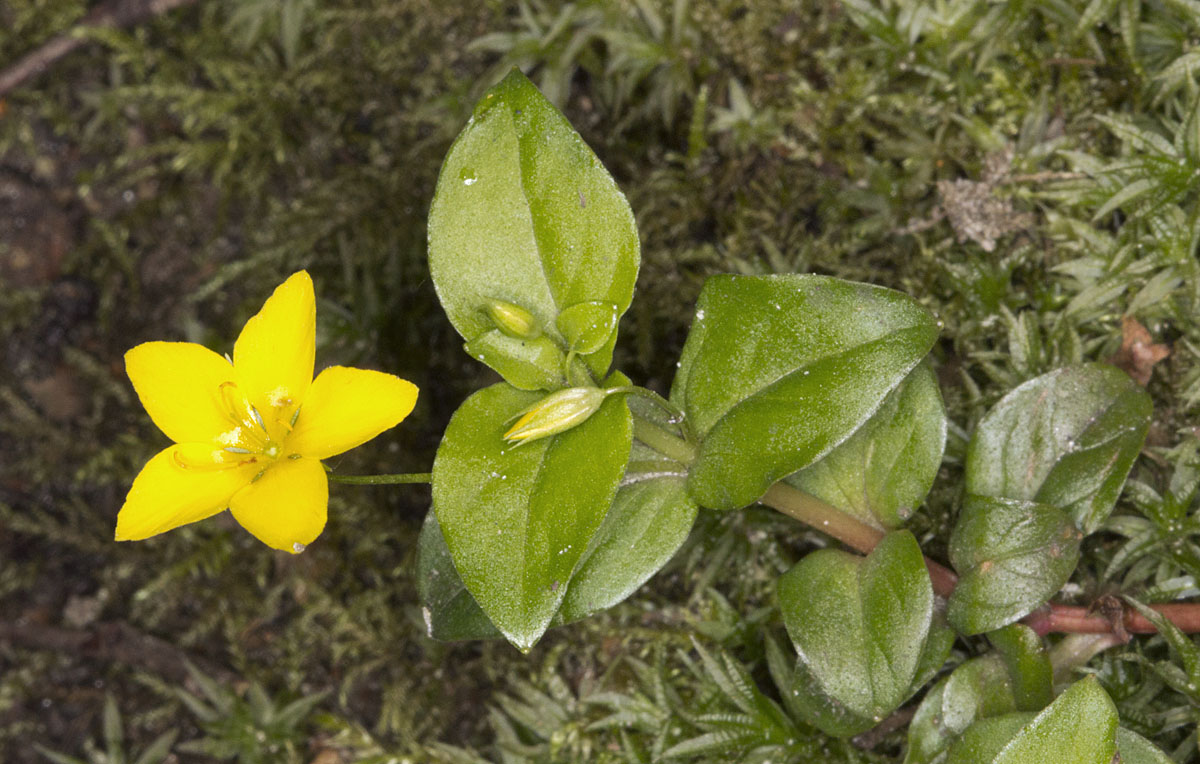
Yellow Pimpernel, Lysimachia nemorum.  Joyden's Wood, 12 May 2012.
Yellow Pimpernel, Lysimachia nemorum.  Joyden's Wood, 12 May 2012.
This is botanically a Loosestrife, though it is in the same family as the more famous Scarlet Pimpernel. 

Next, the tiniest flowering plant I have seen.  It's a Thyme-leaved Speedwell, which grew in little clumps by the side of the path.  I was liiking at something else entirely when this minute specimen caught my eye.

Thyme-leaved Speedwell, Veronica serpyllifolia.  Joyden's Wood, 12 May 2012.
Thyme-leaved Speedwell, Veronica serpyllifolia.  Joyden's Wood, 12 May 2012.
Just a single stem with half a dozen leaves and one flower.  Compare the sizes of the blades of grass next to it.  Not far away was a close relative, the much more robust and brightly coloured Germander Speedwell.

Germander Speedwell, Veronica chamaedrys.  Joyden's Wood, 12 May 2012.
Germander Speedwell, Veronica chamaedrys.  Joyden's Wood, 12 May 2012.
This catches the eye much more easily, with its upright racemes of deep blue flowers.

I also got a reasonable shot of the flower of a Wood Speedwell, a plant I showed quite recently; I'll include it here so that you can compare the colours and see the general similarity of form.

Wood Speedwell, Veronica montana.  Joyden's Wood, 12 May 2012.
Wood Speedwell, Veronica montana.  Joyden's Wood, 12 May 2012.
Last one for today.  This is a Hawthorn, and I think it is a hybrid of the Common Hawthorn, which has divided leaves and a single pip in its berry, and the Midland Hawthorn, which has rounded leaves and two or sometimes three pips.

Flowers of Crataegus x media, a hybrid between C. monogyna and C. laevigata.  Joyden's Wood, 12 May 2012.
Flowers of Crataegus x media, a hybrid between C. monogyna and C. laevigata.  Joyden's Wood, 12 May 2012.
In the flowers, each style and ovary will produce a pip.  So you can tell which species you are looking at by examining the leaves and counting the styles in the flowers.  This one has the rounded leaves of  Midland Hawthorn, and flowers with either one or two styles.  This mixed message is typical of a hybrid between the two.