Showing posts with label Trosley Country Park. Show all posts

Tuesday, 31 March 2015

Trosley in Spring


Trosley Country Park, steps down.  27 March 2015.
Trosley Country Park, steps down.  27 March 2015.
I posted some photos from Trosley Country Park in January last year. Two months further into the year this time, there are many signs of life.

These steps might look daunting, but they are far from the steepest part of this route.  They cover about half of the downhill path through the wooded slope.  It's actually easier to walk alongside them, when going downwards at least.  They have the texture of wood but are actually some sort of cast stone.

Higher up, before I got this far, the path was bordered by primroses.  (But these are less dramatic for an opening picture.)

Primroses in Trosley Country Park.  27 March 2015.
Primroses in Trosley Country Park.  27 March 2015.
The path turns left at the bottom and is fenced off from the outside world. But just over the fence is another path, part of the Pilgrim's Way, which is supposed to have led from Winchester to Canterbury.  On the park side, there are clumps of Dog's Mercury under the trees.

Dog's Mercury in Trosley Country Park.  27 March 2015.
Dog's Mercury in Trosley Country Park.  27 March 2015.
All the plants in one clump are genetically the same, and have a single gender.  I saw many male clumps, with pollen like this plant, but none that were female; but some clumps were not yet flowering.  Later in the year, it should be possible to spot the females easily because they will be bearing seeds.

One green patch looked different.  It was a charming, rather tender little plant which is called Moschatel because it is supposed to smell musky at dusk.

Moschatel in Trosley Country Park.  27 March 2015.
Moschatel in Trosley Country Park.  27 March 2015.
The flowers normally all have the arrangement you can see here in bud, four at the sides and one on top.  An alternative name for it is Town Hall Clock.  This plant flowers early and disappears before the middle of summer.

Further on I crossed the grassy chalk slopes, the grass kept short by rabbits.  The grass was full of Hairy Violets, a species typical of chalk country.

Hairy Violets in Trosley Country Park.  27 March 2015.
Hairy Violets in Trosley Country Park.  27 March 2015.
It is the leaves that are hairy.  And further still, I climbed back up by the side of a disused chalk quarry.  This route was steep enough for me to need to hold onto the fence round the quarry to help pull myself up.

Here's a shot taken from halfway up.

Horse riders on the Pilgrim's Way, taken  from Trosley Country Park.  27 March 2015.
Horse riders on the Pilgrim's Way, taken  from Trosley Country Park.  27 March 2015.
I had been hearing voices from half a mile away, getting closer.  Of course, you would have to speak quite loudly to be heard when riding in single file like this.  Seeing the horses explained all!  This is where the Pilgrim's Way turns away from the park.

Finally, walking back along the top I saw masses of Wood Anemones under the trees, always a lovely Spring sight.

Wood Anemones in Trosley Country Park.  27 March 2015.
Wood Anemones in Trosley Country Park.  27 March 2015.
(The top photo was taken with my iPhone; all  the others with my EOS 6D and 100mm macro lens.  I turned the ring flash off for the view of the riders.)

Thursday, 16 January 2014

A Walk Round Trosley

Frosted Wayfaring-tree leaves, Viburnum lantanum.  Trosley Country Park, 29 December 2013.
Frosted Wayfaring-tree leaves, Viburnum lantanum.  Trosley Country Park, 29 December 2013.
I have been in the upper part of Trosley Country Park before, looking for late fungi, but I had not done the route they call the Downland Trail before a visit on 29th December.  Strange weather; calm and sunshine one day, and blustery rain the next.  This was a very pleasant sunny day.

In the woods, Trosley Country Park, 29 December 2013.
The upper woods mostly look something like this at the moment.  Bare trees, many showing signs of long-ago coppicing, with quite a few fallen trunks.  But the land drops off sharply to one side, as with many of the local woodland walks.  I went down many big wooden steps, then some more steps, thinking at the time that I would certainly have to be going up again later on.

Power pole on the Downland Trail, Trosley Country Park, 29 December 2013.
Along the bottom of the hill I encountered a power line.  I like that sign, so direct and graphic.  You would have to be quite determined to be killed by this pole.

Downland Trail, one way back up.  Trosley Country Park, 29 December 2013.
Downland Trail, one way back up.  Trosley Country Park, 29 December 2013.
Further along, I came to the chalk downland that this route was named after.  This is one of the tracks back up the hill, which I looked at but didn't take.  The grass is very short at this time of year, but should be full of flowers in late spring. 

This path is heavily eroded, as were others I saw, so must see a lot of footfall in season.   It was slippery, too.  It was around here that I saw the leaves at the top of this post.  You can see it had been frosty the night before, but the frost was disappearing as soon as the winter sun hit it, and it didn't seem very cold.  Of course, I was wearing scarf and gloves, which helps.

View over the Weald towards the Medway.  Downland Country Walk, Trosley Country Park, 29 December 2013.
View over the Weald towards the Medway.  Trosley Country Park, 29 December 2013.
At the far end of this route, the path climbs a steep slope to a good viewpoint.  This photo looks east towards the River Medway.  In more or less this direction are some other excellent places to visit; Leybourne Lakes, Ranscombe Farm Nature Reserve, and further to the north, Riverside Country Park.

The last slope. Downland Trail, Trosley Country Park, 29 December 2013.
This shot looks back the way I came from the same position as the last one.  My path came along the bottom of this slope and then straight up it.  That was tricky with the ground being so slippery.  Then there are some more steps up through the wood, and an easy track back towards the visitor centre.

This walk must have been only two or three miles, but it felt longer because of the steep and slippery parts!  The leaflet says to allow two hours, but it took me one.  I would have taken longer, and brought a bigger camera, in a more flowery season.

These photos were all taken with my iPhone.  It really boosts the saturation, and I had to undo that a little in Photoshop to reduce the intense blueness of the sky to something more natural.

Thursday, 12 December 2013

Fungi at Trosley


Clytocybe geotropa, Trooping Funnel.  Trosley Country Park, 19 November 2013.
A coupe of fungi seen on a walk in Trosley Country Park in November.  "Trooping" means occurring in numbers, but scattered, perhaps a few individuals here and there, perhaps in a curved row.  But I only saw this single Trooping Funnel!  It was fairly large, about 5 inches across.

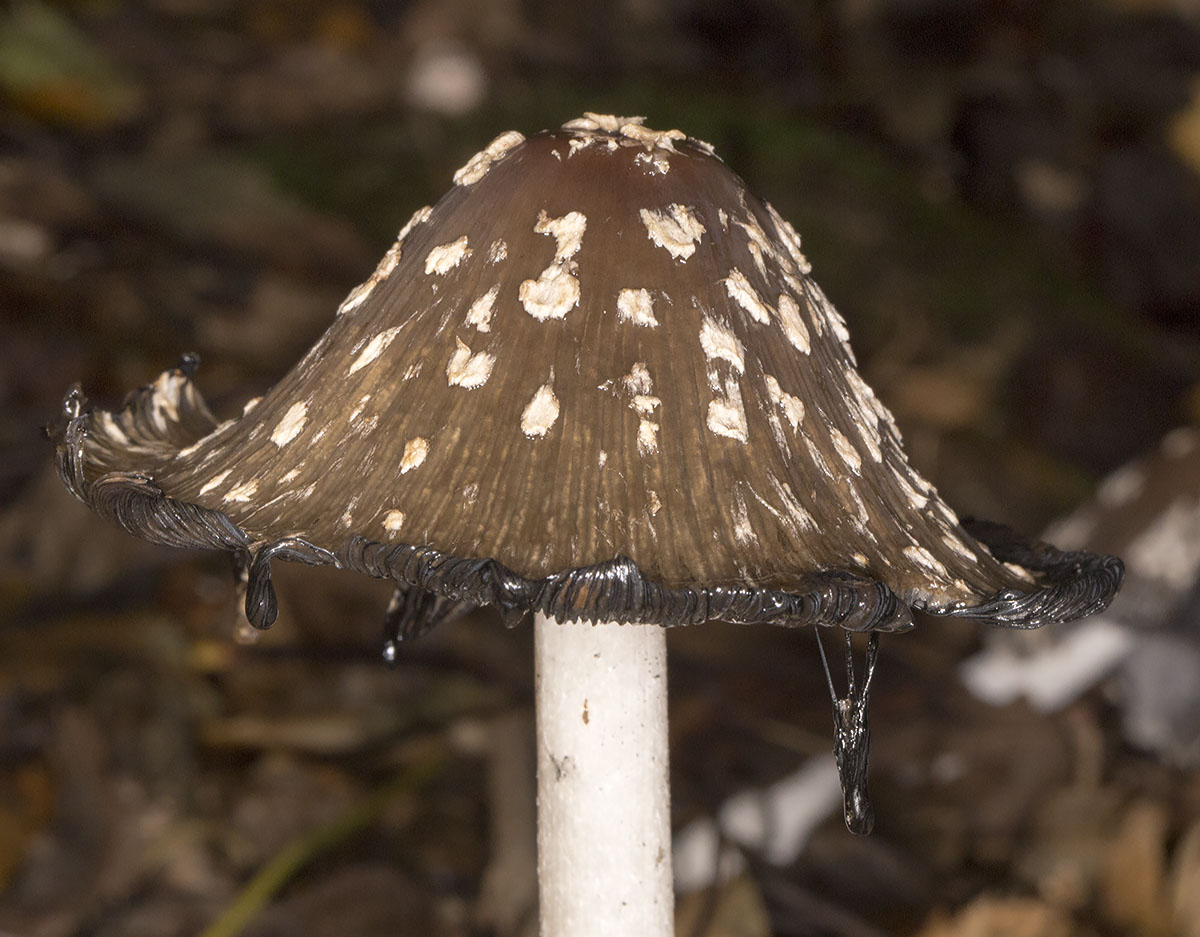
Coprinopsis picacea (Coprinus picaceus), Magpie Inkcap.  Trosley Country Park, 19 November 2013.
Coprinopsis picacea (Coprinus picaceus), Magpie Inkcap.  Trosley Country Park, 19 November 2013.
This is the top of another conspicuous species.  The Magpie Inkcap, like its relatives, deliquesces into a black liquid as it ages.  The colour comes from the spores the liquid contains.  Here you can see the "ink" dripping off the edges, which are just staring to disintegrate.  This fungus was about 8 inches tall and 3 inches across.

Common Puffball, Lycoperdon perlatum.  Trosley Country Park, 19 November 2013.
Common Puffball, Lycoperdon perlatum.  Trosley Country Park, 19 November 2013.
This one was lying on top the the leaf letter.  It must have been kicked there by someone, or maybe an animal, as it was off the track.  It's a young specimen of a common fungus, but always pretty, looking like the head of a medieval weapon.