Showing posts with label flowers. Show all posts

Thursday, 9 August 2018

Catkins

Hazel catkins on Hayes Common, 5 February 2017.
I was searching my photo folders with the key work "cat" and I came across a lot of interesting pictures, including cathedrals and catkins.  So here are some of the catkins.

This photo is what people probably think of first.  Hazel catkins in early spring.  This is the male reproductive organ, and you can tap off showers of pollen.  It is spread by the wind to the tiny red female flowers:

Hazel, female flower.  The Knoll, Hayes, 19 February 2017.
Hazel, female flower.  The Knoll, Hayes, 19 February 2017.
No petals, because they do not need to attract insects.  Just sticky stigmas, with some tiny yellow pollen grains already stuck on.

These catkins are one of the first signs of spring, showing new growth on the trees.  But quite a few different sorts of trees use catkins to reproduce.

Pussy Willow catkins in Jubilee Country Park, 15 March 2011.
Pussy Willow is what we called this where I grew up, because the catkins were soft and furry.  These ones have been rained on!  It seems to be more often called Goat Willow here in the south, which matches its scientific name, Salix caprea.  The female flowers are on separate trees and are also bunched up into a sort of catkin:

Female goat willow catkins, Hayes common; 2 April 2011.
These are either Pussy Willow or a close relative.   Other catkin trees include:

Catkin of a Silver Birch.  Hayes Common SSSI, 16 May 2012.
Catkin of a Silver Birch.  Hayes Common SSSI, 16 May 2012.
Birches - this one is Silver Birch.

Oak catkins in Spring Park, 22 April 2011.
Oaks.  These rather straggly catkins can sometimes have their own parasitic galls, caused by the sexual generation of same gall wasp that produces leaf galls later in the year.

Currant Galls, sexual generation of the gall wasp Neuroterus quercusbaccarum.  Heathfield Road, Keston.  4 May 2015.
Currant Galls, sexual generation of the gall wasp Neuroterus quercusbaccarum.  Heathfield Road, Keston.  4 May 2015.
And the last catkin tree that I have photos of, Alders.

Alder catkins, Alnus glutinosa, on the roadside on Hayes Lane, Hayes.  4 March 2013.
Alder catkins, Alnus glutinosa, on the roadside on Hayes Lane, Hayes.  4 March 2013.
You can see the alder cones, but otherwise this looks a lot like a tall Hazel.  But these catkins can sometimes be quite showy.

Alder catkins, Alnus glutinosa. Cudham recreation ground, 25 February 2012.

Monday, 30 April 2018

Eridge Rocks

Eridge Rocks,  26 April 2018
Eridge Rocks,  26 April 2018
This part of the High Weald has quite a few sandstone cliffs and outcrops, something we did not have in the Hayes area where I used to live.  That area was mostly on chalk or gravel.  Eridge Rocks consists of about 600 metres of what you see here, a small but impressive cliff.  You can walk out along the bottom, where these photos were taken from, and back along the top. 

Eridge Rocks,  26 April 2018
Eridge Rocks,  26 April 2018
Today, the Sussex Wildlife Trust led a walk along the rocks and through the woodland they sit in.  It's a designated Site of Special Scientific Interest for the mosses, liverworts, ferns and lichens that grow on the rocks.  Climbers come here too, and you can see their chalk on some of the drier rocks.

I expect it counts as a cheat if you go up that dead tree.

Eridge Rocks,  showing the erosion patterns.  26 April 2018
Eridge Rocks,  showing the erosion patterns.  26 April 2018
Erosion has produced cracks in two directions, and a lot of unusual honeycomb patterns on the surface. 

The Victorians loved this place and apparently were known to have dined out here in luxury at least once.  The people who care for the rocks have had to remove a lot of Rhododendron (the Victorians loved Rhododendrons) and now they try to keep the damper rock faces in dappled shade.  This lets the mosses, etc get some light without being shaded out or burnt dry. 

The surrounding woods are full of bluebells.

Woods by Eridge Rocks, 26 April 2018.
Not quite fully out yet, but nearly.  I saw a number of other ancient woodland indicator plants too, such as Redcurrant and

Yellow Pimpernel, Lysimachia nemorum.  Woods near  Eridge Rocks, 26 April 2018.
Yellow Pimpernel, Lysimachia nemorum.  Woods near  Eridge Rocks, 26 April 2018.
Yellow Pimpernel, which likes to grow beside paths.

We saw quite a few beeflies, some hoverflies, bumble bees and a couple of butterflies. 

Beefly, Bombylius major.  Woods near  Eridge Rocks, 26 April 2018.
Beefly, Bombylius major.  Woods near  Eridge Rocks, 26 April 2018.
Interesting woods - I'll be back.

Woods by Eridge Rocks, 26 April 2018.

Monday, 17 July 2017

Colourful Verges

Bird's-foot Trefoil, Lotus corniculatus.  Chapell Green, Crowborough, 3 June 2017.
Bird's-foot Trefoil, Lotus corniculatus.  Chapell Green, Crowborough, 3 June 2017.
Walking around Crowborough in June and July I have seen many colourful flowers in the roadside verges and garden borders.  Most are common in the wild, like this Bird's-foot Trefoil.  Many are actually garden escapes.   They all brighten the roadside.  Here are some of the wildlings.

Fox and Cubs, Pilosella aurantica.  Gordon Road, Crowborough, 3 June 2017.
Fox and Cubs, Pilosella aurantica.  Gordon Road, Crowborough, 3 June 2017.
This vivid Fox-and-Cubs is plentiful.  I enjoy it partly because I only saw a few specimens back in Hayes.   Now, this even comes up in my lawn. 

Green Alkanet, Pentaglottis sempervirens. Whitehill Road, Crowborough, 10 June 2017.
The blue-flowered and very vigorous Green Alkanet is quite scarce here, whereas it was everywhere in Hayes.

Great Willowherb, Epilobium hirsutum.  Goldsmith's Recreation Ground car park, Crowborough, 8 July 2017.
Great Willowherb, Epilobium hirsutum.  Goldsmith's Recreation Ground car park, 8 July 2017.
Great Willowherb needs a bit more space, and is happy here in the rough ground beside a car park. 

Common Mallow, Malva sylvestris.  Outside Crowborough library, 8 July 2017.
Common Mallow, Malva sylvestris.  Outside Crowborough library, 8 July 2017.
Common Mallow has lesser requirements, and has sprouted here in an untended patch of concrete paving outside the library.

Tufted Vetch, Vicia cracca.  Luxford Lane, Crowborough, 7 July 2017.
Tufted Vetch, Vicia cracca.  Luxford Lane, Crowborough, 7 July 2017.
Tufted Vetch likes a less busy spot.  Here it is scrambling through the long grass and brambles under a half-wild roadside hedgerow.

Yarrow, Achillea millefolium.   Luxford Lane, Crowborough,13 June 2017.
Yarrow, Achillea millefolium.   Luxford Lane, Crowborough,13 June 2017.
Yarrow is scattered in the short grass everywhere.  You can see some of its leaves among the Bird's-foot Trefoil flowers at the top of this post.  This plant is in my own lawn.  There are yellow and red flowered varieties of this plant in the garden centres at this time of year, and it's easy to see where they would thrive.

Also in this shot are the tiny yellow flowers of Lesser Trefoil, sometimes regarded as a garden pest.  Here, it is vigorous at the start of the year but is now dying back, at the end of its growth cycle and probably hastened on its way by fungal infections, of which I have seen a lot.  But it will be back next year.

Sunday, 14 May 2017

Hawthorns

Midland Hawthorn, Crataegus laevigata, and Common Hawthorn, Crataegus monogyna.  Sevenoaks Wildlife Reserve, 25 April 2017.
Midland Hawthorn, Crataegus laevigata, and Common Hawthorn, Crataegus monogyna.
Sevenoaks Wildlife Reserve, 25 April 2017.
Most of the hawthorn bushes we see in the south of England are the Common Hawthorn, Crataegus monogyna.  The bush in the middle distance of this photo is one.  In the foreground is a less common species, a Midland Hawthorn.  Its flowers are just a little more showy than the common sort.  Also, the leaves are in general much less divided.  But this is not the best way to tell them apart.

Midland Hawthorn, Crataegus laevigata, and Common Hawthorn, Crataegus monogyna.  Flowers compared.  25 April 2017.
Midland Hawthorn, Crataegus laevigata, and Common Hawthorn, Crataegus monogyna. Flowers compared.  25 April 2017.
Common Hawthorns have just one stigma in the centre of each flower, and just one seed in the berry later on.  Midland Hawthorns have two or sometimes three stigmas, and two or three seeds in the berry.

Counting stigmas or pips is the only real way to be sure of these.  Because, as is so often the case, you might also come across a hybrid between these two species, Crataegus x media, which has leaves and flowers intermediate between them.  So on the hybrid, the flowers have mostly one, but sometimes two stigmas, and the pips in the berries follow suit.  Here is one we found in May last year:

Hybrid Hawthorn, Crataegus x media.  C. monogyna x C. laevigata. Near Jail Lane, 21 May 2016
Hybrid Hawthorn, Crataegus x media.  C. monogyna x C. laevigata. Near Jail Lane, 21 May 2016
They're common in some places, but often under-reported in the wild because not everyone goes around counting stigmas on hawthorn bushes.  I am told that they have been used in hedging because they are robust, but I have never found the common C. monogyna to be less than vigorous. 

Counting stigmas is MUCH easier than counting the pips, so this is the time of year to look for Midland or hybrid hawthorns them if you are so inclined.  Coloured and double-petaled forms of the hybrid are sold as garden shrubs. 

Wednesday, 10 May 2017

Tentacular Spectacular

Bogbean, Menyanthes trifoliata. Sevenoaks Wildlife Reserve, 25 April 2017.
I had to post this photo of the flowers of Bogbean, a water plant in a small pool in Sevenoaks Wildlife Reserve.  The plant looks unexceptional for most of the year.

Bogbean, Menyanthes trifoliata. Sevenoaks Wildlife Reserve, 25 April 2017.
It has a short flowering season, so normally you just see these leaves.  But those petals covered with tentacles are amazing.

You can see some of the plant in the background of this photo I took of the same pond in September last year:

New Zealand Pigmyweed, Crassula helmsii.  Sevenoaks Wildlife Reserve, 2 September 2016.
New Zealand Pigmyweed, Crassula helmsii.  Sevenoaks Wildlife Reserve, 2 September 2016.
This photo is of an invasive foreign plant, New Zealand Pigmyweed, which covers most of the edge of the pond.  It has pretty little flowers:

New Zealand Pigmyweed, Crassula helmsii.  Sevenoaks Wildlife Reserve, 2 September 2016.
New Zealand Pigmyweed, Crassula helmsii.  Sevenoaks Wildlife Reserve, 2 September 2016.
But unfortunately it chokes and outgrows any native plant that likes the same habitat.  Here's a quote from the Non-native Species Secretariat:

"Introduced in 1911 as an oxygenating plant for ponds and, since the 1970s, has spread rapidly. Forms dense mats and can impede drainage, causing flooding. Displaces other aquatic plant species and reduces amenity use of the waterbody.

New Zealand Pigmyweed is listed under Schedule 9 to the Wildlife and Countryside Act 1981 with respect to England, Wales and Scotland. As such, it is an offence to plant or otherwise cause this species to grow in the wild."

Wednesday, 19 April 2017

Suburban Wildflowers

Field Forget-me-not, Myosotis arvensis.  Coney Hall, 10 April 2017.
Field Forget-me-not, Myosotis arvensis.  Coney Hall, 10 April 2017.
I have not been out to any new sites this year, but I keep taking photos of plants I see near my home.  Here are some photos of suburban wildflowers from one particular footpath that runs between two roads.  It's unusually rich in flowers, both showy and inconspicuous.

It's common to find Wood Forget-me-not in the suburbs because it is planted in gardens and seeds itself easily.  But this looks like its field relative, with smaller flowers. 

Field Forget-me-not, Myosotis arvensis.  Coney Hall, 10 April 2017.
Field Forget-me-not, Myosotis arvensis.  Coney Hall, 10 April 2017.
Most of these photos show several wildflowers because they all grow close together.  In this shot, surrounding the forget-me-not are some Cornsalads and, at bottom right, a Common Chickweed.  Just below the centre is a Petty Spurge, which has tiny green flowers that you can only make out in this shot if you already know they're there.

Cornsalad, Valerianella species.  Coney Hall, 10 April 2017.
Cornsalad, Valerianella species.  Coney Hall, 10 April 2017.
This is a bigger specimen of the Cornsalad.  I won't be able to tell the species until it fruits.  It's not at all common and is really a weed of arable land.  I was pleased to find one little plant on Hayes Street Farm last year, and then I could never find it again when it should have had fruits.  This one will be harder to lose track of.

Cut-leaved Crane's-bill, Geranium dissectum.  Coney Hall, 10 April 2017.
Cut-leaved Crane's-bill, Geranium dissectum.  Coney Hall, 10 April 2017.
A Cut-leaved Crane's-bill with a couple of small flowers.  Also in this photo are leaves of some other wildflowers.  In the centre, a Common Field Speedwell.  At bottom right, a Dove's-foot Crane's-bill.  At bottom left, a Lesser Celandine.  Middle left, some small Ivy-leaved Speedwells.

Common Field Speedwell, Veronica persica.  Coney Hall, 16 March 2017.
Common Field Speedwell, Veronica persica.  Coney Hall, 16 March 2017.
Here's a flower on a Common Field Speedwell.  There are half a dozen common speedwells.  You can tell this one by the leaf shape and that it has a single blue flower from each leaf axil.
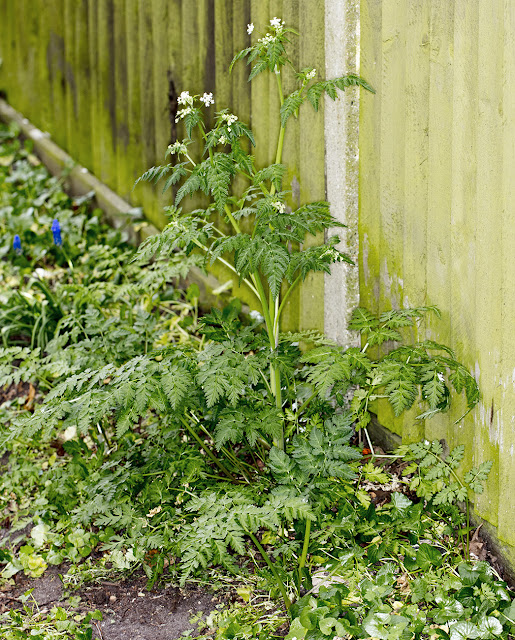
Cow Parsley, Anthriscus sylvestris.  Coney Hall, 10 April 2017.
Cow Parsley, Anthriscus sylvestris.  Coney Hall, 10 April 2017.
This is just the start of the Cow Parsley season.  Many country lanes will be lined with a froth of white in a week or two.  It's very common and grows fast and well. 

In the foreground are some more Lesser Celandine leaves.  The blue flower in the background is a Garden Grape-hyacinth, and true to its name this is a garden escape.  The wild variety has a much more subdued flower colour.

Green Alkanet, Pentaglottis sempervirens.  Coney Hall, 10 April 2017.
Green Alkanet, Pentaglottis sempervirens.  Coney Hall, 10 April 2017.
This Green Alkanet is one of the commonest of our local wildflowers, as well as being one of the showiest.  It grows furiously all spring and summer, flowering all the time.  You could cut this down today and it would be flowering again in two weeks. 

Behind it is some Groundsel, which has no petals on its small yellow flowers.  In the foreground are some I've already shown: Cornsalad, Field Forget-me-not and Petty Spurge.  Growing up the fence are some stems of Cleavers, not yet in flower.

So, you can actually do quite a bit of botanising along 25 yards of one footpath!  And there are a dozen other species, too,  not all in flower at the same time.

Tuesday, 11 April 2017

Sleeping Cuckooflowers

Cuckooflower, Cardamine pratensis.  Withyham, 5 April 2017.
Cuckooflower, Cardamine pratensis.  Withyham, 5 April 2017.
I haven't been to many countryside sites recently as most of my driving has been up and down to a new house I am getting ready for occupation.  But I do still photograph things I pass by, and I could not resist taking my camera along to capture some of the banks of Cuckooflower that are flourishing on roadsides near my new place. 

The Cuckooflower is an early Spring beauty.  It's not rare in the London Borough of Bromley, where I live now, but you see it in much smaller numbers.

It's sometimes called Lady's Smock or Milkmaids.  And I discovered this year that it rests its flowers at night.  The photo above was taken just after noon.

Cuckooflower, Cardamine pratensis.  Withyham, 5 April 2017.
Cuckooflower, Cardamine pratensis.  Withyham, 5 April 2017.
This one was taken at 8 am in the same place.  Flowers all drooping, not yet awake.  Dew still on the grass.

Wednesday, 22 February 2017

Hazel Flowers.

Female Hazel flower, Corylus avellana.  The Knoll, Hayes, 19 February 2017.
Female Hazel flower, Corylus avellana.  The Knoll, Hayes, 19 February 2017.
Just a short post .. You are probably familiar with the cheerful yellow hazel catkins that appear at this time of year.  You might not have noticed these inconspicuous female flowers that usually appear just after the tree has shed its pollen.

The flowers do not need to be conspicuous because the pollen is spread on the breeze, not by insects.

Male Hazel flowers, Corylus avellana.  The Knoll, Hayes, 19 February 2017.
Male Hazel flowers, Corylus avellana.  The Knoll, Hayes, 19 February 2017.
Here's a close-up of catkins on the same tree. You can see that although there are grains of pollen stuck to it, the actual anthers are all empty and the yellow tone is much muted.

Wednesday, 4 January 2017

Three Fields from 2016

Hayes Street Farm with Sowthistles and Scented Mayweed.  5 July 2016.
Hayes Street Farm with Sowthistles and Scented Mayweed.  5 July 2016.
Here are three fields from a folder of things I thought I might put on the blog.  This one is a field on Hayes Street Farm, quite close to my house, which I think must have been sown for green manure.  It was harvested several times during the year.  These plants all occur naturally in this area, but so many similar types all together is not normal.

But because it wasn't fertilised or tended, this field produced a great crop of smaller wildflowers during the year, some of which are quite scarce.  Keep it up!


View of the valley behind Leaves Green, 16 May 2016.
This is one of several dry chalky valleys in the London Borough of Bromley, which extends well out into the countryside.  The yellow flowers are buttercups.

View across fields to the Enfield Road bridge over the River Medway, Leigh, 12 May 2016.
This spot near Leigh is a good area for botanists.  This particular field doesn;t seem to have anything unusual in it, but the display of dandelion flowers and seed heads makes it worth seeing.

But flowers are for the warmer months.  Next time, something more wintery.

Friday, 29 July 2016

Some Things To See at Keston Common

Bog Asphodel, Narthecium ossifragum.  Keston Common bog, 23 July 2016.
Bog Asphodel, Narthecium ossifragum.  Keston Common bog, 23 July 2016.
Masses of Bog Asphodel, in the bog, naturally enough.

Broad-leaved Helleborine, Epipactis helleborine.  Keston Common, 23 July 2016.
Broad-leaved Helleborine, Epipactis helleborine.  Keston Common, 23 July 2016.
A single small patch of Broad-leaved Helleborine by the roadside.

White Water-lily, Nymphaea alba.  Keston Ponds, 23 July 2016.
White Water-lily, Nymphaea alba.  Keston Ponds, 23 July 2016.
White Water-lily in the ponds, looking pure and beautiful.

Yellow Water-lily, Nuphar lutea.  Keston Ponds, 23 July 2016.
Yellow Water-lily, Nuphar lutea.  Keston Ponds, 23 July 2016.
Yellow Water-lilies in the same ponds.  Sometimes called Brandy-bottle from the shape of the fruit.

Cinnabar caterpillar, Tyria jacobaeae.  Keston Common, 23 July 2016.
Cinnabar caterpillar, Tyria jacobaeae.  Keston Common, 23 July 2016.
The yellow and black caterpillar of the Cinnabar moth, eating up a Ragwort, which makes it poisonous for potential predators to eat.

Water Forget-me-not, Myosotis scorpioides.  Keston Ponds, 23 July 2016.
Water Forget-me-not, Myosotis scorpioides.  Keston Ponds, 23 July 2016.
Water Forget-me-not on the margins of the ponds.

Branched Bur-reed, Sparganium erectum.  Keston Ponds, 23 July 2016.
Branched Bur-reed, Sparganium erectum.  Keston Ponds, 23 July 2016.
The flowers of Branched Bur-reed, also on the margins of the ponds.

Emperor Dragonfly ovipositing.  Anax imperator.  Keston Ponds, 23 July 2016.
Emperor Dragonfly ovipositing.  Anax imperator.  Keston Ponds, 23 July 2016.
And lots of Dragonfiles and Damselflies zooming around the ponds, like this Emperor Dragonfly which is laying its eggs.