Showing posts with label Hutchinsons Bank. Show all posts

Thursday, 1 September 2016

Common Lizard

Common Lizard, Zootoca vivipara.  Hutchinson's Bank, 26 August 2016.
Common Lizard, Zootoca vivipara.  Hutchinson's Bank, 26 August 2016.
This lizard is not supposed to be rare in England, though you certainly don't see it everywhere.  I see it hardly at all.  Perhaps I walk too fast, because several of my walks pass through its territory.

I saw some at Ranscombe Farm in 2012.  Since then none, until a few days ago I saw this one sunning itself on a gate at Hutchinson's Bank.

Common Lizard, Zootoca vivipara.  Hutchinson's Bank, 26 August 2016.
Common Lizard, Zootoca vivipara.  Hutchinson's Bank, 26 August 2016.
I was actually hoping to see a Clouded Yellow butterfly, an immigrant species that has come over the channel in good numbers recently.  I did see a couple, but was not able to get a photo.  But the lizard more than made up for that!

The UK only has three lizard species; this one, the Slow-worm and the rare Sand Lizard.  I've seen lots of the snake-looking Slow-worms.  Here is one from Keston Common.

Female Slow-worm, Anguis fragilis.  Keston Common, 14 May 2011.
Female Slow-worm, Anguis fragilis.  Keston Common, 14 May 2011.

And here is my other Common Lizard sighting, from 2012.

Common Lizard, Zootoca vivipara. Ranscombe Farm Country Park, 25 May 2012.

Sunday, 29 May 2016

Hutchinson's Bank

Wild Strawberry, Fragaria vesca.  Hutchinson's Bank, 24 May 2016.
Wild Strawberry, Fragaria vesca.  Hutchinson's Bank, 24 May 2016.
As you walk onto Hutchinson's Bank from a convenient parking spot, the sides of the path are lined with wild strawberries.  These should be fruitful later on.  The fruits are small, but tasty.  However, I am wary of eating fruits which are positioned where dogs can be walked.

Beefly, Bombylius major.   Hutchinson's Bank, 24 May 2016.
Beefly, Bombylius major.   Hutchinson's Bank, 24 May 2016.
In the chalk cutting, there is what looks like a discarded piece of concrete, though it might have some purpose; this is a well-cared-for spot and rubbish would have been removed.  This Beefly was basking on it.  It might look a bit like a bee, but closer up it can be seen to have a fly's antennae and only two wings.

Beeflies lay their eggs in the holes made by solitary bees, and their larvae eat the bee larvae when the eggs hatch.   That long proboscis is not a sting.  It is used by the fly to eat pollen while hovering above a flower.

Horseshoe Vetch, Hippocrepis comosa.  Hutchinson's Bank, 24 May 2016.
Horseshoe Vetch, Hippocrepis comosa.  Hutchinson's Bank, 24 May 2016.
Horseshoe Vetch and the rather similar Kidney Vetch grow here.  These are the larval food plants for Chalkhill Blue and Small Blue butterflies.  The butterflies are only found in association with these chalk-loving plants.

Sainfoin, Onobrychis viciifolia.  Hutchinson's Bank, 24 May 2016.
Sainfoin, Onobrychis viciifolia.  Hutchinson's Bank, 24 May 2016.
Along the top path is a stretch rich in Sainfoin, a plant in the pea family that looks similar to a Lupin. 

Woodruff, Galium odoratum.  Hutchinson's Bank, 24 May 2016.
Woodruff, Galium odoratum.  Hutchinson's Bank, 24 May 2016.
A triangle of woodland at one end of the bank has several ancient woodland indicator species, including lots of Woodruff, its white flowers making light patches in the shadier spots.

Wood Sanicle, Sanicula europaea. Chapel Bank, 24 May 2016.
Across the road is another special site, Chapel Bank.  The path leads through an area rich in Sanicle, another ancient woodland indicator species.

Grizzled Skipper, Pyrgus malvae.  Chapel Bank, 24 May 2016.
Grizzled Skipper, Pyrgus malvae.  Chapel Bank, 24 May 2016.
On a chalk slope on Chapel Bank I photographed this Grizzled Skipper, another butterfly with a limited distribution. 

An unusual feature of Chapel Bank is a swathe of Marsh Thistles on one of the slopes.  When mature they can overtop me, and en masse they can be quite imposing.  At the moment they are still quite immature.  There is a much smaller stand of these plants in Beacon Wood, and even they were impressive.

Bank of Marsh Thistles, Cirsium palustre.  Chapel Bank, 24 May 2016.
Bank of Marsh Thistles, Cirsium palustre.  Chapel Bank, 24 May 2016.

Wednesday, 25 May 2016

Glanville Fritillary

Glanville Fritillary, Melitaea cinxia.  Female.  Hutchinson's Bank, 24 May 2016.
Glanville Fritillary, Melitaea cinxia.  Female.  Hutchinson's Bank, 24 May 2016.
Glanville Fritillaries are rare in the UK, occurring naturally in the Channel Islands and the south coast of the Isle of Wight.  There is a small colony on the Hampshire coast, probably re-introduced there, and two other sites where it has been introduced.  One of these happens to be a couple of miles from my house.

They are pretty creatures.

Glanville Fritillary, Melitaea cinxia.  Male.  Hutchinson's Bank, 24 May 2016.
Glanville Fritillary, Melitaea cinxia.  Male.  Hutchinson's Bank, 24 May 2016.
I actually went there to look for Small Blues, but didn't see any.  What I did see was people in search of the Glanville Fritillary.  I knew it was there, but I did not know that this was its peak time.  There were at least half a dozen specimens flying and basking in a small chalk cutting, and I photographed three.

Glanville Fritillary, Melitaea cinxia.  Male.  Hutchinson's Bank, 24 May 2016.
Glanville Fritillary, Melitaea cinxia.  Male.  Hutchinson's Bank, 24 May 2016.
I was told that they were introduced here in 2011.  Five years is the blink of an eye for a species, but so far they seem to be doing well.  This cutting catches the sun, and I have seen other scarce-ish species here; the Small Blues that I missed this year, and Chalkhill Blues.

It's a nice spot and I took some other photos too, some of which I will show in my next post.

Glanville hunters in a chalk cutting on Hutchinson's Bank.  24 May 2016.
Glanville hunters in a chalk cutting on Hutchinson's Bank.  24 May 2016.

Sunday, 23 August 2015

EOS 5DS

A tiny Sweat Bee, Lasioglossum species, in my back garden, on garden oregano flowers.  12 August 2015.
A tiny Sweat Bee, Lasioglossum species, in my back garden, on garden oregano flowers.  12 August 2015.
I now have a new camera, an EOS 5DS, an amazing thing with a sensor capable of producing detail that only medium format would get to until now.  I am still working on making my shots super sharp*, but meanwhile I can get some shots of tiny insects that are much better than I could have managed before.  This one is a tiny Sweat Bee dipping its proboscis into a tiny flower.

Hoverfly, Sphaerophoria species. Female.  Hutchinson's Bank, 11 August 2015.
Hoverfly, Sphaerophoria species. Female.  Hutchinson's Bank, 11 August 2015.

Hoverfly, Sphaerophoria species. Male.  Hutchinson's Bank, 11 August 2015.
Hoverfly, Sphaerophoria species. Male.  Hutchinson's Bank, 11 August 2015.
These are the female and male of a small Sphaerophoria hoverfly - there are a few species than cannot be told apart just from photographs.   They are feeding on Ragwort.  You can see that their body shapes are quite distinct.  With most hoverflies you look for a gap between their compound eyes at the top of their heads; females have the gap, males do not.  With Sphaerophorias you do not need to get so close.

I got these two shots to be sharper than the bee.

Oncocera semirubella.  Hutchinson's Bank, 11 August 2015.
Oncocera semirubella.  Hutchinson's Bank, 11 August 2015.
You have to chase these moths around to get any sort of close-up.  Like the Crambid grass moths, it flits off when you get close and lands upside down somewhere where it can look like a bit of grass stem.  Oncocera semirubella is usually pinker than this specimen, so I suppose this one has been around a bit and has lost some pink scales.  But enough remain for a positive identification, and it also has this way of holding its palps pointing upwards, which few moths do.

This is about as sharp as the bee.  I do better when I have time to steady the camera.

* What's the best combination of small aperture, speed and ISO for hand-held nature shots?  Small apertures give a good depth of field, but you get diffraction effects which make the whole thing less sharp.  High ISO allows faster shots, so less motion blur, but more noise, specially in the darker areas.  High speed also reduces motion blur but means that unless you are really close, a flash shot will be quite dark, and also relatively noisy.  At the moment I am trying out f/20, 1/800, ISO 250 or ISO 1000.   Also, I can sometimes sharpen a bit and reduce noise a little bit in Photoshop without compromising the pic.  If I were working with static subjects and a tripod I would be trying a very different combination.

Tuesday, 18 August 2015

More Hutchinson's Bank


Chalkhill Blue, Polyommatus coridon.  Hutchinson's Bank, 29 July 2015.
Chalkhill Blue, Polyommatus coridon.  Hutchinson's Bank, 29 July 2015.
This was the photo I was second most pleased with on Hutchinson's Bank.  The Chalkhill Blue is not a common species.  It's not the rarest  butterfly to be found here - that would be the Small Blue - but it was still nice to see one.

The photo I was most pleased with was a hoverfly.

Volucella zonaria.  Hutchinson's Bank, 21 July 2015.
Volucella zonaria.  Hutchinson's Bank, 21 July 2015.
I have been trying to capture on of these for a couple of years, and they have just zoomed past.  This time I found one feeding on a Bramble flower.  Volucella zonaria is a large hoverfly, a hornet mimic, looking dangerous but actually completely harmless to people.

I captured some other hoverfly photos too.

Volucella pellucens.  Hutchinson's Bank, 21 July 2015.
Volucella pellucens.  Hutchinson's Bank, 21 July 2015.
This is Volucella pellucens, also on a Bramble.  I love photographing hoverflies,  They are colourful and varied.

Dronefly, Eristalis pertinax.  Hutchinson's Bank, 29 July 2015
Dronefly, Eristalis pertinax.  Hutchinson's Bank, 29 July 2015.
I have lots of photos of this hoverfly, Eristalis pertinax, but this was an interesting angle.  It's eating pollen from a Hogweed.

Large White, Pieris brassicae, on Creeping Thistle, Cirsium arvense.  Hutchinson's Bank, 21 July 2015.
Large White, Pieris brassicae, on Creeping Thistle, Cirsium arvense.  Hutchinson's Bank, 21 July 2015.
Back to the butterflies .. This Large White, aka Cabbage White because its caterpillars love Brassicas, is feeding on a Creeping Thistle, our commonest thistle, which will grow in any scrap of waste ground.  It has a paler flower than most thistles, and they smell of honey.

Common Red Soldier Beetle, Rhagonycha fulva.  Hutchinson's Bank, 29 July 2015.
Common Red Soldier Beetle, Rhagonycha fulva.  Hutchinson's Bank, 29 July 2015.
There are plenty of other insects, too.  This is the commonest beetle (visible beetle, I should probably say) at this time of year.  It's often called the Hogweed Bonking Beetle because this is how you commonly see it, and it loves Hogweed.  I suppose it must eat sometime or other, as well. 

Wednesday, 12 August 2015

Hutchinson's Bank

Gatekeeper, Pyronia tithonus., on Wild Marjoram,  Origanum vulgare.  Hutchinson's Bank, 21 July 2015
Gatekeeper, Pyronia tithonus., on Wild Marjoram,  Origanum vulgare.  Hutchinson's Bank, 21 July 2015
Hutchinson's Bank is a chalk slope near New Addington, steep enough that you need to look forward to expending some effort to get around it all.  There are paths along the top, the middle and the bottom, and at the end there is a small triangular wood.  A little further up the road there is another area of chalk grassland known for its orchids.

Last year, when I walked around, the bottom path was little more than a muddy trench, but this time all was dry and pleasant.  The chalk flora is lovely, and here is a typical specimen, a Wild Marjoram.  It's aromatic, like so many of the Lamiaceae, and moths and butterflies love it.  This butterfly is a Gatekeeper, and although this was supposed to be a plant post, as there is already a butterfly here I will show what the upper wing surface is like.

Gatekeeper, Pyronia tithonus.  Hutchinson's Bank, 29 July 2015.
Gatekeeper, Pyronia tithonus.  Hutchinson's Bank, 29 July 2015.
It's quite small and quite colourful.

Nemophora metallica on a Field Scabious, Knautia arvensis.  Hutchinson's Bank, 21 July 2015.
Nemophora metallica on a Field Scabious, Knautia arvensis.  Hutchinson's Bank, 21 July 2015.
There are lots of Scabiouses scattered around, Field and Small.  This Field Scabious is being visited by a longhorn moth, Nemophora metallica, whose larvae feed on it.

Wild Parsnip, Pastinaca sativa.  Hutchinson's Bank, 21 July 2015.
Wild Parsnip, Pastinaca sativa.  Hutchinson's Bank, 21 July 2015.
OK, I will definitely cut back on the Lepidoptera now.  This is a Wild Parsnip, which I do not see on every chalk bank.  I haven't tried to pull up a root and expect I would be disappointed if I did.

Tufted Vetch, Vicia cracca.  Hutchinson's Bank, 29 July 2015.
Tufted Vetch, Vicia cracca.  Hutchinson's Bank, 29 July 2015.
Tufted Vetch - it's a cracca.  That is an obscure pun.  This pretty plant is quite common.  I saw some at Leybourne Lakes, too.

Marsh Thistle, Cirsium palustre.  Chapel Bank, 29 July 2015.
Marsh Thistle, Cirsium palustre.  Chapel Bank, 29 July 2015.
In the Leybourne Lakes post I mentioned the Marsh Thistle, comparing it unfavourably with a Welted Thistle.  Well, here it is, in the other chalky area close to Hutchinson's Bank.  It is quite characterful and interesting, and often grows in large groups, as you can see in the background of this photo.  It's tall and skinny, and the flower heads are tacky to the touch rather than spiky.  But those things do not make it pretty.
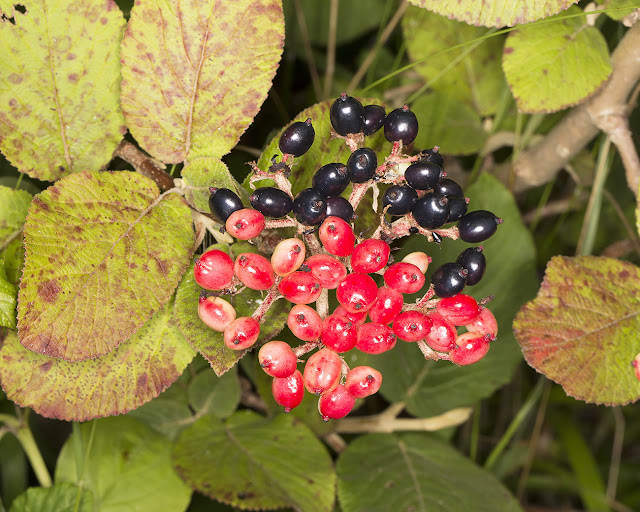
Wayfaring-Tree, Verbena lantana.  Hutchinson's Bank, 29 July 2015.
Wayfaring-Tree, Verbena lantana.  Hutchinson's Bank, 29 July 2015.
Last for today, a typically multicoloured berry head of the Wayfaring-tree, one of our two wild Verbenas.  It is a common shrub on the chalk, and a lovely sight at this time of year.

Wednesday, 4 July 2012

Small Blue

Butterfly, Small Blue, Cupido minimus. Female.  Hutchinson's Bank, 14 June 2012.
Butterfly, Small Blue, Cupido minimus. Female.  Hutchinson's Bank, 14 June 2012.
The Small Blue is a scarce butterfly, though a long way from being our rarest.  But it is our smallest, just over 2cm across.  The larvae feed on Kidney Vetch, which itself is not all that common, being found in 87 of the 2175 four-square-kilometer tetrads that Kent is divided into for recording purposes. 

It's not blue.  But it is related to butterflies that are.  This female is completely brown, but the males do have a hint of blue:

Butterfly, Small Blue, Cupido minimus.  Male.  Hutchinson's Bank, 14 June 2012.
Butterfly, Small Blue, Cupido minimus.  Male.  Hutchinson's Bank, 14 June 2012.
(I couldn't get quite as close to this one.)  It's always interesting to see that the undersides of butterflies' wings look like.  This is the female in the top photo:

Butterfly, Small Blue, Cupido minimus. Female.  Hutchinson's Bank, 14 June 2012.
Butterfly, Small Blue, Cupido minimus. Female.  Hutchinson's Bank, 14 June 2012.
As is often the case, I had to throw myself onto the ground to get that shot!

Wednesday, 20 June 2012

Two More Non-Dandelions

Cat's-ear, Hypochaeris radicata.  Hayes Common, 13 June 2012
Cat's-ear, Hypochaeris radicata.  Hayes Common, 13 June 2012
Two more yellow flowers that look like Dandelions, but aren't.

Identifying a plant in a group like this, where many species look quite similar, is tricky. This one, Cat's-ear, can be identified by the following criteria:

There are no forked hairs on the underside of the leaves (that would make it a Hawkbit.)  There are dark-tipped bracts along the flower stems, which are single or have few branches.  The flowers are bright yellow, with the outer florets greyish beneath.  Around the flower-head are many erect, overlapping, purple-tipped bracts with bristles on their midribs.  And inside the flower, mixed with the florets, there are small, long-toothed scales, which you can find if you pull the flower apart.

You can see many of those things in the photo, but by no means all.  So it is quite necessary for even a partly serious botanist to carry a decent hand lens. 

Rough Hawkbit, Leontodon hispidus.  Hutchinson's Bank, 14 June 2012.
Rough Hawkbit, Leontodon hispidus.  Hutchinson's Bank, 14 June 2012.
This one does have forked hairs on the underside of its leaves, which you can see with a hand lens.  That, and the very hairy calyx, make this a Rough Hawkbit.  (The Lesser Hawkbit, which also has those forked hairs, has a hairless calyx.)

But these flowers also have a different overall look to them if you first assimilate their characteristics and then draw back.  If you then look at the other two non-Dandelions I posted earlier, you can see that they are different again. Once you are familiar with the flowers - and the other parts of the plants - in detail, your eye and mind can pick up those differences even at a glance.

Friday, 9 September 2011

Robin's Pincushion

Robin's Pincushion gall, caused by the wasp Diplolepis rosae, on a wild rose on Hutchinson's Bank, 9 August 2011.
I saw quite a few of these on Hutchinson's Bank. I posted a photo of a bright red one earlier, here: Robin's Pincushion Gall. That one was in Riddlesdown Quarry. They aren't rare, but they're the sort of thing you might not notice unless you look.

Thursday, 11 August 2011

Two Common Blues

Common Blue butterflies, Polyommatus icarus. Male.  Hutchinson's Bank, 2 August 2011.
Common Blue butterflies, Polyommatus icarus. Male.  Hutchinson's Bank, 2 August 2011.
The top of its wings are a pleasing blue; you can just see the colour peeping over the near wingtips. The undersides have a pattern which is similar to several related species.

Wednesday, 10 August 2011

Spear Thistle

Spear Thistle flower, Cirsium vulgare.  Hutchinson's Bank, 2 August 2011.
Spear Thistle flower, Cirsium vulgare.  Hutchinson's Bank, 2 August 2011.
This is for comparison with yesterday's Creeping Thistle.  Spear Thistle flowers are individually larger and a darker pink, almost magenta. This one was taken with my EOS 60D, 200mm prime lens and 2x extender.

Friday, 5 August 2011

Woody Nightshade

Woody Nightshade, aka Bittersweet, Solanum dulcamara.  Hutchinson's Bank, 2 August 2011.
Woody Nightshade, aka Bittersweet, Solanum dulcamara.  Hutchinson's Bank, 2 August 2011.
Sprays of this small but colourful flower crop up all around, in hedgerows, scrub and waysides. It's a Solanum, and like most of that group, the berries are poisonous, but all you have to do is not eat them. From one of their names, it sounds as though someone has tried.  Tomatoes are also a Solanum species, an interesting exception! So are potatoes, which are not an exception; they bear poisonous berries.