Showing posts with label walks. Show all posts

Wednesday, 6 September 2017

Some of the Ashdown.

Camps in a grove on Ashdown Forest.
Here are some impressions of the Ashdown Forest, which is mostly moorland.  But it does have plenty of trees, some in groves like this one which is just downhill from The Hollies car park, some in woods, some along streams.

I wrote to a friend recently that you can't get lost in the Ashdown.  That's because it consists of several large hollows with roads along the high points, so that if you go uphill you will eventually find a road.  And you can see across the hollows to the high points opposite.

But you can't get lost only as long as you are mobile.  There are plenty of places where it would be hard to find you if you got stuck or had an accident.  And there are plenty of places where you could do just that.

The Airman's Grave, downhill from The Hollies car park.  Ashdown Forest, 31 August 2017.
The Airman's Grave, downhill from The Hollies car park.  Ashdown Forest, 31 August 2017.
Here you can see a broad path downhill, houses in the distance, it looks as though you could walk to the far side of this depression to that ridge of trees in less than an hour, if the path carries on like this.

Pool on Ashdown Forest, 31 August 2017.
Just at the bottom of this immediate dip is a stream, with pleasant pools.  I'd been taken on a walk here about 10 years ago and shown an interesting fungus, so I tried following what I could remember of the way: cross the stream and walk up it, looking for a place to cross back. 

A path on Ashdown Forest, 31 August 2017.
I didn't find the second crossing place.  I was soon walking on this path, which is not exactly well-trodden.  The bracken I pushed through was covered with dew and I was wet to the waist, and completely soaked to the knees.  My view ahead was this, with trees screening my view of the stream to the right, and to the left:

View from a path on the Ashdown Forest, 31 August 2017.
This looks very different from the safe-looking broad path I started out on.  It was lucky I knew to keep going uphill, because after eventually negotiating some boggy ground which fed the stream I got back safely.   But if I had fallen at this spot, who would have found me?  I was pleased that I had a good signal on my phone.  (Another sign of not being in a real wilderness.)  And the GPS was invaluable, as it showed me where I was on a map.

It was fun!  And I saw this:

Marsh Gentian, Gentiana pneumonanthe.   Ashdown Forest, 31 August 2017.
Marsh Gentian, Gentiana pneumonanthe.   Ashdown Forest, 31 August 2017.
A Marsh Gentian, quite a scarce plant which I had seen a few miles away on another part of the Ashdown on a different walk.  Around it are the mauve clusters of Cross-leaved Heath flowers, and yellow Dwarf Gorse flowers. 

That walk was only a short distance, but it felt longer.

Wednesday, 14 September 2016

A Walk round the Hawkwood Estate - part 3 of 3

Walk round the Hawkwood Estate 25, 30 August 2016
Walk round the Hawkwood Estate 25, 30 August 2016.
This is the last in a series of three posts following a walk around the Hawkwood Estate with an iPhone camera. 

Here I was past the halfway point and going mostly downhill.  Some parts of the route can be done along the edges of fields as shown in this first photo ...

Walk round the Hawkwood Estate 26, 30 August 2016
But I took the woodland path instead.  It is not far away and goes the same way.  There are many well-defined paths through local woodlands, though I see very few people there.  I heard voices while I was in Petts Wood, and in a couple of these iPhone photos people are visible in the distance, but even on a fine day like this it was hardly crowded.

Flushers Pond.  Walk round the Hawkwood Estate 27, 30 August 2016
Flushers Pond.  Walk round the Hawkwood Estate 27, 30 August 2016
The path skirts Flushers Pond.  I had to duck through a fence to take this photo.  In wet weather, the level is higher and the water comes right up to the fence.

Redshank, Persicaria maculosa.  Walk round the Hawkwood Estate 28,, 30 August 2016
Redshank, Persicaria maculosa.  Walk round the Hawkwood Estate 28, 30 August 2016
A stand of Redshank in a more open part of the wood.  You can buy related Persicarias as garden plants.

Redshank, Persicaria maculosa.  Walk round the Hawkwood Estate, 30 August 2016
Redshank, Persicaria maculosa.  Walk round the Hawkwood Estate, 30 August 2016
These are the flowers closer to.  Not many plants start to flower at this time of year.  Most, even those still with open flowers, started some while ago.

Greater Plantain, Plantago major.  Walk round the Hawkwood Estate, 30 August 2016
Greater Plantain, Plantago major.  Walk round the Hawkwood Estate, 30 August 2016
Like this Greater Plantain in the same spot, which has brown, ripe fruiting spikes.  Greater Plantain is a common sight near, and sometimes even on pathways because it can withstand quite a lot of being walked on.

Wild Clematis, Clematis vitalba, Walk round the Hawkwood Estate 29, 30 August 2016
Wild Clematis to the right of the path, known as Traveller's Joy when flowering and Old Man's Beard later when it has hairy fruits. 

Information board.  Walk round the Hawkwood Estate 30, 30 August 2016
Information board.  Walk round the Hawkwood Estate 30, 30 August 2016
An information board!  Complete with a map that points to where you are.  I have been following more or less the yellow route.  My starting point was at the very leftmost point on that route.

Walk round the Hawkwood Estate 31, 30 August 2016
 You could hardly miss this path - it has more signs than a city street.  A dog walker is just visible in the distance.

The small yellow arrow points to an alternative route that goes past Tong Farm.

Walk round the Hawkwood Estate 32, 30 August 2016
Further on it is once again possible to bypass the woods, with a view over fields that look more rough than the neat grass elswehere.  This field is off the edge of the estate. 

Graffitied tree.  Walk round the Hawkwood Estate 33, 30 August 2016
Graffitied tree.  Walk round the Hawkwood Estate 33, 30 August 2016
One of the paths through the wood goes past this elaborate graffiti, so elaborate that I can't really tell what it says.  Lacey?  The hearts show that it is a love message, anyway. 

Pond Wood.  Walk round the Hawkwood Estate 34, 30 August 2016
Pond Wood.  Walk round the Hawkwood Estate 34, 30 August 2016
This is the second pond on this walk, in the usefully named Pond Wood.  It doesn't seem to have a name, but if it did, I expect it would be Wood Pond.

Walk round the Hawkwood Estate 35, 30 August 2016
The path leads out to that same rough field seen earlier.  At the bottom of this slope is a footbridge over the Kyd Brook, near the start point.


Kyd Brook.  Walk round the Hawkwood Estate 36, 30 August 2016
Kyd Brook.  Walk round the Hawkwood Estate 36, 30 August 2016
There's the brook, and a path with a sign which is an alternative entry point to this walk.  But I went straight past this path - my route went from left to right, just behind where I was standing to take this.

Start and finish point.  Walk round the Hawkwood Estate 37, 30 August 2016
Start and finish point.  Walk round the Hawkwood Estate 37, 30 August 2016
And back to the start!  That walk took me about an hour and a quarter, but I walk fast.  Good exercise in good countryside.

Monday, 5 September 2016

A Walk round the Hawkwood Estate - part 1 of 3

Gosshill Road. Walk round the Hawkwood Estate, 01, 30 August 2016.
Gosshill Road. Walk round the Hawkwood Estate 01, 30 August 2016.
I'm going to show a walk around the Hawkwood Estate, taking in one edge of Petts Wood, in the same style as the Walk to Nash I posted in June.  That is, a sequence of iPhone photos of the route.  This time I will also include some closeups taken with my EOS 5DS.  As I am at least partly a botanist, I could not resist some photos of plants.

There are more than 40 photos this time, so I will post in 3 sections.  iPhone photos are numbered.  The others just slot in.

The quiet road in the first photo, Gosshill Road, is where a car can be parked.  Mine is on the right.
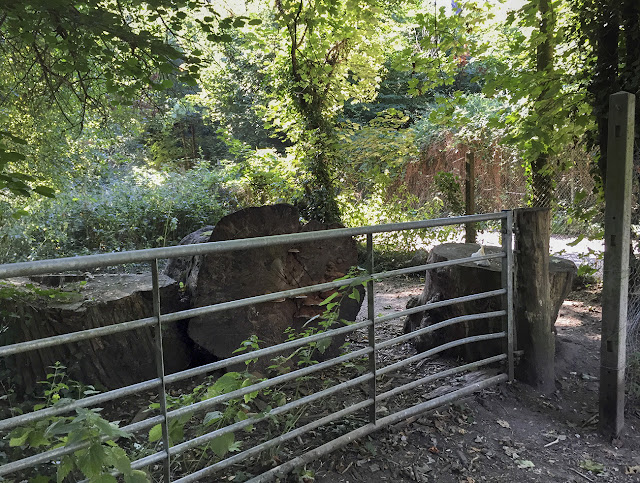
Walk round the Hawkwood Estate 02, 30 August 2016.
To start the route, I went through this narrow gap.  There's a plastic bag of dog poo on the stump which added its characteristic aroma to  the scene.  (This bag is not an essential part of this walk.)

The face of the felled trunk has some interesting fungi.  That day, they were covered with released spores that looked like brown dust.  In wet weather, with the spores washed off, you can see the odd shine on the top surfaces, and the yellow edge, that tell you it's Ganoderma pfeifferi, Beeswax Bracket.  Here is what it looked like when I was there in 2013:

Ganoderma pfeifferi, Beeswax Bracket.  22 December 2013.
Ganoderma pfeifferi, Beeswax Bracket.  22 December 2013.
Soon it became less ... well, doggy ... and I was walking through what looks like a neglected orchard.

Walk round the Hawkwood Estate 03, 30 August 2016.
The sun shone, all was lovely.  Past the small orchard ...
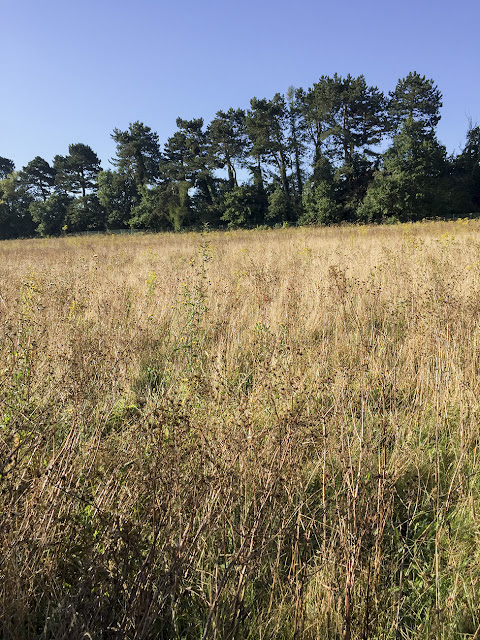
Walk round the Hawkwood Estate 04, 30 August 2016.
To the right was what looked like a field ready to be harvested for hay.  The trees mask a busy railway.  But if this is really for hay, the harvester needs to be careful.

Ragwort, Senecio jacobaea, on the Hawkwood Estate, 30 August 2016
There's a lot of Ragwort in the field.  This plant is poisonous and can harm horses and cows.  They don't eat it in the field because it tastes bitter, but apparently it loses this bitterness when dried in hay and so becomes dangerous.

The Kyd Brook.  Walk round the Hawkwood Estate 05, 30 August 2016.
The Kyd Brook.  Walk round the Hawkwood Estate 05, 30 August 2016.
To the left is a small, quiet, well-shaded stream, the Kyd Brook.  The Kyd Brook runs on towards London and becomes the River Quaggy, which then joins the Ravensbourne by Lewisham station.  The Ravensbourne runs on into the Thames.
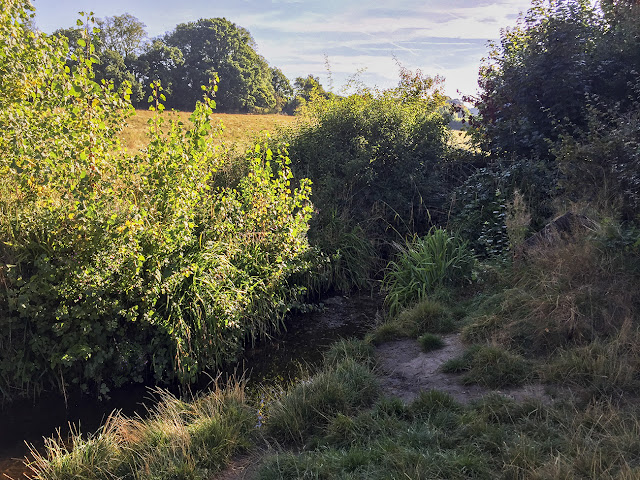
The Kyd Brook.  Walk round the Hawkwood Estate 06, 30 August 2016.
The Kyd Brook.  Walk round the Hawkwood Estate 06, 30 August 2016.
This is the Kyd Brook looking upstream, in the direction of the walk.

I have been along this route in wet weather and the path along here was little more than a series of muddy puddles.  The weather has been dry recently, so the walk was much more pleasurable.

Bristly Oxtongue, Helminthotheca echioides.  Walk round the Hawkwood Estate 07, 30 August 2016.
Bristly Oxtongue, Helminthotheca echioides.  Walk round the Hawkwood Estate 07, 30 August 2016.
These large yellow-flowered plants in the field to the right are Bristly Oxtongue.  I don't know how palatable they are, but they are not poisonous.

Mugwort, Artemisia vulgaris.  Walk round the Hawkwood Estate 08, 30 August 2016.
Mugwort, Artemisia vulgaris.  Walk round the Hawkwood Estate 08, 30 August 2016.
To the left of the path, Mugwort is still in flower.  This is a relative of wormwood, the plant that supposedly drives people mad when used in absinthe.  But for this plant, my reference book (*) says "The leaves and flowering tops are used as a spice" if gathered when the flowers are still immature. 

The flowers are small, and look like this:

Flowers of Mugwort, Artemisia vulgaris.  Hawkwood Estate, 30 August 2016.
Flowers of Mugwort, Artemisia vulgaris.  Hawkwood Estate, 30 August 2016.
More to follow next time ...

(*) "Plants Consumed by Man" by B. Brouk.  Academic Press, London, 1975.  ISBN 0-12-136450 X.

Sunday, 5 June 2016

A Walk to Nash

Path to Nash.  Steps down from Westerham Road.  2 June 2016.
Path to Nash.  Steps down from Westerham Road.  2 June 2016.
This post is just a pile of iPhone shots from a walk that took me past the tiny village of Nash.  I had walked nearly all of this route in sections in the past, at different times as parts of different routes, and the section leading to Nash only once a few years ago.  There had been a lot of rain over the past two days which made the idea of going to look at woods and farmland sound really muddy, so I did this instead.

I took  a bus to the end of Keston Common and found a steep path  down from the main road.  I was immediately in a very moody tunnel of trees (shown above).

Path to Nash.  Down from Westerham Road.  2 June 2016.
Path to Nash.  Down from Westerham Road.  2 June 2016.
A side view opened up showing a field of buttercups.

Path to Nash.  Down from Westerham Road.  2 June 2016.
Path to Nash.  Down from Westerham Road.  2 June 2016.
But mostly I was walking between two very tall hedgerows.  It came out to a road at the bottom, and another path was available after a couple of hundred yards.  This ran between less tall hedgerows but it was still hemmed in, so it was good to be able to hop over a piece of missing barbed wire and get a wider view of the fields.

Path to Nash.  From Jackass Lane to Fortune Bank Farm.  2 June 2016.
Path to Nash.  From Jackass Lane to Fortune Bank Farm.  2 June 2016.
Mostly it was like this.

Path to Nash.  From Jackass Lane to Fortune Bank Farm.  2 June 2016.
Path to Nash.  From Jackass Lane to Fortune Bank Farm.  2 June 2016.
The recent rain had caused a lot of the flowering plants to lean over.

Path to Nash.  From Jackass Lane to Fortune Bank Farm.  2 June 2016.
Path to Nash.  From Jackass Lane to Fortune Bank Farm.  2 June 2016.
The path took a right angle and ran along a more open section.  There's a rather pretty small Hawthorn in flower, and you can see in the distance the pylons that distribute power across the London Borough of Bromley.

Path to Nash.  From Jackass Lane to Fortune Bank Farm.  2 June 2016.
Path to Nash.  From Jackass Lane to Fortune Bank Farm.  2 June 2016.
Then another right angle, and I was back to this. Someone must be taking regular care of this path, or it would soon be one solid impenetrable hedge.

Path to Nash.  From Jackass Lane to Fortune Bank Farm.  2 June 2016.
Path to Nash.  From Jackass Lane to Fortune Bank Farm.  2 June 2016.
A LOT of the Cow Parsley that looks so pretty on this route had been bowed down by the rain and had to be brushed through.

Path to Nash.  From Jackass Lane to Fortune Bank Farm.  2 June 2016.
Path to Nash.  From Jackass Lane to Fortune Bank Farm.  2 June 2016.
Resulting in wet legs and feet .. At this point I had emerged onto a farm track and saw signs of (modern) life; a delivery van went past me.

Fortune Bank Farm, Nash, 2 June 2016.
The path actually goes through the farmyard, which as you can see does business as riding stables.  This is as much of Nash as I saw, and there is actually not much more to see!  Then, another short road section.

Nash Lane, 2 June 2016.
The country roads are all narrow and have high hedges.  Soon I turned off onto another track which joined another path, one I had walked several times between Well Wood and Coney Hall.  Parts of it were strewn with petals, and though that was not specifically for me I still felt good.

Path from Well Wood to Coney Hall.  2 June 2016.
Path from Well Wood to Coney Hall.  2 June 2016.
 I turned towards Coney Hall. 

Path from Well Wood to Coney Hall.  2 June 2016.
Path from Well Wood to Coney Hall.  2 June 2016.
 Now houses were visible over the hedge.  This is Coney Hall.

View over fields to Coney Hall.  2 June 2016.
View over fields to Coney Hall.  2 June 2016.
Though I was still very much in the countryside.  Past this field I emerged into a road, and stuck to roads for a while to get a closer view of an interesting house I had caught a glimpse of - you can just see it two photos back.

House on Harvest Bank Road, Coney Hall, 2 June 2016.
 Very interesting, part brutal and part deco, not at all like the 1930s mock Tudor things to the sides.

Hayes Common, 2 June 2016.
Then back to the woods for the last familiar section through Hayes Common.

Well, I enjoyed that!


Wednesday, 11 April 2012

Crofton Heath, April.

A burnt patch at the west edge of the wood.  Orpington Field Club outing to Crofton Heath and nearby woods on 7 April 2012.
A burnt patch at the west edge of the wood.  7 April 2012.
Another outing with the Orpington Field Club, and once again it was overcast with the likelihood of rain. In fact there were a few spots, but no serious wetness. Given that we are in a drought and there are hosepipe bans, I would have hoped for some better weather for these trips.

Crofton Heath connects several differently named woods, including Sparrow Wood, which I walked through part of in March last year.   The top photo shows a patch at the edge of the wood which had burnt sometime in the last few days. There was no serious damage, but if it spread this far it shows that the wood might be vulnerable to a larger fire, especially if there is a hot dry spell.

These woods are right next to suburbia, with gardens backing onto them in several places, and garden refuse has clearly been dumped around the edges. This plant is one result.

Variegated Yellow Archangel, Lameastrum galeobdolon ssp. argentatum.  Orpington Field Club outing to Crofton Heath and nearby woods on 7 April 2012.
Variegated Yellow Archangel, Lameastrum galeobdolon ssp. argentatum.  7 April 2012.
It's a variegated subspecies of a very pretty dead-nettle that is found in ancient woodlands, the Yellow Archangel, but this garden variety is very vigorous and invasive and not really welcome in the woods. There were some genuine indicators of ancient woodland scattered around, though; lots of Wood Anemones and English bluebells, and some large patches of Wood Sorrel.

Wood Sorrel, Oxalis axetosella.  Orpington Field Club outing to Crofton Heath and nearby woods on 7 April 2012.
Wood Sorrel, Oxalis axetosella.  7 April 2012.
It was interesting to see some small shrubs of Midland Hawthorn in flower.

Midland Hawthorn, Crataegus laevigata.  Two styles are visible in this flower, and notice the leaf shape.  Orpington Field Club outing to Crofton Heath and nearby woods on 7 April 2012.
Midland Hawthorn, Crataegus laevigata.  7 April 2012.
Unlike the common Hawthorn, there are two or sometimes three seeds in each berry on this shrub, and although the camera has not captured much detail in the flowers you can just about see two distinct styles in this one.  Each style will produce a seed.  The leaf shape is also different, but the two styles are the best diagnostic feature in the absence of an actual berry.

It was still early spring, and only a few flowers could be seen. It was cool, so few insects were about, though I did see a couple of queen bumblebees, Bombus lucorum, and a moth flitted past at one point too fast to be identified. There were some odd pieces of old brick and concrete work in places, near a site which was once an isolation hospital, and near the entrance to the woods was this sign, in Victorian metalwork:

A metal sign saying Isleworth Blue School Governors, on the edge of Gumping Common.  Orpington Field Club outing to Crofton Heath and nearby woods on 7 April 2012.
A metal sign saying "Isleworth Blue School Governors", on the edge of Gumping Common.  7 April 2012.
This is surprising An Isleworth Blue School does exist, but it is on the far side of London and the connection isn't obvious.  Perhaps they had some long-lost investment in these woods.

The last photo for today is a closeup of some fungus found on the underside of a fallen branch.

Split Porecrust, Schizopora paradoxa.  Orpington Field Club outing to Crofton Heath and nearby woods on 7 April 2012.
Split Porecrust, Schizopora paradoxa.  7 April 2012.
This photo was taken by incident light, falling at an angle, and the structure of the pores shows up much better than my ring flash would have done, though for most of these pics I longed for my SLR, but given the weather forecast I didn't take it with me.  It would have brought out much better detail in the white flowers.  The first four photos were taken with my iPhone, and the last two with my Ixus 100.