Showing posts with label Kelsey Park. Show all posts

Friday, 7 September 2018

A Rare Treat

Clifden Nonpareil, Catocala fraxini.  Crowborough, 4 September 2018.
Clifden Nonpareil, Catocala fraxini.  Crowborough, 4 September 2018.
This is a Clifden Nonpareil, sometimes called Blue Underwing. It was once resident in the UK, but died out, and was then seen only as an occasional immigrant.  It is re-establishing itself, but still is only seen a few times a year away from the coast.  So I was lucky that this specimen appeared on my garden fence above the light of my moth trap.

I saw it from my kitchen window before dawn and thought I might have a Red Underwing.

Red Underwing, Catocala nupta.  West Wickham Common, 8 September 2016.
Red Underwing, Catocala nupta.  West Wickham Common, 8 September 2016.
That would have been good because although these are not scarce, they rarely come to light, and I have only seen two, both at West Wickham Common.  But no!  It was bigger and better than that.

Clifden Nonpareil, Catocala fraxini.  Crowborough, 4 September 2018.
Clifden Nonpareil, Catocala fraxini.  Crowborough, 4 September 2018.
And it is big, one of our biggest moths.   The Old Lady is quite sizeable:

Old Lady, Mormo maura. Kelsey Park, 28 August 2015.
.. But it's not as big, and it lacks the flashy underwings.  For size, you might consider Hawk-moths; they are pretty big, like this Privet Hawk-moth that some trappers brought to Sevenoaks.

Privet Hawkmoth, Sphinx ligustri.  Sevenoaks Wildlife Reserve, 7 July 2013.
Privet Hawkmoth, Sphinx ligustri.  Sevenoaks Wildlife Reserve, 7 July 2013.
I saw one at Hayes the next year.  These were very impressive.  Incidentally, blue is a rare colour among moths.  I only know one other in Britain with some blue, and it's another Hawk-moth:

Eyed Hawk-moth, Smerinthus ocellata.  Crowborough, 3 July 2017.
Eyed Hawk-moth, Smerinthus ocellata.  Crowborough, 3 July 2017.
All of these were a real pleasure to see and handle.  But the Clifden nonpareil is the rarest.

Clifden Nonpareil, Catocala fraxini.  Crowborough, 4 September 2018.
Clifden Nonpareil, Catocala fraxini.  Crowborough, 4 September 2018.


Thursday, 10 September 2015

Kelsey Park Moths 2015


Mother of Pearl, Pleuroptya ruralis.  Kelsey Park, 28 August 2015.
Mother of Pearl, Pleuroptya ruralis.  Kelsey Park, 28 August 2015.
While the bat walkers were moving round the lake in Kelsey Park, I was looking for moths.  I saw this Mother of Pearl flying around.  It ignored the light trap and landed on the underside of a leaf on a nearby bush.  With some contortions, I managed to get this photo of it, before capturing it in a plastic pot.  I would have at least one moth to show the bat people!

But actually there were half a dozen eventually.  This Maiden's Blush turned up in the trap quite soon.

Maiden's Blush, Cyclophora punctaria.  Kelsey Park, 28 August 2015.
Maiden's Blush, Cyclophora punctaria.  Kelsey Park, 28 August 2015.
You can see the dark patches on its wings from which it gets its common name.  And also in the trap were two smaller moths.

Chequered Grass-veneer, Catoptria falsella..  Kelsey Park, 28 August 2015.
Chequered Grass-veneer, Catoptria falsella.  Kelsey Park, 28 August 2015.
This Chequered Grass-veneer is one of a group of very similar moths which you can often see flying ahead of you if you walk through long summer grass.  They are easily disturbed in the day.


Piniphila bifasciana.  Kelsey Park, 28 August 2015.
The larvae of this little Piniphila bifasciana live on Scots Pine, of which there are several specimens near the trap.   I was pleased to be able to identify this, as it is a new species for me. 

Just before we packed up, an old favourite flew into the trap.

Old Lady, Mormo maura.  Kelsey Park, 28 August 2015.
Old Lady, Mormo maura.  Kelsey Park, 28 August 2015.
This is quite a large moth, though not really showy.  We have seen this species here before.  And during the bat walk on 1 September, arranged late to cope with unexpected demand, one of these was the only moth to settle in the trap.  It might even have been the same individual.  My photo from 1 September shows noticeably more wear than this one.

We only had two other moths,  a Double-striped Pug and a Vine's Rustic, and I don't have a decent photo of either, so I will finish with another view of the reliable Old Lady.

Old Lady, Mormo maura.  Kelsey Park, 28 August 2015.
Old Lady, Mormo maura.  Kelsey Park, 28 August 2015.
Dark red eyes and purple legs.  So not entirely dowdy!

Let me just add that all the creatures that came to my light trap were, as always, released unharmed. 

Saturday, 5 September 2015

Kelsey Park Insects

Midge, probably Chironomus luridus.  Kelsey Park, 28 August 2015.
Midge, probably Chironomus luridus.  Kelsey Park, 28 August 2015.
There are usually two bat walks in Kelsey Park (Beckenham) each year.  You have to book for them because they are so popular; the best bat walk in the area, because there you can see Daubenton's bats skimming over the water. For the last three years I have put out my moth trap during the August walk to see what might be around.

Results have been very varied. Even on good moth nights, the walk is usually finishing before many moths have arrived.  This year, an extra walk was put on to cope with demand, but the second was on a cool damp night and almost nothing turned up in the trap (but there were plenty of bats over the lake).

However, during the first August walk I saw the usual flush of midges large and small.  This was one of the larger ones.  It's not a biter - no long proboscis is visible. The name I have attached to it is only tentative. A similar creature was identified as this last year.

We also had some Caddises.

Caddis, Speckled Peter, Agrypnia varia.  Kelsey Park, 28 August 2015.
Caddis, Speckled Peter, Agrypnia varia.  Kelsey Park, 28 August 2015.
This black-and-white Speckled Peter was the prettiest.  You can expect to see lots of Caddisflies around water because that's where their larvae live.

Water Boatman, probably a Callicorixa species.  Kelsey Park, 28 August 2015.
Water Boatman, probably a Callicorixa species.  Kelsey Park, 28 August 2015.
This is another sign of nearby water; a beetle, actually a true bug, called a Water Boatman because of the way it uses its legs to swim around under the water.  They look rather like oars.  Most people don't realise that these creatures also fly around at night.  We had several in the light trap.

Forest Bug, Pentatoma rufipes.  Kelsey Park, 28 August 2015.
Forest Bug, Pentatoma rufipes.  Kelsey Park, 28 August 2015.
Forest Bugs also tend to come to light.  These are also true bugs, but have nothing to do with the nearby water.  They live in trees.

While looking around I also saw this Harvestman on a Scots Pine.

Harvestman, order Opiliones.  Kelsey Park, 28 August 2015.
Harvestman, order Opiliones.  Kelsey Park, 28 August 2015.
Harvestmen are related to spiders, but have only a single body segment, whereas spiders have two.  I often see them when trapping at night.  They don't usually come to the light, but they are always wandering around so I see them coming and going.   Most species have long legs, some much longer than this, though a few are more compact.  They are one of the groups of creatures called Daddy Long-legs.  Craneflies and some spiders also get that name.

Next time I will show some actual moths!

Tuesday, 25 December 2012

Merry Christmas!

Amanita muscaria (Fly Agaric) under the glaucous form of the Atlas Cedar (Cedrus atlantica forma glauca).  Kelsey Park, 30 October 2012.
Amanita muscaria (Fly Agaric) under the glaucous form of the Atlas Cedar (Cedrus atlantica forma glauca).
Kelsey Park, 30 October 2012.
This looks suitably Christmas-coloured, like a tree ornamented with Santa's red and white.   So, a merry Christmas to all my viewers!

Below is the same tree and fungus from further away.

Amanita muscaria (Fly Agaric) under the glaucous form of the Atlas Cedar (Cedrus atlantica forma glauca).
Kelsey Park, 30 October 2012.

Tuesday, 30 October 2012

Grey Herons in Kelsey Park

Young Grey Heron, Ardea cinerea, in Kelsey Park on 27 October 2012
I am not a bird-watcher, but occasionally they present themselves to be photogpaphed, like this young Grey Heron.  There are several heron nests in Kelsey Park and the young ones seem to be less concerned about people than their more experienced elders.

The bird below seems to be going for a stroll.

Young Grey Heron, Ardea cinerea, in Kelsey Park on 27 October 2012

Saturday, 25 February 2012

Myathropa florea

Hoverfly, Myathropa florea, female, on Hogweed, Heracleum sphondylium, on the Orchid Bank at High Elms Country Park, 14 July 2011.
Hoverfly, Myathropa florea, female, on Hogweed, Heracleum sphondylium, on the Orchid Bank
at High Elms Country Park, 14 July 2011.
I saw these attractive hoverflies several times last year, from April right through to October. Their bright golden fur makes them stand out, and the bat-shaped outline on the thorax, which you can see in the second photo, is distinctive.

Hoverfly, Myathropa florea, female.  Kelsey Park, 8 August 2011.
Hoverfly, Myathropa florea, female.  Kelsey Park, 8 August 2011.

Hoverfly, Myathropa florea, male.  Farningham Wood,  2 October 2011.
Hoverfly, Myathropa florea, male.  Farningham Wood,  2 October 2011.

Friday, 23 September 2011

Yew Berries

Yew berries, Taxus baccata, on Hayes Common, 17 September 2011.
Yew berries are poisonous, we are told as children, and that is partly true. The fleshy red part is sweet and good, though not to everyone's taste. It is the bitter seeds at the centre that can kill.

These berries are not constructed like an ordinary fruit. Each one is a modified cone, and the red fleshy part is technically an aril, an organ which can be as different as the edible parts of a pomegranate or the fibres in a cotton boll.

Some people are known to eat yew berries as a dare, spitting out the pips. In fact they are nutritious. Foxes eat them too, licking them up off the ground where they fall in large numbers. This does not seem to suit their digestive systems; the resulting scat looks distinctly uncomfortable.

Fox scat, Vulpes vulpes, containing yew berries, Taxus baccata.  Fruit and Nut walk at High Elms Country Park, led by Nick Hopkins.  20 September 2011.
Fox scat, Vulpes vulpes, containing yew berries, Taxus baccata.
20 September 2011.
The photo on the left was taken on a very thinly attended walk at High Elms Country Park on 20th September. I was the only one to turn up, but the ranger, Nick Hopkins, still showed me a few of the things he had prepared. Finding the fox scat was fortuitous.

You can see the red colouration, and the seeds, which have passed through untouched. Presumably it was their gelatinous surroundings that caused this result.

Yew branches grow thickly and block out the light. For the photo above, I had to use a flash. Below, however, is one I took more than a decade ago in Kelsey Park, when I saw the sunlight shining through the berries, making them look very festive.

Yew berries in Kelsey Park.

Saturday, 16 April 2011

Crackle and Pop

The thing about bat walks is that there are no photos. They take place after sunset, and torches and flashes are discouraged because they ruin peoples' night vision. But they are wonderful.

The walk on 16th April was in Kelsey Park, Beckenham. It was organised by the Friends of the park and led by Ishpi Blatchley, a local lichen and bat expert. The park is closed at night, so we were locked in for the duration of the walk.

Ishpi gave her usual talk about bats, their nature and habits, and we wandered around listening on heterodyning bat detectors for their supersonic echolocating calls. At first we heard the commonest British bats, common pipistrelles, and saw some against the sky flitting across clearings. When we came to an outlook over one of the lakes, we saw and heard a soprano pipistrelle, a little scarcer than common pips. Pipistrelles make a call that sounds like a fast series of hollow pops, very distinctive when you are familiar with it; at around 45 kilohertz for common pips, and 55 for the sopranos.

The real treat came when we approached the big lake. Not only was the air like bat soup, with pipistrelles flocking around the lake margin, but we heard one of the bigger bats, possibly a Leisler's or a Serotine. It was calling at about 27 khz, slower and louder than the pips. It circled around several times, but no-one got a reliable sighting. Ishpi recorded it and should be able to identify it later from an analysis of the recording.

This lake is a great place to see Daubenton's bats. These creatures are specialised to feed over water. They zoomed around the lake just above water level, and as they turned, followed by a guide's torch beam (strictly pointed away from us at low level) we could see their white bellies. They have big hairy feet with which they can catch insects, but they were too far away for us to see this detail.

Daubenton's bats call at about 40 kilohertz and make more of a crackling sound on the detector, almost sounding like radio interference with the pipistrelles, which of course were calling at the same time. Tuning into bat calls is very like tuning an old-fashioned long wave radio; they are both heterodyning devices.

Since first going on a bat walk last year I have become much more aware of their presence. And pipistrelles are easy to find. Last week I was standing on my balcony at night watching my cat wander around my tiny garden, and three of them flew less than two metres over my head; first one, then two more. Magic.

Friday, 11 March 2011

Part of The Beck Corridor

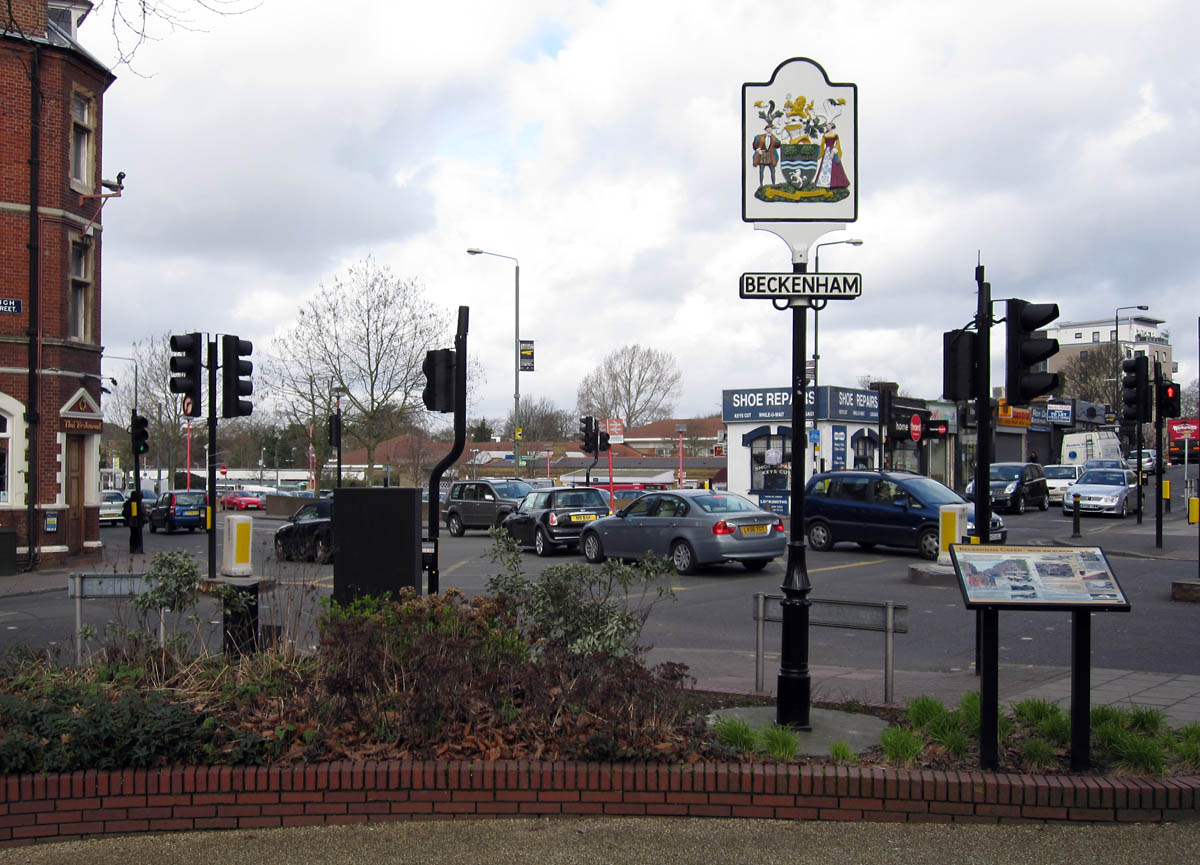
The Beckenham Village sign on Beckenham Green
On 11 March, Ewa Prokop led a walk along part of the Beck Corridor, which in its entirety runs between the London Loop and the Capital Ring (which sounds as though it would really have liked to be called the London Loop, but the name was taken; though as they were both conceived in 1990, I don't actually know which got in first.)

The Beck Corridor follows the route of the river Beck, which probably got its name from the village, rather than the other way around as one might think.  When the railway arrived in 1857, the little village of Beckenham began to grow, and is now a small town, a suburb of London.  But it likes being a distinct community, and this is the village sign at Beckenham Green, just by the church, where the walk started. Beckenham Junction station is visible over the crossroads.
An old signpost in Beckenham

We looked around the churchyard, which was full of old graves and their stones and enclosures.  Everywhere were plants and flowers, some cultivated and some wild, growing over and around the stones and memorials.  Primroses and celandines were in flower.  Some might say this looks unkempt, but it is good for biodiversity.  And the churchyard was not neglected; potentially damaging baby trees were cut back.

We left through the 13th century lich gate (much restored) and walked through the town, past the old signpost in the second photo, to Kelsey Park.

This is a wonderful park to find in a suburb.  It contains two lakes formed by damming the Beck, which are full of bird life in daytime and bat life at night.  I have seen Daubenton's Bats as well as common and soprano pipistrelles.  (But not on this walk. At night, in summer.) 

The photo below was taken at the Beckenham end of the park, where the gate is dedicated to Tom Edward Thornton, 1857-1933, "former editor and proprietor of The Beckenham Journal, through whose efforts this park was acquired in 1913 for the enjoyment of the public."   There is a lot of local history not readily available on line. 
Ewa Prokop and a walker by the east gate of Kelsey Park, Beckenham

There is an ice-house at the far end of the park which originally belonged to the Kelsey Manor Estate.  There are several ice-houses and ice-wells scattered around the borough of Bromley, probably one for each estate.  This one would have been supplied from the lake. 

Over the road from the park is the entrance to the Harvington Estate, another woodland through which the Beck runs.  There is still a line of Scots Pines which probably lined the original driveway.  The big old cedar in the next photo would have been close to the house. 

You can just about make out at the base of the cedar how the hollows have been filled with concrete and wire mesh. This method of caring for trees is not followed these days. The trees are strong enough without it, and decay fungi are just as likely to be trapped behind the concrete as they are to get into the tree without it.
Ewa Prokop and a walker by a big cedar in the Harvington Estate

The trouble with photography on overcast winter days under trees is that there isn't enough light for real sharpness with my little digital camera. I don't have any really standout shots from this walk.  Photos like this one of Ewa are a little bit fuzzy.

Past the estate, we walked through Harvington Park and then along some roads to High Broom Wood.  This is a stretch of ancient woodland along the Beck.  It is surrounded by houses and estates, so does not get the kind treatment it deserves.  There are some new tree sculptures in the park, and one has already been vandalised; a dragonfly's wings have been broken off.   But the park has a "friends" group, and is clearly managed.

High Broom Wood is a wet woodland, or carr, and has many alders. Their purple leaf buds and purple catkins were quite colourful close up.  Those shown below seem to be unopened, and you can see the rounder female catkins from last year in the background. There are some willows and also a great deal of pendulous sedge, which can be a real pest in a damp garden as they reproduce and grow at a great rate. (Personal experience there.)

Male alder catkins, apparently unopened, on a fallen branch in High Broom Wood
Male alder catkins on a fallen branch in High Broom Wood

We also saw celandines, wood anemone and wood sorrel, all in flower, and lots of bluebells growing up strongly.

Part way through High Broom Wood, the walk ended, and we split up to make our various ways home.