 |
| Female goat willow catkins on Hayes Common |
Friday, 8 April 2011

Wednesday, 6 April 2011

Tuesday, 5 April 2011
Apollo from Didyma
 |
| Bronze AE18 of Miletos in Ionia, c. 200 BCE |
These statues are well known now, as they were then, largely because copies were widespread. It is only these copies, and sometimes only descriptions, that have survived into the present. Copies were installed as decorative works in public buildings and even in the more luxurious private houses and gardens, particularly in Roman times; just as you can find some "classical" statues even now in garden centres. To have such famous and impressive works of art, even as copies, would have added prestige.
Several of these were also reproduced on ancient coins. For example, the poses known as Apollo Musagetes, Apollo Lykeios, Apollo Sauroktonos and Apollo Smintheos. I have a web page on Apollo on ancient coins which shows these among other Apollo images, and tells a bit more about them.
The coin shown here is quite scarce. It shows a cult statue of Apollo from a sanctuary in Didyma, and hence often known as Apollo Didymaios. Didyma (now Didim in Turkey) was in Ionia, close to the town of Miletos and within its territorial boundaries, and because it was a famous oracular centre it was honoured - and advertised - on Miletos' coins. The ability to foretell the future was one of Apollo's powers; the most renowned oracle in the ancient world, at Delphi, was at a temple of Apollo, and the centre at Didyma was almost as well known.
Apollo is holding a stag on his outstretched right hand, and has his bow in his left. The huge original statue was in bronze, and was created by a sculptor from Sikyon in Corinthia called Kanachos, in the late 6th century BCE. Kanachos is also known to have created another statue of Apollo in Thebes, this time of wood.
The history of the sanctuary at Didyma, its mythical origins and eventual destruction, is long and involved and I will not repeat it here. You can read some of it in this post by Jochen on the Forum Classical Numismatics Discussion Board. And for a detailed look at another Apollo type on ancient coins, here is Pat Lawrence's study of Apollo Sauroktonos on ancient coins.
Monday, 4 April 2011

Sunday, 3 April 2011
Spring Ponds in Jubilee Country Park
 |
| Jenny Price addressing the group by a pond in Jubilee Country Park |
The park has half a dozen ponds scattered around, some in the open and some in woodland, some permanent and some which dry up in summer. Even those temporary ponds are valuable for wildlife. For example, amphibians don't need open water all year round, just somewhere to lay their eggs that stays wet long enough for the tadpoles to metamorphosise.
 |
| Great Crested Newt in Jubilee Country Park on 3 April 2011 |
However, a successful population of amphibians requires a metapopulation, that is, a group of local populations that interact, and preserve the various species on one or more sites even when other sites might be subject to local disasters. Jubilee Country Park probably has enough ponds to form such a metapopulation, and there are other ponds in the local area which will also interact.
Britain has six native species of amphibians (some would say seven, but the native status of the pool frog is dubious) and all six can be found in this park. And we saw all three species of newt on this walk. The park's regular wildlife surveyors, last seen finding us some small mammals, showed us even the scarce and protected great crested newt. This specimen is male, but it is too early in the year for its distinctive crest to be fully developed.
 |
| Smooth Newt in Jubilee Country Park |
The palmate newt, which likes a woodland environment, moved too fast for successful photography, but I did get a shot of the more common smooth newt.
I used to have these in a tiny pond in a house I once lived in. I know from then that while newts will disappear as soon as they see you coming, if you wait they will come back to the surface to breathe, then disappear again into the depths.
In the case of the loosestrife pond, much of which is full of very muddy water, they can only be seen at all when they have this quick breather. There's a photo of this pond in my post on the recent Thornet Wood and Sparrow Wood walk. There are still tadpoles to be seen here, though many fewer than even a week ago.
 |
| The group at Ray's Pond, Jubilee Country Park |
We then moved on to spend some time at Ray's Pond, which was created only 18 months ago with the help of a grant from Veolia, the company that runs waste disposal and recycling in Bromley and many other places too. A Veolia dustcart recently sprayed my house, car and shrubs with quantities of hydraulic oil, so it is only fair that they also do something positive for the environment.
Ray's pond is lined with a tough plasticised material, and has filled naturally with rainwater, so there is no reason why it should not be a permanent pond, at least for as long as the lining lasts. Old maps show that there has been a pond there in the past.
 |
| Ray's Pond in Jubilee Country Park on 3 April 2011 |
It was planted with species that occur locally, and already has plenty of wildlife. In fact somone seems to have added a couple of goldfish, and if these are not found and removed (perhaps by the local herons?) they will severely reduce the wildlife value of this pond.
The group were shown a range of insects and their larvae, including dragonfly larvae. I saw an adult Acilius sulcatus swim past; this is a large beetle with distinctive legs that look and act like a pair of sculls. We also saw some late frogspawn (frogs lay first, then toads, then newts) and I am including a photo of some spawn of the common toad, forming a string wound around the stem of a water plant.
The plants in the pond include marsh marigolds, looking like giant buttercups, brought from High Elms; purple loosestrife brought from the loosestrife pond; flag iris, bog bean and a couple of others; and they all seem to be doing well. I saw some duckweed scattered around, which it is hoped will not become pestiferous.
In the background of this photo of Ray's Pond you can see the old elder that was shown in my post on Thornet Wood and Sparrow Wood just over a week ago. The dry woody plant on the left of the pond is purple loosestrife, showing last year's dead stems and now sprouting healthy new growth from its base.
Here are a few more images.
 |
| A glade in Thornet Wood, Jubilee Country Park, full of wood anemones. |
 |
| Marsh marigolds, sometimes called kingcups, in Ray's Pond, Jubilee Country Park |
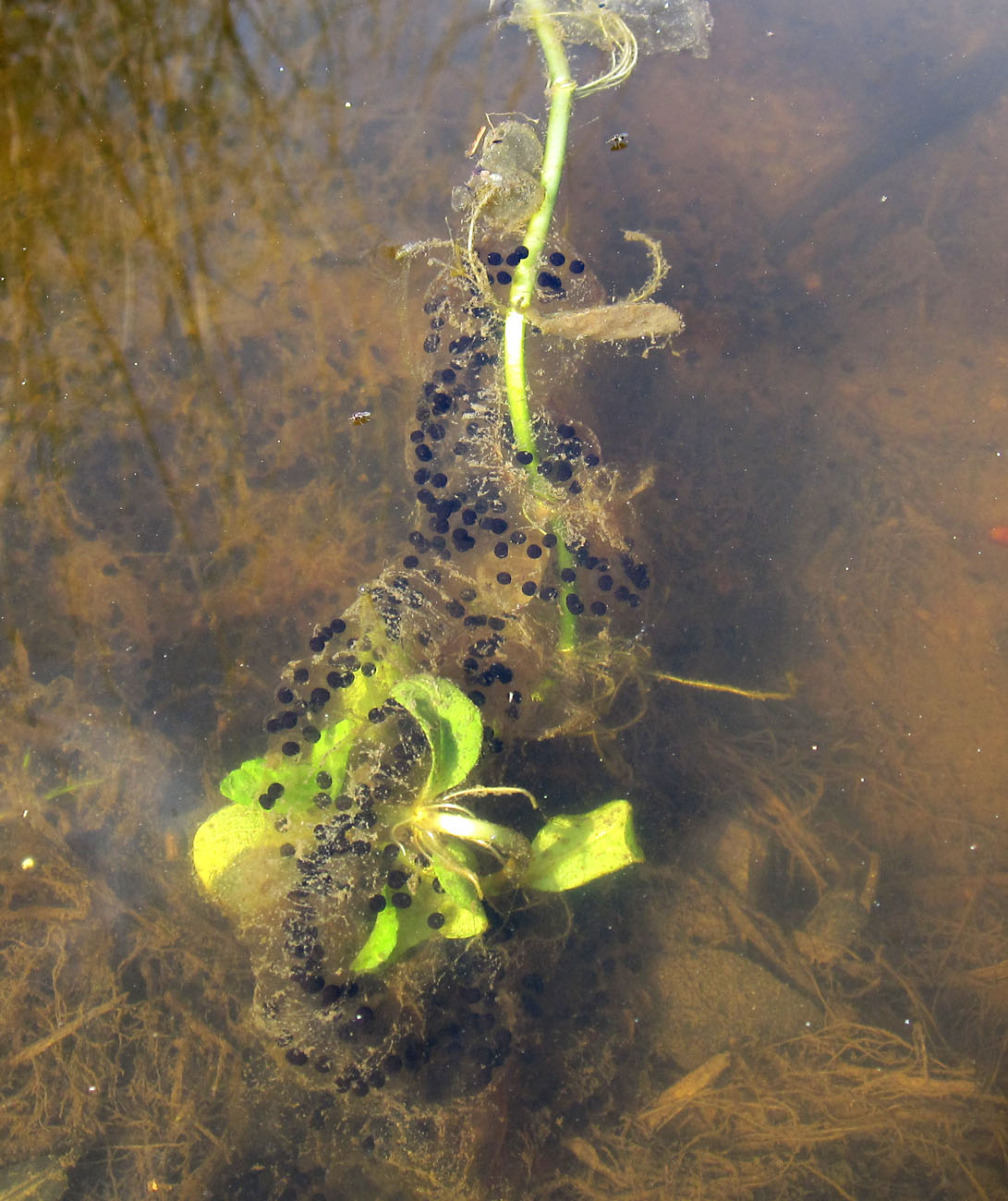 |
| Toadspawn wrapped round a plant stem in Ray's Pond, Jubilee Country Park, on 3 April 2011. |
Saturday, 2 April 2011

Friday, 1 April 2011

Subscribe to:
Posts (Atom)