Sunday, 18 March 2012

Two Early Moths

Hebrew Character, Orthosia gothica.  Noctuid.  In my moth trap in Hayes on 9 March 2012.
Hebrew Character, Orthosia gothica.  Caught in my moth trap in Hayes on 9 March 2012.
I have been putting my moth trap out over the winter, on days which seem milder than most, and catching an occasional creature. Now, in March, some more moths are turning up.

This first one is the Hebrew Character, named after that wing marking which looks a little like the Hebrew letter Nun, נ, and has something of the style of the Hebrew alphabet.

Some would disparage the second one as an LBJ, or "little brown job." But that does it a disservice. The wings, though muted in tone, are clearly marked and the whole thing looks very smart.

Common Quaker, Orthosia cerasi.  Caught in my moth trap in Hayes on 11 March 2012.
Common Quaker, Orthosia cerasi.  Caught in my moth trap in Hayes on 11 March 2012.
I picked up a rough piece of bark in Scords Wood and I have been using it as a background for some of my moth photos. So far it's quite effective.

Thursday, 15 March 2012

Pupae

Pupae of the Eyed Hawkmoth, Smerinthus ocellata.  Orpington Field Club AGM, BEECHE, 10 March 2012.
Pupae of the Eyed Hawkmoth, Smerinthus ocellata.  Orpington Field Club AGM, BEECHE, 10 March 2012.
At the Orpington Field Club Annual General Meeting, one of the interesting features was these moth pupae brought in by one of the members.

When moths that have been trapped are kept in jars for study (to be released unharmed afterwards), sometimes they might lay eggs. If you keep those eggs and feed the larvae when they hatch, they will grow, pupate, and eventually emerge as adult moths.

This member had managed to rear three different moths this way. Not bad going for someone who only started trapping moths last year.

Pupae of the Poplar Hawkmoth, Laothoe populi. Orpington Field Club AGM, BEECHE, 10 March 2012.
There were many more than those in the photo; I just took two representative examples from each tray. The Hawkmoth pupae were impressive, over 3 cm long, and they can wriggle, flexing at the joints between segments, which must be a shock if you're holding one.  The caterpillars are correspondingly large and hungry, and must be fed each day with fresh leaves.  Goat Willow would probably do, though, no surprise, the Poplar Hawkmoth likes Poplars.

The Muslin Moth pupae below are much smaller; the caterpillars will eat several herbaceous plants.

Pupae of the Muslin Moth, Diaphora mendica. Orpington Field Club AGM, BEECHE, 10 March 2012.

Monday, 12 March 2012

Beech Fingers

Beech roots like a hand groping into the ground.  Toys Hill, 3 March 2012.
Beech roots like a hand groping into the ground.  Toys Hill, 3 March 2012.
A startling formation of roots, looking a little like a hand groping into the ground, probably more so than an oak tree I posted last year. I know two people with some fingers fused on one hand, so this might look more lifelike to me than to most.

Friday, 9 March 2012

Lumpy Bracket

Lumpy Bracket, Trametes gibbosa.  The Knoll, Hayes, 18 January 2012.
Lumpy Bracket, Trametes gibbosa.  The Knoll, Hayes, 18 January 2012.
This is apparently quite a common fungus, but it had me stumped, just because there are so many different fungi in the books that I missed it;  and the actual specimens hardly ever look exactly like the books' photos. This one is growing on the top of a Beech stump in one of my local parks.

The scientific name comes from a Latin word meaning humped or hunched, which you can also see in the word gibbous, applied to the moon when it is more than half full. And it often does have that big lumpy hump in the middle. The green shade is where algae have grown on the surface, which is hairy when it is young, giving purchase for the algae to grow.

It is tough, with a texture like stiff rubber.

Lumpy Bracket, Trametes gibbosa, showing the underside.  The Knoll, Hayes, 18 January 2012.
Lumpy Bracket, Trametes gibbosa, showing the underside.  The Knoll, Hayes, 18 January 2012.
I was able to pull up the edge like this, but it took some force, and it snapped back into place when I let it go. The pores are large and conspicuous, and indeed this is the same genus as the Turkeytail, which has visible pores, and is not a Ganoderma, which are large brackets similar to this in general appearance but with what looks to the eye like a plain white underside.

In places, the pores are visible at the top of the fungus. You can see some on the left of the first photo. I think this must be where slugs or snails have browsed away the top layers.

Lumpy Bracket, Trametes gibbosa.  Cross-section.  The Knoll, Hayes, 26 January 2012.
Lumpy Bracket, Trametes gibbosa.  Cross-section.  The Knoll, Hayes, 26 January 2012.
I went back on another day with a very sharp knife and cut out this wedge. You can see that the pores are nowhere near the top on the untouched growth.

Tuesday, 6 March 2012

Toys Hill, March

View from Scord's Wood, 3 March 2012.
On another rainy and drizzly day the Orpington Field Club walked some of the trails around Toys Hill, looking in particular for mosses and liverworts.

We saw quite a few. I had seen some of the mosses before, but I was surprised by all the different liverworts, which are so inconspicuous and moss-like that I have probably seen them many times without realising it. I will put about a dozen moss and liverwort photos, as well as these and other photos from the walk, in this folder if anyone wants to see them all: Toys Hill photos.

Here is a sample.

Atrichum undulatum.  Toys Hill, 3 March 2012.
Atrichum undulatum.  Toys Hill, 3 March 2012.
This is one of a group of mosses that grow in clumps with a robust and starry appearance. Some, the Polytrichums, have opaque leaves and have hairy caps over the young spore capsules; these have translucent wavy leaves and hairless caps.

Mnium hornum with capsules.  Toys Hill, 3 March 2012.
Mnium hornum with capsules.  Toys Hill, 3 March 2012.
Mnium hornum is a common moss. This clump is full of spore capsules.

Diplophyllum albicans, a leafy liverwort. Toys Hill, 3 March 2012.
Some liverworts have flat lobes, and some are leafy, like this one, and hard to tell from mosses when they have no spore capsules. When they do, you can see that the capsules are rounded and dark brown or black, and the setae that bear them are fragile and temporary.

Lophocolea species.  A liverwort that smells of disinfectant.  Toys Hill, 3 March 2012.
Lophocolea species.  A liverwort that smells of disinfectant.  Toys Hill, 3 March 2012.
This Lophocolea is spreading over a tree stump, and you can see some of the round capsules and whitish setae. This one is also unlike a moss in that if you drag a fingernail over it, it smells strongly of disinfectant.

We also saw some fungi, including one I had not seen before:

Bitter Oysterling, Panellus stipticus. Toys Hill, 3 March 2012.
This fungus was supposedly once used to stem the flow of blood. We also saw many more of the Scarlet Elfcups that I first saw back in February; some of these were noticeably larger, as much as 5cm across.
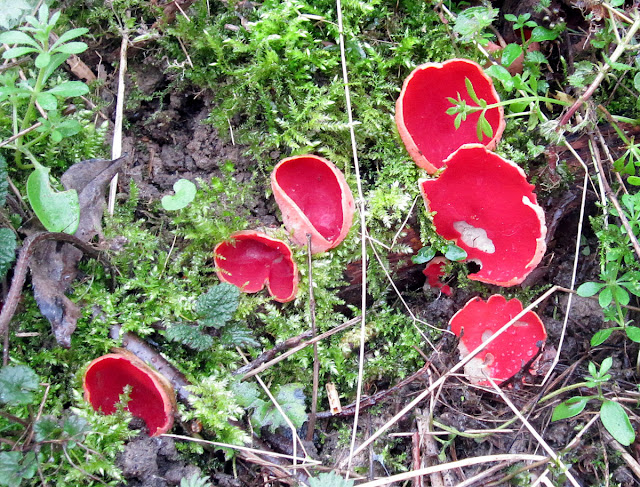
Scarlet Elf-cup, Sarcoscypha coccinea (confirmed to be the local species the previous year).  Scord's Wood, 3 March 2012.
Scarlet Elf-cup, Sarcoscypha coccinea.  Scord's Wood, 3 March 2012.
I would not want you to think that we only saw mosses, liverworts and fungi. The woods were full of new growth. There were hillsides covered with bluebells, but only a few scattered plants were in flower. Primroses flowered by the paths, and there were small specimens of the so-called Golden Saxifrage in many places.  I didn't get decent photos of any of them.  There were ferns, including this one, which was on a clay bank:

Hard Fern, Blechnum spicant. Toys Hill, 3 March 2012.
Its fronds are branched once, with simple pinnae, unlike many of our ferns which are branched twice or three times. And Hazel catkins were abundant.  The tree in the centre of the top photo is full of them.  On the way back we passed an old water tower, which has been converted into a bat tower. There is a superb echo if you hoot into the doorway, and few could resist having a go.

Investigating the echo in the Bat Tower. Toys Hill, 3 March 2012.
As we approached the car park, the sun came out! But once again, because of the rain I didn't take my big camera. I wished I had it for a lot of these closeups. The two scenic views were taken with my iPhone, and the rest with my Ixus 100.

Sunday, 4 March 2012

Christmas Rose

Christmas Rose, Helleborus niger, in my back garden in Hayes on 24 February 2012.
A single photo of a flower in my back garden that, as with many unobtrusive flowers, is quite lovely when looked at close up and in detail.

Thursday, 1 March 2012

Moths in February

Three Chestnuts, Conistra vaccinii.  Noctuids. Moths trapped in my back garden in Hayes on 24 February 2012.
Three Chestnuts, Conistra vaccinii, trapped in my back garden in Hayes on 24 February 2012.
With a brief spell of unusually warm weather for February, I put my trap out and found these winter fliers, dark brown and looking very glossy. There was also a micromoth in the trap, and I found another of the same in my house that evening. This one was on a lightshade.

Agonopterix species (might be A. scopariella, A. heracliana or a couple of others; needs microscopic examination).  Micromoth.  In my house in Hayes in the evening. 24 February 2012.
Agonopterix species. Micromoth in my house in Hayes in the evening of 24 February 2012.
Just a tiny, rather undistinguished thing, but with some distinctive features. Unfortunately, there are several species with the same features, so I could only identify the genus. But there was another micromoth on the same night, this one on my window, looking more than most moths like a creature wrapped in a fur coat.  This one could be clearly identified (with the help of the iSpot site!).

Rufous-margined Button Moth, Acleris cristana.  Tortrix.   Micromoth caught on the outside of my back window in Hayes, 23 February 2012, and photographed again in the house the next night, 24 February 2012.  Manley says there are over 120 named forms!  But the tuft of scales on the wing is definitive here.
Rufous-margined Button Moth, Acleris cristana,
photographed on my wall on 24 February 2012.
These two photos were actually taken the next day; it got away in the house and I found it later sitting on the wall. At last it was sitting still!  Moths often tuck their antennae under their wings when resting.  There are numerous variations in the appearance of this moth, but the strange tufts of scales on its wings are definitive in identifying the species.

Rufous-margined Button Moth, Acleris cristana, showing the wing tufts.  24 February 2012.
Rufous-margined Button Moth, Acleris cristana, showing the wing tufts.  24 February 2012.
Both of these micromoths are only about a centimetre long.

Well, after weeks of catching nothing or occasionally one moth, it looks as though the season might be starting up again.