Sunday, 14 June 2015

Orchid Time

White Helleborine, Cephalanthera damasonium.  Flower showing yellow throat.  Downe Bank, 11 June 2015.
White Helleborine, Cephalanthera damasonium.  Flower showing yellow throat.  Downe Bank, 11 June 2015.
Wild orchids are flowering profusely on the chalk banks in Bromley (the London Borough Of, not the town).  This is a White Helleborine, one of the more common types, seen in many woods at the edge of pathways, which makes one think that like many plants it prefers the edge habitat.  In a place such as that it can have shelter from winds and the worst of the weather, yet not be completely shaded out.

Seldom do the flowers open widely enough to display this yellow throat.  But this was a particularly large specimen.

White Helleborine, Cephalanthera damasonium.  Downe Bank, 11 June 2015.
White Helleborine, Cephalanthera damasonium.  Downe Bank, 11 June 2015.
Usually the flowers stay closed, as most of these are; the plant is self-pollinating.

Near this plant were groups of Common Twayblades and Fly Orchids, both of which are also quite happy in full sun in the open.  This Fly Orchid was on a grassy bank.

Fly Orchid, Ophrys insectifera.  Downe Bank, 11 June 2015.
Fly Orchid, Ophrys insectifera.  Downe Bank, 11 June 2015.
This one is far from being self-pollinating, and has almost an orchid trademark system.  It is disguised as an insect and puts out pheromones that attract digger wasps.  When they try to mate with the flower, clumps of pollen grains known as pollinia become attached to the genuine insects and are transferred by them.  The plants are quite inconspicuous to the human eye and you need to look carefully to spot them among the grass.

In fact, several of our wild orchids have a disappointing appearance, even close up.  Here is one of the Common Twayblades I mentioned earlier.

Common Twayblade, Neottia ovata.  Downe Bank, 11 June 2015.
Common Twayblade, Neottia ovata.  Downe Bank, 11 June 2015.
A large and healthy specimen, with its single pair of leaves - the "tway blades" - prominently in view, but not exactly a stunner even though it is in full flower.

More orchids next time ...

Friday, 5 June 2015

More Mug Shots


Muslin Moth, Diaphora mendica.  Erebidae.   Hayes, 14 May 2015.
Muslin Moth, Diaphora mendica.  Erebidae.   Hayes, 14 May 2015.
 This Muslin Moth is a sort of Stan Laurel moth with a fetching tuft of hair; but it has no hands to run through it. 

Early Grey, Xylocampa areola.  Noctuidae.   Hayes, 24 March 2015.
Early Grey, Xylocampa areola.  Noctuidae.   Hayes, 24 March 2015.
The Early Grey lives up to its name; it is one of the first species to appear in the trap each year.  It does not have comb-like antennae, and like a lot of the Noctuidae it tucks them out of the way when at rest.

Yellow-barred Brindle, Acasis viretata.  Geometridae.   Hayes, 25 May 2015.
Yellow-barred Brindle, Acasis viretata.  Geometridae.   Hayes, 25 May 2015.
The Geometridae do not generally make good subjects for this kind of photo.  They look spindly and often unwell.  This Yellow-barred Brindle (which only appears yellow when it is old) is a fair example, and actually looks better than most.
Herald, Scoliopteryx libatrix.  Erebidae.   Hayes, 11 May 2015.
Herald, Scoliopteryx libatrix.  Erebidae.   Hayes, 11 May 2015.
This Herald, on the other hand, looks very smart, with those bright white dots highlighting the base of its antennae and some parts of its wings. 

Monday, 1 June 2015

Mug Shots

Lunar Marbled Brown.  Drymonia ruficornis.  Notodontidae.  West Wickham Common, 15 April 2015
Lunar Marbled Brown.  Drymonia ruficornis.  Notodontidae.  West Wickham Common, 15 April 2015
Here are a few frontal shots of moths, which can be very characterful.  This Lunar Marbled Brown is the same moth I showed a few posts ago, from the West Wickham Common light trap. 

Marbled Brown, Drymonia dodonaea.  Notodontidae.  West Wickham Common, 15 April 2015
Marbled Brown, Drymonia dodonaea.  Notodontidae.  West Wickham Common, 15 April 2015
And here is a close relative, a Marbled Brown, from the same trap a month later.  And from the same place and time:

Pale Tussock, Calliteara pudibunda.  Lymantriidae.  West Wickham Common, 15 April 2015
Pale Tussock, Calliteara pudibunda.  Lymantriidae.  West Wickham Common, 15 April 2015
A Pale Tussock, a lovely furry creature.  And one which is named after its appearance from this angle ...

Spectacle, Abrostola tripartita.  Noctuidae.  West Wickham Common, 15 April 2015
Spectacle, Abrostola tripartita.  Noctuidae.  West Wickham Common, 15 April 2015
A Spectacle.  Quite a few moths have a tuft of scales just behind the head, as you can see from the previous photos, but on this creature it is rather larger than average.  And then there are the false eyes  ...


Thursday, 28 May 2015

Insects and Flowers

Beetles, Byturus ochraceus, in a Bulbous Buttercup flower.  Darrick Wood, 11 May 2015.
Beetles, Byturus ochraceus, in a Bulbous Buttercup flower.  Darrick Wood, 11 May 2015.
 Just two photos this time.  I was pleased to get this shot of these tiny beetles.  Usually I find them with their heads buried in their food, which you can see that some of these are doing.  But one of them has its head clearly visible.

I am fairly sure of the species name, but not completely confident, so my apologies if it is incorrect.

Hoverfly, Sphaerophoria species, female, on Meadow Saxifrage, Saxifraga granulata.  Darrick Wood, 11 May 2015.
Hoverfly, Sphaerophoria species, female, on Meadow Saxifrage, Saxifraga granulata.  Darrick Wood, 11 May 2015.
I love hoverflies on flowers.  They provide great contrast in forms, textures and colours.  You can tell this Sphaerophoria is female because there is a gap between the two compound eyes.  It's not possible to identify the species from a photograph.  It's eating the pollen from the stamen of this Meadow Saxifrage - you can see its tongue reaching out.

Sunday, 24 May 2015

Flower Closeups

Fodder Burnet, Poterium sanguisorba ssp. balearicum.  Darrick Wood, 10 May 2015.
Fodder Burnet, Poterium sanguisorba ssp. balearicum.  Darrick Wood, 10 May 2015.
These are flower closeups.  They do not give an impression of the plants as a whole in any way, but they do show the beauty of detail.  The first is Fodder Burnet, a close relative of the more common Salad Burnet.  The heads have flowers of two different genders.  First, the female flowers open at the top.  You can see the red stigmas on the head in the middle.  Then the stamens droop out of the male flowers.
 
Wood Forget-me-not, Myosotis sylvatica.  The Knoll, Hayes, 10 May 2015.
Wood Forget-me-not, Myosotis sylvatica.  The Knoll, Hayes, 10 May 2015.
These Wood Forget-me-not flowers are a light sky blue, and are larger than those of the other wild Forget-me-nots. It's a common wildflower and can also be seen as a garden plant.  They seed themselves quite well in my own little garden.

Hoary Cress, Lepidium draba.  West Wickham Common, 11 May 2015.
Hoary Cress, Lepidium draba.  West Wickham Common, 11 May 2015.
Hoary Cress appears to be tolerant of salt.  I found this display at the edge of a main road.  It makes a white splash in much the same way that Cow Parsley lines country lanes.

Crosswort, Cruciata laevipes.  Field below Darrick Wood, 11 May 2015.
Crosswort, Cruciata laevipes.  Field below Darrick Wood, 11 May 2015.
Crosswort is easy to find in Bromley county.  Look for yellow patches in meadows.  The leaves are yellowish too, and the plant as a whole almost glows.  It grows well on the chalk, but this patch was in a clay meadow.

Field Horsetail, Equisetum arvense.  Fertile cone.  Field below Darrick Wood, 11 May 2015.
Field Horsetail, Equisetum arvense.  Fertile cone.  Field below Darrick Wood, 11 May 2015.
In the same field I found this much more primitive flower.  It's a fertile cone of a Field Horsetail, a plant that reproduces with spores rather than seeds, as ferns do.  Plants in this family are the distant descendants of those that turned into coal.  Their vegetative shoots look nothing like this!


Wednesday, 20 May 2015

Two Tiny Gems

Slender Parsley-piert, Aphanes australis.  Joyden's Wood, 27 April 2015
Slender Parsley-piert, Aphanes australis.  Joyden's Wood, 27 April 2015
Joyden's Wood is a very pleasant and varied environment.  You can walk through the woods, past an area of heath, or examine the very short grass in what is known as the Picnic Area.  There, you can find several tiny plants, two of which I have not seen anywhere else.  This is not because they are rare, but because you have to look hard to spot them!  The mosses in this photo will give you an idea of the scale. 

This green plant, Slender Parsley-piert, has flowers which are also green, helping its disguise.  In the top photo, it is in full bloom.  But it is widespread here, which helps it to be seen.

Slender Parsley-piert, Aphanes australis.  Joyden's Wood, 27 April 2015
Slender Parsley-piert, Aphanes australis.  Joyden's Wood, 27 April 2015
Here's an enlarged picture with flowers at the centre.  The lobes surrounding the flowers are oblong, distinguishing this from Alphanes arvensis, Parsley-piert without the slender, which has triangular lobes. 

This plant is widespread in the Picnic Area, but there is another which seems to be a lot less prolific.

Bird's-foot, Ornithopus perpusillus.  Joyden's Wood, 12 May 2015.
Bird's-foot, Ornithopus perpusillus.  Joyden's Wood, 12 May 2015.
You might think this Bird's-foot, having a coloured flower, would be easier to spot, but the whole rosette is only 3 cm across and the flowers are about 2mm each, so in fact you have to get down on your knees to be sure they are there at all.

Bird's-foot, Ornithopus perpusillus.  Joyden's Wood, 12 May 2015.
Bird's-foot, Ornithopus perpusillus.  Joyden's Wood, 12 May 2015.
The plant is named after the appearance of the seed pods, which will be along later.  It is a lot less common than the Slender Parsley-piert, but still has 44 known sites in Kent, for those prepared to get down and look. 

Saturday, 16 May 2015

More Late Spring Flowers

Common Bird's-foot Trefoil, Lotus corniculatus.  Hayes Churchyard.  4 May 2015.
Common Bird's-foot Trefoil, Lotus corniculatus.  Hayes Churchyard.  4 May 2015.
 Some more of what's flowering all around.  This Bird's-foot Trefoil even grows in lawns, as long as the owner doesn't use a selective weedkiller.  It's the seed pods that resemble a bird's foot; not visible yet.
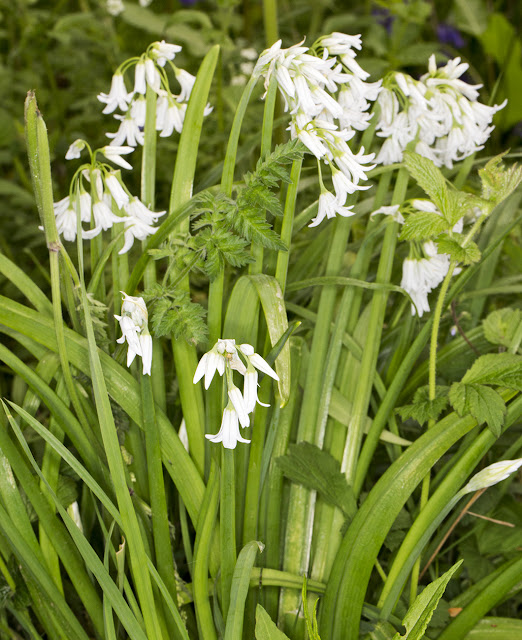
Three-cornered Leek, Allium triquetrum.  Roundabout Wood, 8 May 2015.
Three-cornered Leek, Allium triquetrum.  Roundabout Wood, 8 May 2015.
This Three-cornered Leek (or sometimes Garlic) has a strong oniony smell and is quite edible.  It turns up in many local woods and although it is decorative, it's an invasive pest, so why not eat it to death?  Well, local woods are usually well used by dog walkers, so some caution and a thorough washing would be advisable.

Danish Scurvygrass, Cochlearia danica.  Verge of Heathfield Road, Keston.    4 May 2015.
Danish Scurvygrass, Cochlearia danica.  Verge of Heathfield Road, Keston.    4 May 2015.
Many roads are lined by this small white flower, Danish Scurvygrass.  It spreads along the very edges of the grass verges because it is tolerant of salt and its seeds are spread by traffic, which taken together are making it very successful.  Without the roads it would just live at the coast.  It contains vitamin C and (it is said) used to be eaten by sailors to prevent scurvy.

Sheep's Sorrel, Rumex acetosella.  Keston Common, car park and grass nearby.  4 May 2015.
Sheep's Sorrel, Rumex acetosella.  Keston Common, car park and grass nearby.  4 May 2015.
This humble plant gives a reddish tint to areas of acidic grassland.  Those lovely leaves are described as "hastate."  That ought to mean "like a spear" but in botany, it means having the shape of a halberd.  But if you look up halberds, you will be hard pushed to find one of this shape.  So, that name for the shape is not entirely helpful.
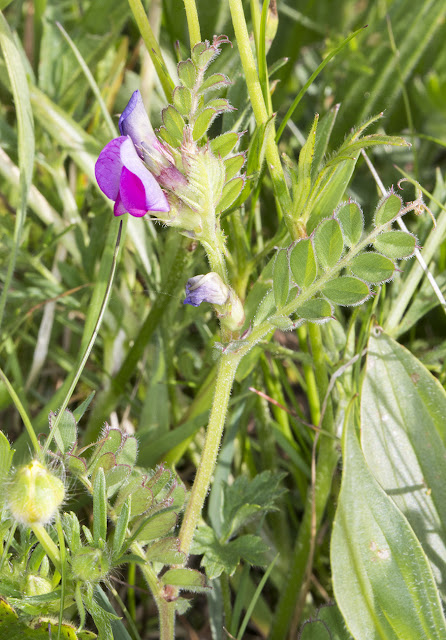
Common Vetch, Vicia sativa.  Keston Common, grass near car park.  4 May 2015.
Common Vetch, Vicia sativa.  Keston Common, grass near car park.  4 May 2015.
This is one of several vetch species in this area, and so far this year, the only one I have seen in flower. 

The last one today, Wood Speedwell, is similar to the Germander Speedwell shown in the previous post.  The differences are, this one has evenly hairy stems, leaves with stalks, and flowers which are more mauve than blue.  But they are close enough in appearance that many people confuse them, especially when not in flower.

Wood Speedwell, Veronica montata.  Roundabout Wood, 8 May 2015.
Wood Speedwell, Veronica montata.  Roundabout Wood, 8 May 2015.
Despite the Latin name montana, it does grow in the woods.