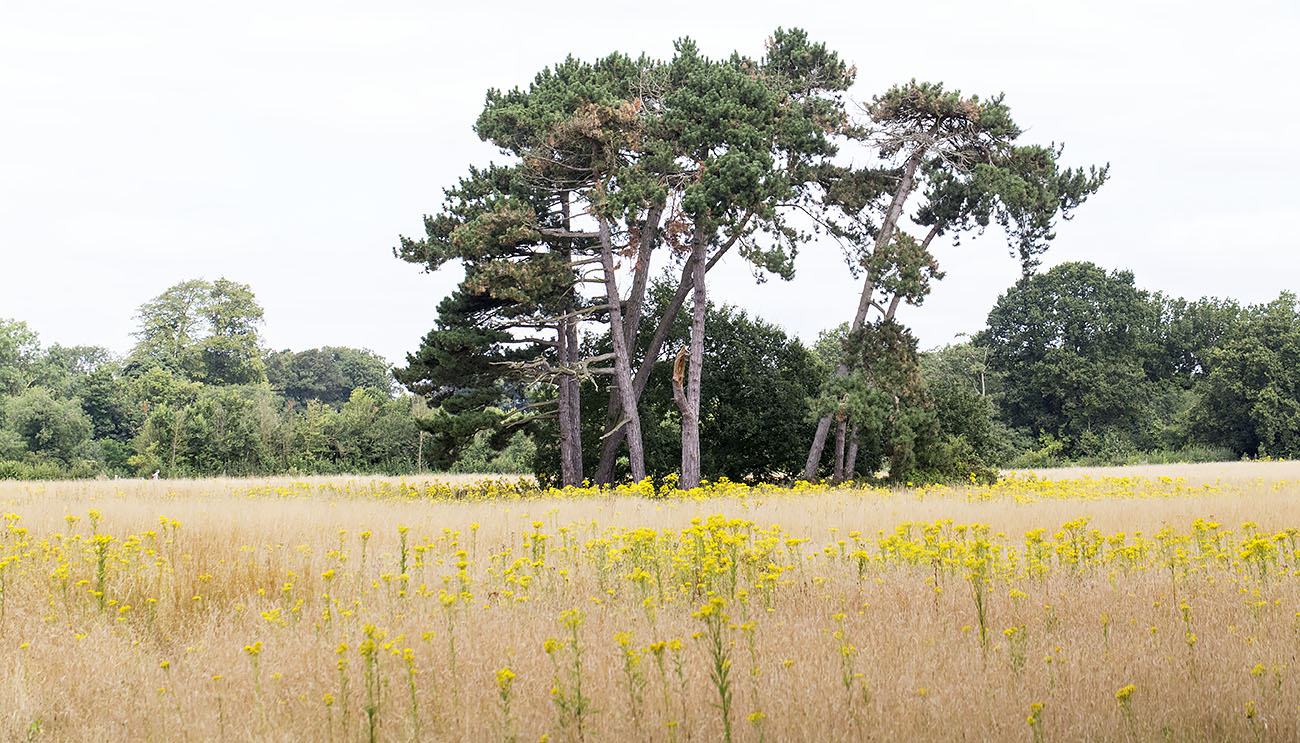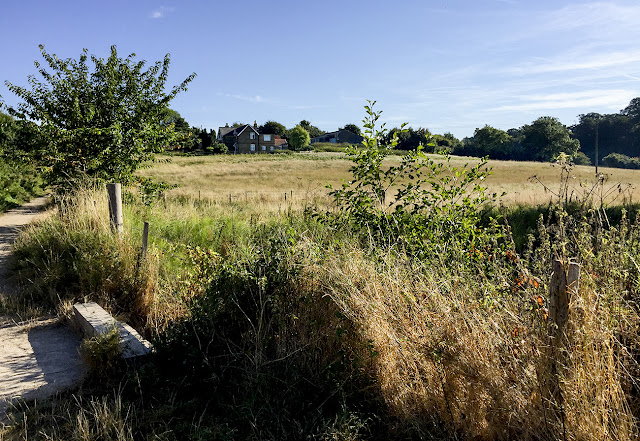
Friday, 9 September 2016

A Walk round the Hawkwood Estate - part 2 of 3

Tong Farm. Walk around the Hawkwood Estate 09, 30 August 2016.
This is the second part of a three-part walk around the Hawkwood Estate and the edge of Petts Wood, consisting mostly of iPhone photos taken on the way around.

Having walked alongside the Kyd Brook, I came to a T-junction.  Up the slope to the left is Tong Farm, a working farm open to the public.  The path up here also serves as a short cut back down from later in the walk.

Walk around the Hawkwood Estate 10, 30 August 2016.
I turned right along this shaded path between fields, towards the railway.

Railside path.  Walk around the Hawkwood Estate 11, 30 August 2016.
Railside path.  Walk around the Hawkwood Estate 11, 30 August 2016.
Then left along the side of the railway, which is well fenced off.  This path looks dry and well-drained now, but in wet weather it is another row of mud puddles.

View across the railway.  Walk around the Hawkwood Estate 12, 30 August 2016.
View across the railway.  Walk around the Hawkwood Estate 12, 30 August 2016.
The far side of the railway is populated by Rosebay Willowherb, Chamerion angustifolium, sometimes called Fireweed.  It grows freely on disturbed ground and used to be common in bomb craters in London.  I used to work over the road from what must have been just about the last undeveloped London bomb crater, near Ludgate Circus - it is now office buildings - and it certainly grew there.

Railway footbridge.  Walk around the Hawkwood Estate 13, 30 August 2016.
Railway footbridge.  Walk around the Hawkwood Estate 13, 30 August 2016.
This footbridge would take you over the railway to Jubilee Country Park, which has its own wartime history. (*)  I went around the steps and onwards.

Petts Wood sign.  Walk around the Hawkwood Estate 14, 30 August 2016.
Petts Wood sign.  Walk around the Hawkwood Estate 14, 30 August 2016.
This is the edge of Petts Wood, which gave its name to the neighbouring conurbation.  Despite what the sign says, there are no bye-laws on its back.  (I have a photo of the back, but I have left it out because it is boring, there being nothing there, so the photo numbers jump by one at this point.)

Wooden walkway.  Walk around the Hawkwood Estate 16, 30 August 2016.
Wooden walkway.  Walk around the Hawkwood Estate 16, 30 August 2016.
The National Trust does not build walkways like this unless the ground is usually a sea of mud.  Luckily, this has been a dry spell.

The gantry just visible at the top right is the last sight of the railway, as the walkway curves off to the left.

Petts Wood.  Walk around the Hawkwood Estate 17, 30 August 2016.
Petts Wood.  Walk around the Hawkwood Estate 17, 30 August 2016.
Up into woodland, now.  The path is broad, and obviously must be used by a lot of people, but they are clearly not all here at once.  I only came across half a dozen people on the whole walk, two of whom were running for exercise, and the others were walking dogs.

Remains of English bluebells, Hyacinthoides non-scripta. Walk around the Hawkwood Estate 18, 30 August 2016.
Most of the low woodland plants flower really early, to get the benefit of spring sunshine before the trees' leaf canopy blocks it all off.  This is all that remains of bluebells by this time of year.

Dry stream bed.  Walk around the Hawkwood Estate 19, 30 August 2016.
Dry stream bed.  Walk around the Hawkwood Estate 19, 30 August 2016.
 This is known as the wet part of the wood.  This dry runoff watercourse just emphasises again that we have been having a dry spell.  All that dry mud is usually wet mud.
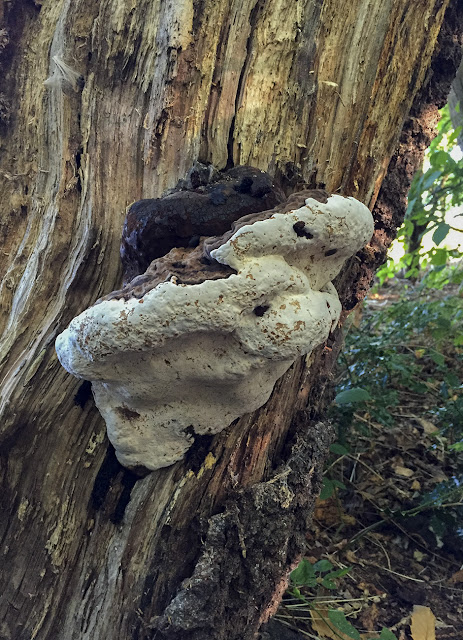
Ganoderma fungus.  Walk around the Hawkwood Estate 20, 30 August 2016.
Ganoderma fungus.  Walk around the Hawkwood Estate 20, 30 August 2016.
This is a tough fungus, hard to the touch, genus Ganoderma, growing on an old dead stump.  The white surface is composed of the pores for spore dissemination and can be easily marked.

Soldiering Field.  Walk around the Hawkwood Estate 21, 30 August 2016.
Soldiering Field.  Walk around the Hawkwood Estate 21, 30 August 2016.

The path turns out of the woods and between two fields.  The field on the right is known as the Soldiering Field.  It is where volunteers mustered and drilled in the 19th century.  Here is a view from the other side in 2014:

Soldiering Field, Hawkwood Estate, 30 July 2014.
Along that path I could not resist taking a closeup of a hoverfly.  

Hoverfly, Syrphus species.  Walk round the Hawkwood Estate, 30 August 2016
Hoverfly, Syrphus species.  Walk round the Hawkwood Estate, 30 August 2016
Adult hoverflies eat pollen, and this one is steadying an anther with its left foreleg while it uses its proboscis to gather the tasty food.

Into the trees again at the far side, where there is an area of heath.  Several plots in Petts Wood have been scraped and seeded with Ling heather.

Walk around the Hawkwood Estate 23, 30 August 2016.
This is the same species that covers the hills of Northumberland and Durham, where I grew up.

Rowan tree, Sorbus aucuparia.  Walk around the Hawkwood Estate 24, 30 August 2016.
Rowan tree, Sorbus aucuparia.  Walk around the Hawkwood Estate 24, 30 August 2016.
A left turn here takes you downhill.  Rowan, or Mountain Ash, is the most showy of the early berry trees and occurs in many woods.  Our two native Viburnums, Guelder Rose and Wayfaring Tree, are also full of berries but are smaller, and usually found on chalk.  Spindle is showier, but later, and also usually smaller.

Next time, back to the starting point!

Monday, 5 September 2016

A Walk round the Hawkwood Estate - part 1 of 3

Gosshill Road. Walk round the Hawkwood Estate, 01, 30 August 2016.
Gosshill Road. Walk round the Hawkwood Estate 01, 30 August 2016.
I'm going to show a walk around the Hawkwood Estate, taking in one edge of Petts Wood, in the same style as the Walk to Nash I posted in June.  That is, a sequence of iPhone photos of the route.  This time I will also include some closeups taken with my EOS 5DS.  As I am at least partly a botanist, I could not resist some photos of plants.

There are more than 40 photos this time, so I will post in 3 sections.  iPhone photos are numbered.  The others just slot in.

The quiet road in the first photo, Gosshill Road, is where a car can be parked.  Mine is on the right.

Walk round the Hawkwood Estate 02, 30 August 2016.
To start the route, I went through this narrow gap.  There's a plastic bag of dog poo on the stump which added its characteristic aroma to  the scene.  (This bag is not an essential part of this walk.)

The face of the felled trunk has some interesting fungi.  That day, they were covered with released spores that looked like brown dust.  In wet weather, with the spores washed off, you can see the odd shine on the top surfaces, and the yellow edge, that tell you it's Ganoderma pfeifferi, Beeswax Bracket.  Here is what it looked like when I was there in 2013:

Ganoderma pfeifferi, Beeswax Bracket.  22 December 2013.
Ganoderma pfeifferi, Beeswax Bracket.  22 December 2013.
Soon it became less ... well, doggy ... and I was walking through what looks like a neglected orchard.

Walk round the Hawkwood Estate 03, 30 August 2016.
The sun shone, all was lovely.  Past the small orchard ...

Walk round the Hawkwood Estate 04, 30 August 2016.
To the right was what looked like a field ready to be harvested for hay.  The trees mask a busy railway.  But if this is really for hay, the harvester needs to be careful.

Ragwort, Senecio jacobaea, on the Hawkwood Estate, 30 August 2016
There's a lot of Ragwort in the field.  This plant is poisonous and can harm horses and cows.  They don't eat it in the field because it tastes bitter, but apparently it loses this bitterness when dried in hay and so becomes dangerous.

The Kyd Brook.  Walk round the Hawkwood Estate 05, 30 August 2016.
The Kyd Brook.  Walk round the Hawkwood Estate 05, 30 August 2016.
To the left is a small, quiet, well-shaded stream, the Kyd Brook.  The Kyd Brook runs on towards London and becomes the River Quaggy, which then joins the Ravensbourne by Lewisham station.  The Ravensbourne runs on into the Thames.

The Kyd Brook.  Walk round the Hawkwood Estate 06, 30 August 2016.
The Kyd Brook.  Walk round the Hawkwood Estate 06, 30 August 2016.
This is the Kyd Brook looking upstream, in the direction of the walk.

I have been along this route in wet weather and the path along here was little more than a series of muddy puddles.  The weather has been dry recently, so the walk was much more pleasurable.

Bristly Oxtongue, Helminthotheca echioides.  Walk round the Hawkwood Estate 07, 30 August 2016.
Bristly Oxtongue, Helminthotheca echioides.  Walk round the Hawkwood Estate 07, 30 August 2016.
These large yellow-flowered plants in the field to the right are Bristly Oxtongue.  I don't know how palatable they are, but they are not poisonous.

Mugwort, Artemisia vulgaris.  Walk round the Hawkwood Estate 08, 30 August 2016.
Mugwort, Artemisia vulgaris.  Walk round the Hawkwood Estate 08, 30 August 2016.
To the left of the path, Mugwort is still in flower.  This is a relative of wormwood, the plant that supposedly drives people mad when used in absinthe.  But for this plant, my reference book (*) says "The leaves and flowering tops are used as a spice" if gathered when the flowers are still immature. 

The flowers are small, and look like this:

Flowers of Mugwort, Artemisia vulgaris.  Hawkwood Estate, 30 August 2016.
Flowers of Mugwort, Artemisia vulgaris.  Hawkwood Estate, 30 August 2016.
More to follow next time ...

(*) "Plants Consumed by Man" by B. Brouk.  Academic Press, London, 1975.  ISBN 0-12-136450 X.

Thursday, 1 September 2016

Common Lizard

Common Lizard, Zootoca vivipara.  Hutchinson's Bank, 26 August 2016.
Common Lizard, Zootoca vivipara.  Hutchinson's Bank, 26 August 2016.
This lizard is not supposed to be rare in England, though you certainly don't see it everywhere.  I see it hardly at all.  Perhaps I walk too fast, because several of my walks pass through its territory.

I saw some at Ranscombe Farm in 2012.  Since then none, until a few days ago I saw this one sunning itself on a gate at Hutchinson's Bank.

Common Lizard, Zootoca vivipara.  Hutchinson's Bank, 26 August 2016.
Common Lizard, Zootoca vivipara.  Hutchinson's Bank, 26 August 2016.
I was actually hoping to see a Clouded Yellow butterfly, an immigrant species that has come over the channel in good numbers recently.  I did see a couple, but was not able to get a photo.  But the lizard more than made up for that!

The UK only has three lizard species; this one, the Slow-worm and the rare Sand Lizard.  I've seen lots of the snake-looking Slow-worms.  Here is one from Keston Common.

Female Slow-worm, Anguis fragilis.  Keston Common, 14 May 2011.
Female Slow-worm, Anguis fragilis.  Keston Common, 14 May 2011.

And here is my other Common Lizard sighting, from 2012.

Common Lizard, Zootoca vivipara. Ranscombe Farm Country Park, 25 May 2012.

Tuesday, 30 August 2016

Out Come the Tiny Ones

Moths in my garden light trap, 25 August 2016.
The hot weather brings with it some really tiny moths, making identification of a night's catch very tricky.  This photo is from my garden trap.  Bottom right are a couple of big, showy Jersey Tigers.  Above them, left to right, are a Tree-lichen Beauty, a Chequered Fruit-tree Tortrix, a female Light Brown Apple Moth (on the diagonal strut), and an Elbow-striped Grass-veneer.


Those last two are quite small, but very distinctively marked, so I can identify them at a glance.  But the tiny dark thing at top right is also a moth.  It's one of a large family of tiny moths whose caterpillars live inside leaves, between the upper and lower skins, eating out their juicy centres and leaving a passage behind, so that they are known as leaf miners.  It is (I think) in the genus Stigmella.   These can not be identified to species without dissection.

Many of the tiny moths can only be taken to genus.

Parornix and Ectoedemia.  West Wickham Common light trap, 24 August 2016.
Parornix and Ectoedemia.  West Wickham Common light trap, 24 August 2016.
The larger of these two is itself so small that it just looks like a dark fleck to the eye.  The little one, which I think is an Ectodoemia, is something I only see as a moth when I enlarge photos and examine all the tiny imperfections close up.   It belongs to the same family as the Stigmella, the Nepticulidae.

Amateur trappers mostly used to ignore these smaller moths completely until 2012, when a decent field guide to them came out.  (*)  Another guide is also now available (**) which includes photos of all the British moths, and if you know roughly what you are looking at, you can get a lot of help from the UK Moths site.

(*) Field Guide to the Micro Moths of Great Britain and Ireland, by Phil Sterling and Mark Parsons, illustrated by Richard Lewington.  This relies on paintings and includes a key to genera, which is useful if you have a specimen and a low-powered microscope.  Otherwise, go through the pictures!

(**) British Moths, second edition, by Chris Manley.  This is a photographic guide and is enough better than the first edition that I use it a lot. 


Monday, 15 August 2016

So I like Thorns.

Dusky Thorn, Ennomos fuscantaria.  Hayes, 8 August 2016.
Dusky Thorn, Ennomos fuscantaria.  Hayes, 8 August 2016.
Yes, I like Thorns.  They are photogenic from any angle.  So here is a set of photographs of a single specimen, a Dusky Thorn in my garden light trap.

Dusky Thorn, Ennomos fuscantaria.  Hayes, 8 August 2016.

Dusky Thorn, Ennomos fuscantaria.  Hayes, 8 August 2016.

Dusky Thorn, Ennomos fuscantaria.  Hayes, 8 August 2016.

That's all!

Wednesday, 10 August 2016

Windy Woods


Oak tree by the railway path West Wickham to Hayes, 29 July 2016.
Oak trees are known for dropping branches unpredictably.  Where they grow near footpaths, site managers usually make sure that any overhanging branches are cut back, and you can see in this photo where that has been done.  But even though it has not been especially windy, a large branch has still torn itself away.

Fallen Oak branch by the railway path West Wickham to Hayes, 29 July 2016.
This is it, just behind the fence.  It might have fallen on or over the fence, or onto the railway just beyond the tree, or onto a train.  Oaks are unpredictable.

Scots Pine blown over by storm Katie at the edge of Woodland Way in Spring Park.  28 March 2016.
Scots Pine blown over by storm Katie at the edge of Woodland Way in Spring Park.  28 March 2016.
Of course, when there are high winds, all trees are susceptible.  This Scots Pine looked strong, but came down across a footpath during Storm Katie. 

Scots Pine blown over by storm Katie at the edge of Woodland Way in Spring Park.  28 March 2016.
Scots Pine blown over by storm Katie at the edge of Woodland Way in Spring Park.  28 March 2016.
The trunk has split.  Close examination showed signs of internal decay, a fungus infection that probably weakened it.

Scots Pine blown over by storm Katie at the edge of Woodland Way in Spring Park.  28 March 2016.
Scots Pine blown over by storm Katie at the edge of Woodland Way in Spring Park.  28 March 2016.
This is the inner face of a piece of one of the splinters, and that whitish substance is fungal mycelium.  Either it has taken advantage of an existing weakness, probably making it worse, or it has caused the weakness in the first place.

Danger during high winds is the reason why woodland walks are cancelled if it is too windy.

Later, I also saw this:

Fallen tree on Hayes Common, 28 April 2016.
Clearly something big has come down on top of the fence, probably also a victim of Storm Katie, and has been partly tidied up. 


Saturday, 6 August 2016

Thorns.

Purple Thorn, Selenia tetralunaria.  Hayes, 30 July 2016.
Purple Thorn, Selenia tetralunaria.  Hayes, 30 July 2016.
I think that Thorns are the most photogenic of British moths, and the Purple Thorn probably the most lovely of them.   Here are some Thorns.  Some of them have probably been posted before, but it's worth seeing them together.

Early Thorn, Selenia dentaria.  Hayes, 4 August 2016.
Early Thorn, Selenia dentaria.  Hayes, 4 August 2016.
The Early Thorn comes twice a year, in April and May, and again in August and September.  This is because it can go through its complete life cycle twice a year.  Unlike other Thorns, it typically poses with its wings tight together above its back, like a butterfly.

Canary-shouldered Thorn, Ennomos alniaria.  Hayes, 20 July 2017.
Canary-shouldered Thorn, Ennomos alniaria.  Hayes, 20 July 2017.
The Canary-shouldered Thorn is named for the bright yellow furry appearance of its head and thorax.

Feathered Thorn, Colotois pennaria.  Hayes, 14 November 2015.
Feathered Thorn, Colotois pennaria.  Hayes, 14 November 2015.
The Feathered Thorn, a later arrival than most, likes to lie flat.

Little Thorn, Cepphis advenaria.  Oldbury Hill, 10 June 2012.
Little Thorn, Cepphis advenaria.  Oldbury Hill, 10 June 2012.
I saw this Little Thorn on a mothing trip to an old wood at Oldbury Hill.

August Thorn, Ennomos quercinaria.  Hayes, 25 July 2016.
August Thorn, Ennomos quercinaria.  Hayes, 25 July 2016.
The August Thorn sometimes also lies flat like the Feathered Thorn.

Dusky Thorn, Ennomos fuscantaria.  Hayes, 3 September 2014.
Dusky Thorn, Ennomos fuscantaria.  Hayes, 3 September 2014.
But the Dusky Thorn, like the pettiest Thorns, holds its wings cocked at an angle.  In fact I'll show that more clearly:

Dusky Thorn, Ennomos fuscantaria.  Hayes, 3 September 2014.
Dusky Thorn, Ennomos fuscantaria.  Hayes, 3 September 2014.
Like so!

But I will finish with another shot of my favourite.

Purple Thorn, Selenia tetralunaria.  Hayes, 30 July 2016.
Purple Thorn, Selenia tetralunaria.  Hayes, 30 July 2016.
In photography, it's easy for surrounding objects to reflect their colours onto the subject of the photo and distort subtle shades.  That's why I try to use neutral grey egg boxes in my traps.  Moths photographed inside my wooden trap or on pieces of bark suffer from this.  This last photo does not have a pretty background, but the clear plastic allows the true colours of the moth's wings to show up.  It's easy to lose that light mauve shade that gives this Purple Thorn its name.