Wednesday, 16 November 2016

New This Year

Streamer, Anticlea derivata.  On the wall above my garden light trap in Hayes on 2 May 2016
Streamer, Anticlea derivata.  On the wall above my garden light trap in Hayes on 2 May 2016
I've been catching moths in my garden for five years, in a fairly basic light trap, and I still get new species to add to my list.  There were 22 new species this year.  Some of them I had already seen elswehere, but others were completely new to me.  That doesn't mean they are rare!  There are about 2,500 species of moth in the UK and a lot of them, often quite common ones, just don't live near me or only arrive occasionally.

Here are a few of this year's new arrivals.

The Streamer's caterpillars feed on dog-roses and the adult arrives quite early in the year.  I had not seen one of these before.

Light Brocade, Lacanobia w-latinum.  In my garden light trap in Hayes on 13 May 2016.
Light Brocade, Lacanobia w-latinum.  In my garden light trap in Hayes on 13 May 2016.
Light Brocades have turned up a few times in the West Wickham Common trap, about a mile away, but this was the first one in my garden.  Its caterpillars eat broom and related plants, and there's not much of those off the commons.

Esperia sulphurella.  Male.  In my garden light trap in Hayes on 21 May 2016.
Esperia sulphurella.  Male.  In my garden light trap in Hayes on 21 May 2016.
The so-called micromoths – and some of them are indeed extremely small, much smaller than this, which has a 15mm wingspan – usually turn up in the middle of the year, so it's nice to see some early on.  I had not seen this Esperia sulphurella before, though it's not rare.  The caterpillars eat dead wood.

Metalampra italica.  In my garden light trap in Hayes on 20 July 2016.
Metalampra italica.  In my garden light trap in Hayes on 20 July 2016.
Metalampra italica was first seen in England in 2003, but now seems to have established breeding colonies.  It still arrives as an immigrant, and that's probably how this got into my garden.  This was a nice catch.  It's another micromoth, with a 12mm wingspan.  Again, the caterpillars eat decaying wood.

Lesser Swallow Prominent, Pheosia gnomaIn my garden light trap in Hayes on 31 August 2016.
  Lesser Swallow Prominent, Pheosia gnomaIn my garden light trap in Hayes on 31 August 2016.
I've seen Lesser Swallow Prominents in a number of places, but this was the first to come to my garden trap.  Its caterpillars eat birch, and, like the trees, the moths are common.  They are smart-looking creatures and, despite having "lesser" in their common name, are quite large, with a wingspan up to 50mm.

I'll post some more next time.

Friday, 11 November 2016

Filming at Downe Bank

Irene Palmer and Tony Robinson being filmed on Downe Bank.  6 July 2016.
Irene Palmer and Tony Robinson being filmed on Downe Bank.  6 July 2016.
Back in July I watched Irene Palmer and Tony Robinson being filmed for a section of his "Britain's Ancient Tracks with Tony Robinson" series.  Now it has been broadcast, my photos are out of embargo.

Irene, our local orchid expert and also currently chair of the Orpington Field Club, was showing how Darwin investigated the way orchids are pollinated, and she was able to collect pollinia from a Common Spotted Orchid  using a pencil as Darwin did.  From this distance all you can see is the pencil, and in the film itself the little pollen packet was only just visible.

All the photos I took during the actual filming were taken from a distance – I was warned away so that my camera clicks didn't spoil the sound track.  Absolutely all of my photos suffered from the high contrast caused by the brilliant sunshine.  Look at the cameraman's arm in that first photo.  The sequence was filmed in the shade to avoid this contrast problem, and so that the participants wouldn't squint all the time.

Irene Palmer and Tony Robinson being filmed on Downe Bank.  6 July 2016.
Irene Palmer and Tony Robinson being filmed on Downe Bank.  6 July 2016.
I also took a few shots at the top of the bank before the filming, and there I was able to use Photoshop to tone down a lot of the contrast.  Raw photos taken on a good camera allow a lot of latitude for adjustments.

Irene Palmer and Tony Robinson before filming on Downe Bank.  6 July 2016.
Irene Palmer and Tony Robinson before filming on Downe Bank.  6 July 2016.
Here, Tony Robinson is apparently sorting out some sun-block.

But during the filming I also spent some time looking for butterflies on orchids.  I saw a lot of Marbled Whites on Pyramidal Orchids, which will have disappointed them as those orchids have no nectar.

Marbled White, Melanargia galathea, on Pyramidal Orchid, Anacamptis pyramidalis.  6 July 2016.
Marbled White, Melanargia galathea, on Pyramidal Orchid, Anacamptis pyramidalis.  6 July 2016.
This butterfly, with a golden band along the leading edge of its wings, is a female.

Marbled White, Melanargia galathea, on Pyramidal Orchid, Anacamptis pyramidalis.  6 July 2016.
Marbled White, Melanargia galathea, on Pyramidal Orchid, Anacamptis pyramidalis.  6 July 2016.
This one, browner and without the golden band, is a male.

I also spotted this pretty little Small Skipper on a Bird's-foot Trefoil. Much more rewarding!

Small Skipper, Thymelicus sylvestris, on Common Bird's-foot Trefoil, Lotus corniculatus.  6 July 2016.
Small Skipper, Thymelicus sylvestris, on Common Bird's-foot Trefoil, Lotus corniculatus.  6 July 2016.
That was the second time I have watched Irene being filmed explaining about orchids on Downe Bank.  The last time it was about the pollination of Fly Orchids, and as an assistant I got a whole 3 seconds of screen time (non-speaking) on The One Show!  So I'm a star.  But not as much of one as these butterflies.

Saturday, 5 November 2016

Fungus Season

Armillaria species, Honey Fungus.  Beckenham Place Park, 16 October 2016.
Armillaria species, Honey Fungus.  Beckenham Place Park, 16 October 2016.
 Autumn is the fungus season, when many species put out their fruiting bodies.  Although this year, we have had an unusually sunny and dry start to the season, and there are fewer fungi than usual.

But that is far from saying there are none.  This group are from Beckenham Place Park, which had a golf course, some parkland and a nice piece of ancient woodland. 

The first photo is a Honey Fungus.  These are parasites on living trees, and can also consume the dead wood when the tree dies, very handy for a destructive parasite.  Honey Fungus used to be classified as a single species, Armillaria mellea, but is now split into about 10 species, and I can't tell which this one is.  It is too scaly to be the remaining A. mellea. 

Chondrostereum purpureum, Silverleaf.  Beckenham Place Park, 16 October 2016.
Chondrostereum purpureum, Silverleaf.  Beckenham Place Park, 16 October 2016.
This is another destructive parasite, which causes silverleaf on plum trees.  I have seen it in an old orchard nearby.  The purple tint makes it easy to recognise at this stage.  There is another fungus that has small purplish brackets, but that only grows on dead conifer wood. 

Ganoderma resinaceum, Lacquered Bracket.  Beckenham Place Park, 16 October 2016.
Ganoderma resinaceum, Lacquered Bracket.  Beckenham Place Park, 16 October 2016.
Ganoderma is another genus that is parasitic on trees.  This one, Lacquered Bracket, is not the most common.   You can often see brackets like this on Beech; those are different species.  This one is on an Oak.  The books say it also grows on other species, but Oak is where I see it.

It's growing vigorously.  Those other species are perennial growths, and are nearly as tough as the wood they grow from, but this one is annual and is quite spongy.


Coprinellus micaceus.  Glistening Inkcap.  Beckenham Place Park, 16 October 2016.
Coprinellus micaceus.  Glistening Inkcap.  Beckenham Place Park, 16 October 2016.
This one is different.  These sparkly caps grow in grass and among trees.  They only last a few days, but there can be several flushes in the same locality.  It's not always this easy to identify, because the sparkles can wash off in a good rainstorm and there are a few other similar non-sparkling species.

Finishing with another tree dweller:

Grifola frondosa, Hen of the Woods.  Beckenham Place Park, 16 October 2016.
Grifola frondosa, Hen of the Woods.  Beckenham Place Park, 16 October 2016.
This "Hen of the Woods" is edible, and is said to be tasty.  It grows at the base of Oaks.  This is the first I have seen, though coincidentally I saw another in a different local wood not long after.  Not to be confused with the yellow brackets of "Chicken of the Woods," this one does look a bit like fluffed-out hen's feathers.

Friday, 28 October 2016

Crystal Palace Terraces

Crystal Palace Park terraces, 1990s.
There must have been more of these statues along the terraces, but this is the only one left.   It's in reasonable condition considering what has happened to the rest of the stonework, caused by age and vandalism.

Crystal Palace Park terraces,  10 August 2016.
Crystal Palace Park terraces,  10 August 2016.
Here's a wider - and current - view of the terraces.  You can see the same statue just off centre.  Those plinths used to have stone vases ...

Crystal Palace Park terraces and stone vases, 1990s.
.. And cement rendering.  Their loss is due to vandalism.

In the background of the first photo you can see two of the park's sphinxes.  (Sphinges is an acceptable alternative, but then I think, if sphinx, sphinges then why not hinx, hinges?)   They are all in decent condition but are currently being refreshed, and are fenced off, so photo opportunities are limited.

Crystal Palace Park sphinxes, 10 August 2016.
There are four in this photo.  Two more are at the other end of the terrace.  They were all cast from an original in the Louvre.

The park also has these features:

"Laptop" auditorium, Crystal Palace Park, 10 August 2016.
This auditorium replaced a "temporary" one in the 1990s.  It is designed to have that rusty finish.  It received two awards: Civic Trust Award 1998, and Royal Institute of British Architects Regional Architecture Award 1998.  Small plaques showing these are on the other side of the neglected stage.

Royal Naval Volunteer Reserve memorial bell.  Crystal Palace Park, 10 August 2016.
Royal Naval Volunteer Reserve memorial bell.  Crystal Palace Park, 10 August 2016.
This is a memorial to the fallen of the First World War.    There used to be explanatory plaques, but they have disappeared.  Luckily there are details on line.

Crystal Palace station.  Crystal Palace Park, 10 August 2016.
Crystal Palace station.  Crystal Palace Park, 10 August 2016.
And the Victorian railway station, between the park and Anerley Hill.  I used to go to work from here, at a time when one of the rooms was used as a chapel by the Old Catholic Church, a small offshoot of Catholicism.  I could look through the keyhole and see the rich appurtenances inside. (Or so I recall it.)

I also noticed not far from the park a "Coffee and Brunch Kitchen" offering "cake, wine and beer" and opposite that, an Artisan Chocolate Café. These are an easy walk from where I used to live and were not there at the time!

Finally, a view of the wall outside the park:


It does actually say C.P.P., but a bit of Photoshop makes it look quite exotic.

Friday, 7 October 2016

Crystal Palace Park Maze

Crystal Palace Park Maze entrance, 12 August 2016
Not much remains of the Victorian aspect of the maze in Crystal Palace Park.  The whole thing is hidden behind a screen of trees, and it was badly out of condition in the 1980s until it was replanted in 1987. 

You can just see through the gate that the hedge is not particularly tall, only waist high.  It doesn't block your view at all, but that doesn't make it easier to get to the centre.  There's an escape route straight out from there, but once you are in the depths of the maze that does not help.

Crystal Palace Park Maze escape gate, 12 August 2016
This escape gate seems to be an original feature.  I think the posts were renewed at the time of the replanting. 

Since I lived nearby, the centre has been remodeled to feature paving decorated with a plan of the maze, installed by the Girl Guides organisation. 

Crystal Palace Park Maze centre feature, 12 August 2016
You can't step back far enough to get it all into a photo.  This is all very well, but when I lived there, the centre had a signpost showing the directions and names of the various entrances to the park.

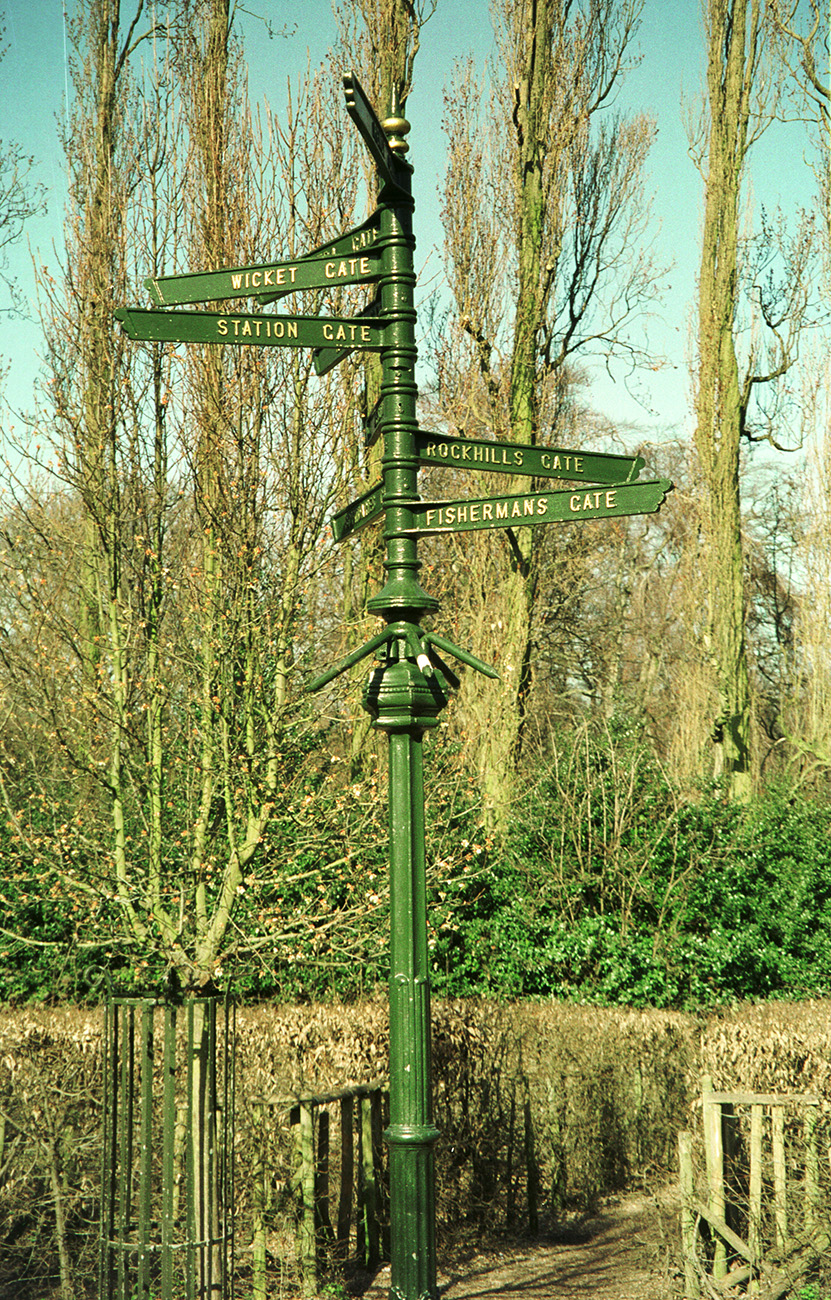
Crystal Palace Park Maze centre signpost, 1990s.
You could see it from within the maze, and the helpful directions seemed to mock your attempts to actually reach the thing.  I liked this, clearly a Victorian original, and I wish they had retained it. 

Thursday, 22 September 2016

Crystal Palace Park Dinosaurs

Crystal Palace Park dinosaur lake, 12 August 2016.  Spare head in the foreground.
Crystal Palace Park dinosaur lake, 12 August 2016.  Spare head in the foreground.
I used to live near Crystal Palace Park, and we sometimes walked past the childrens' zoo and sat on a bench to read newspapers and try to stop the goats from eating them.  Goats and zoo are now long gone.  Around that time, parts of the park were refurbished, particularly the Victorian attraction that is the dinosaur lake.  The origin and much of the history of these dinosaurs is covered in Wikipedia, so I won't repeat it, but the repainting of the dinosaurs at that time does not seem to get a mention.

Since then it has been refurbished yet again.  I wonder how many spare dinosaur heads they have?  When I went back there this August I thought this (above) was the same head I remembered being put near an information point at the time of the repainting, but the details are different.

Crystal Palace Park, 1990s.  Spare dinosaur head in the foreground.
Crystal Palace Park, 1990s.  Spare dinosaur head.
Here's the earlier head.  The old photos in this post are internally dated February 1998, but that's when the negatives were scanned; the photos will have been taken earlier in the 1990s.  These days I make the date part of the filename.

Crystal Palace Park dinosaur lake, 12 August 2016.
The lake with its big models is really quite eye-catching. 

Iguanodons at Crystal Palace Park dinosaur lake, 12 August 2016.
These are the most spectacular models.  Those nose horns are now known to actually have been spiky thumbs, but they did the best with what they knew at the time.  That rather puny tree fern trunk under the Iguanodon's foot is a recent addition.

Iguanodons at Crystal Palace Park dinosaur lake, 1990s.
The original tree had died and shrunk away at this point, so a replacement is fair enough, but I don't think that tree fern would have stood up to the dinosaur.  They've also changed the colour scheme, and planted a much more appropriate, less Wordsworthian array of flora. 

I'll post some more about Crystal Palace Park - strictly speaking it's not natural history, but it is at least a park.

Wednesday, 14 September 2016

A Walk round the Hawkwood Estate - part 3 of 3

Walk round the Hawkwood Estate 25, 30 August 2016
Walk round the Hawkwood Estate 25, 30 August 2016.
This is the last in a series of three posts following a walk around the Hawkwood Estate with an iPhone camera. 

Here I was past the halfway point and going mostly downhill.  Some parts of the route can be done along the edges of fields as shown in this first photo ...

Walk round the Hawkwood Estate 26, 30 August 2016
But I took the woodland path instead.  It is not far away and goes the same way.  There are many well-defined paths through local woodlands, though I see very few people there.  I heard voices while I was in Petts Wood, and in a couple of these iPhone photos people are visible in the distance, but even on a fine day like this it was hardly crowded.

Flushers Pond.  Walk round the Hawkwood Estate 27, 30 August 2016
Flushers Pond.  Walk round the Hawkwood Estate 27, 30 August 2016
The path skirts Flushers Pond.  I had to duck through a fence to take this photo.  In wet weather, the level is higher and the water comes right up to the fence.
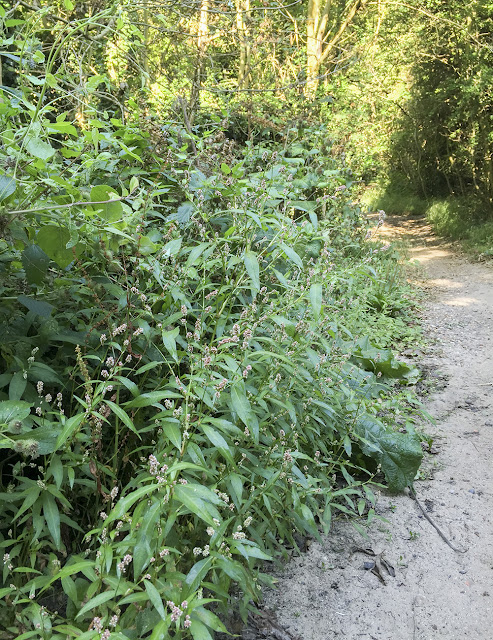
Redshank, Persicaria maculosa.  Walk round the Hawkwood Estate 28,, 30 August 2016
Redshank, Persicaria maculosa.  Walk round the Hawkwood Estate 28, 30 August 2016
A stand of Redshank in a more open part of the wood.  You can buy related Persicarias as garden plants.

Redshank, Persicaria maculosa.  Walk round the Hawkwood Estate, 30 August 2016
Redshank, Persicaria maculosa.  Walk round the Hawkwood Estate, 30 August 2016
These are the flowers closer to.  Not many plants start to flower at this time of year.  Most, even those still with open flowers, started some while ago.

Greater Plantain, Plantago major.  Walk round the Hawkwood Estate, 30 August 2016
Greater Plantain, Plantago major.  Walk round the Hawkwood Estate, 30 August 2016
Like this Greater Plantain in the same spot, which has brown, ripe fruiting spikes.  Greater Plantain is a common sight near, and sometimes even on pathways because it can withstand quite a lot of being walked on.

Wild Clematis, Clematis vitalba, Walk round the Hawkwood Estate 29, 30 August 2016
Wild Clematis to the right of the path, known as Traveller's Joy when flowering and Old Man's Beard later when it has hairy fruits. 

Information board.  Walk round the Hawkwood Estate 30, 30 August 2016
Information board.  Walk round the Hawkwood Estate 30, 30 August 2016
An information board!  Complete with a map that points to where you are.  I have been following more or less the yellow route.  My starting point was at the very leftmost point on that route.

Walk round the Hawkwood Estate 31, 30 August 2016
 You could hardly miss this path - it has more signs than a city street.  A dog walker is just visible in the distance.

The small yellow arrow points to an alternative route that goes past Tong Farm.

Walk round the Hawkwood Estate 32, 30 August 2016
Further on it is once again possible to bypass the woods, with a view over fields that look more rough than the neat grass elswehere.  This field is off the edge of the estate. 
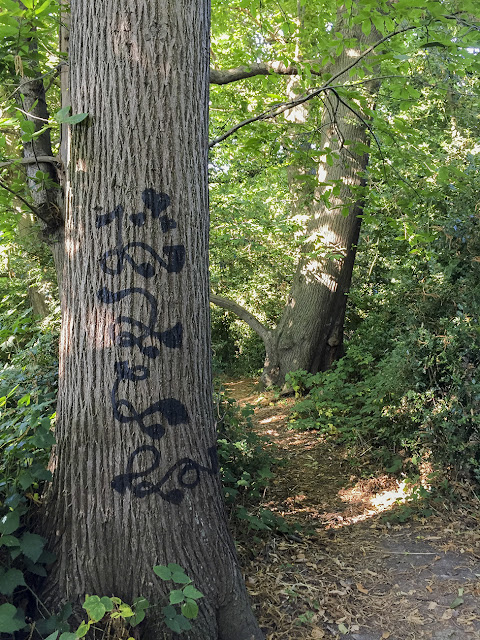
Graffitied tree.  Walk round the Hawkwood Estate 33, 30 August 2016
Graffitied tree.  Walk round the Hawkwood Estate 33, 30 August 2016
One of the paths through the wood goes past this elaborate graffiti, so elaborate that I can't really tell what it says.  Lacey?  The hearts show that it is a love message, anyway. 

Pond Wood.  Walk round the Hawkwood Estate 34, 30 August 2016
Pond Wood.  Walk round the Hawkwood Estate 34, 30 August 2016
This is the second pond on this walk, in the usefully named Pond Wood.  It doesn't seem to have a name, but if it did, I expect it would be Wood Pond.

Walk round the Hawkwood Estate 35, 30 August 2016
The path leads out to that same rough field seen earlier.  At the bottom of this slope is a footbridge over the Kyd Brook, near the start point.


Kyd Brook.  Walk round the Hawkwood Estate 36, 30 August 2016
Kyd Brook.  Walk round the Hawkwood Estate 36, 30 August 2016
There's the brook, and a path with a sign which is an alternative entry point to this walk.  But I went straight past this path - my route went from left to right, just behind where I was standing to take this.
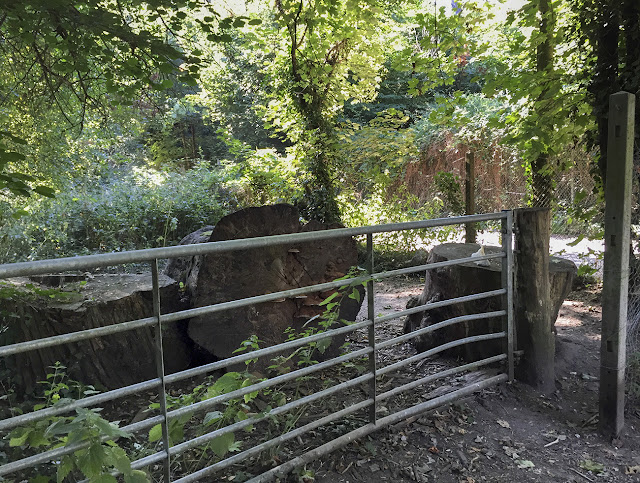
Start and finish point.  Walk round the Hawkwood Estate 37, 30 August 2016
Start and finish point.  Walk round the Hawkwood Estate 37, 30 August 2016
And back to the start!  That walk took me about an hour and a quarter, but I walk fast.  Good exercise in good countryside.