Monday, 30 January 2012

Drone-fly

Hoverfly, Drone-Fly, Eristalis pertinax.  Lullingstone Country Park, 14 October 2011.
Hoverfly, Eristalis pertinax.  Lullingstone Country Park, 14 October 2011.
I took lots of photos of hoverflies last year. I think they are particularly beautiful flies, and there is quite a lot of variety among them. Some are tiny and delicate, some are big bruisers.

This one is medium-sized. Several hoverflies mimic more dangerous insects, and this has the common name Drone-fly because it resembles a honey-bee.  Even though it is not brightly coloured, it looks very elegant in different shades of brown.

I will post some more hoverflies in due course.

Saturday, 28 January 2012

Small Elm

Trunk of small elm, edge of Gates Green Road, Coney Hall, 8 March 2011.
Having posted part of the trunk of a dead Elm tree a few days ago, I dug up this photo I took nearly a year ago of the trunk of a living one.

Although nearly all the mature Elm trees in England have been wiped out, and the disease is still making its way through Scotland, there are still lots of Elms around, in the form of hedgerows and low scrub. It seems that the bark beetles that carry the deadly fungus tend not to fly near the ground, so don't attack the low-growing young trees. But the taller ones in the hedgerow where I took this photo are dead.

The reason for this photo is, of course, the configuration of the bark. The mature trees show the same ridges, but on a large trunk they don't look so unusual.

Thursday, 26 January 2012

Ladybirds

A crude montage of ladybirds photographed in 2011.
On the principle that I should photogaph anything that looked like an interesting invertebrate or plant, I ended up with shots of many different creatures last year. Only one of these photos was taken when we were actually looking for ladybirds. The others were on general walks, or just when I was looking around.  I have posted a few of these before, but not all of them.

Many of them are named for the number of spots they show, and it doesn't help that some of these have variable numbers of spots. But most in this montage are pretty typical of their species. The Harlequin is a special case; it has three basic colour forms in this country, and this mating pair shows two of them. So those two are Harmonia axyridis forma conspicua (black with two red spots) and succinea (orange-red with black spots).

The scientific names also get complicated when describing the number of spots. Although sometimes you see their scientific names with the numeric characters, that is not strictly correct; and, for example, the 24-Spot Ladybird should really be called Subcoccinella vigintiquattuorpunctata, not 24-punctata.

This isn't close to being all the British species, but even so, I was pleased to find I had as many as this.

Tuesday, 24 January 2012

Scadbury Park Field Trip

Hard Shield Fern, Polystichum aculeatum, left; Broad Buckler Fern, Dryopteris dilatata, right.  Orpington Field Club trip to Scadbury Park, 21 January 2012.
Hard Shield Fern, Polystichum aculeatum, left; Broad Buckler Fern, Dryopteris dilatata, right.   Scadbury Park, 21 January 2012.

On Saturday 21st January I joined the Orpington Field Club field trip to Scadbury Park, 300 acres of Local Nature Reserve, with woodland, grassland and the ruins of a historically important manor house.

In the middle of winter, I think there were pretty low expectations of interesting natural history. Nine people turned up, quite a small group for the OFC. But I had a good time; I found a dozen species of fungus and was shown some mosses. There were also some ferns in the wood. The top photo shows the difference between the leaflets of the Hard Shield Fern and the Broad Buckler Fern, both still showing plenty of green leaf. The Broad Buckler Fern has a frond which subdivides twice. The Hard Shield Fern does not quite do that; the pinnules have one thumb, more or less distinct, and are otherwise just toothed. It was interesting to see a Hard Shield Fern; two of us had just been shown a sample in our wildflower class the day before, otherwise I would certainly have not known what it was, and even then it had to be pointed out to me. It looks a lot like the much more common Male Fern.

There were some nice examples of fungi that I have either already posted or will soon.

Witches' Butter, Exidia glandulosa. Orpington Field Club trip to Scadbury Park, 21 January 2012.
Witches' Butter, Exidia glandulosa.  Scadbury Park, 21 January 2012.
This uninviting, jelly-textured black growth is Witches' Butter, Exidia glandulosa. It was all over a very large felled oak tree. There was also plenty of this:

Split Porecrust, Schizopora paradoxa. Orpington Field Club trip to Scadbury Park, 21 January 2012.
Split Porecrust, Schizopora paradoxa. Scadbury Park, 21 January 2012.
A pored fungus whose pores are in separate little fingerlets. It is quite common on the lower sides of fallen trees.

This moss was available both wet and dry, which shows that when it dries up it shrinks into little spirals.

Bryum capillare.  Scadbury Park, 21 January 2012.
Bryum capillare.  Scadbury Park, 21 January 2012.
This next one is very common, and there are a few others that look quite similar so you seem to see more of it than you actually do. But it can be quite striking.

Turkeytail, Trametes versicolor. Orpington Field Club trip to Scadbury Park, 21 January 2012.
Turkeytail, Trametes versicolor.  Scadbury Park, 21 January 2012.
The common name Turkeytail seems quite apposite.

Finally for today, one of the group found this plume moth in a little bush. It was hanging on to a branchlet and being blown back and forth in the breeze, and this is the best shot I could get. I think it is a Stenoptilia, but to find the species you need to kill it and examine its genitalia under a microscope, something I do not wish to do. It's interesting to see one around in January.
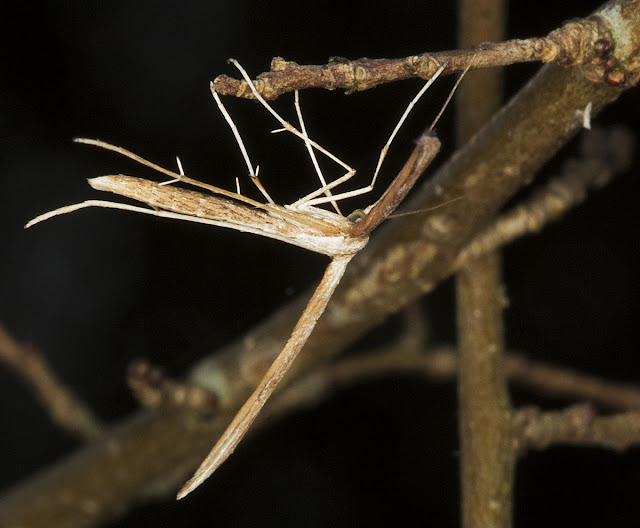
Plume moth, probably Stenoptilia species.  Orpington Field Club trip to Scadbury Park, 21 January 2012.
Plume moth, probably Stenoptilia species.   Scadbury Park, 21 January 2012.
I have some more photos, some of them not properly identified; I'll post them when I have a better idea of what they all are.

Sunday, 22 January 2012

Frog, Hopper

Young common frog, Rana temporaria.  One of many heading towards the lake.  Hayes Street Farm, 13 June 2011.
Young common frog, Rana temporaria, or toad, Bufo bufo.  Hayes Street Farm, 13 June 2011.
Two more photos from last spring. In June, I was walking through Hayes Street Farm past the lake which makes up a trout farm, and saw a whole crowd of these youngsters heading through the grass in the direction of the lake. It's likely that they came from spawn deposited in a nearby ditch.

A month earlier, on a reptile walk led by the Bromley rangers, I had seen the creature below; it's a Froghopper. It's one of a group of true bugs (insects with sucking mouthparts) whose young live in froth deposited on green plants, a phenomenon known as cuckoo-spit. I forgot about this one when I was making up my recent series of posts on bugs!

The top photo was taken with my Canon EOS 450D and 100mm macro lens; the bottom one with my Ixus 100.

Froghopper, Cercopis vulnerata, on bracken on a dry meadow.  Keston Common, 14 May 2011.
Froghopper, Cercopis vulnerata, on bracken on a dry meadow.  Keston Common, 14 May 2011.

Friday, 20 January 2012

Rosebay Willowherb

Rosebay Willowherb seeds, Epilobium angustifolium, on Orchid Bank. High Elms Country Park, 22 August 2011.
Rosebay Willowherb seeds, Epilobium angustifolium. High Elms Country Park, 22 August 2011.
A photo from last Autumn. Rosebay Willowherb is also called fireweed. Some say it is because the seeds blowing away from the vivid flowers look like smoke from a fire. Others, that it likes to grow where there has been a fire.

It is certainly an early urban coloniser. In London, after World War II, it grew in the craters where buildings had been blown up in the Blitz. Where I grew up, near Newcastle, we often saw it where rows of houses had been demolished.

The flower of this species is what the crab spider I posted recently was sitting on.

Wednesday, 18 January 2012

Bark Beetle Galleries

Bark beetle galleries.  Hayes Common, 25 December 2011.
Bark beetle galleries. Hayes Common, 25 December 2011.
Another Christmas day find was a fallen tree with much of the bark missing. In the wood below were these intriguing patterns.

These, known as galleries, were created by bark beetles while the tree was alive. The deep central groove was made by the parent beetle, which crawled along laying eggs on both sides. When the eggs hatched, the larvae ate away at the nutritious cambium, the part of the wood just below the bark. They radiated out from the central groove until they were large enough to pupate and then emerge as adults through holes in the bark.

The patterns made by bark beetles are said to be typical of each species, and these were probably the Elm Bark Beetle.  It was actually quite thrilling to find the remains of a large, mature elm that must have been lying there since around 1970.  The results are quite pretty, but there were so many on this tree that I can't help thinking that these might have killed the tree even without the fungus disease that they carried that wiped out nearly all the British elms. You can also see occasional holes where other beetles have bored more deeply.

Bark beetle galleries. Hayes Common, 25 December 2011.
Bark beetle galleries.  Hayes Common, 25 December 2011.