Showing posts with label Deal. Show all posts

Wednesday, 15 July 2015

Butterflies By The Sea


Marbled White, Melanargia galathea.  Sandwich Bay, 3 June 2015.
Marbled White, Melanargia galathea.  Sandwich Bay, 3 June 2015.
It was windy in the dunes along Sandwich Bay.  Mostly, too windy to get good photos of anything small, because everything was moving.  But there was a sheltered spot with a range of flowering plants, and butterflies were feeding there in abundance.

There were dozens of Marbled Whites.  They are very pretty, and as is often the case, the undersides of their wings are more interesting than the upper surfaces.

Small White, Pieris rapae.  Sandwich Bay, 3 June 2015.
Small White, Pieris rapae.  Sandwich Bay, 3 June 2015.
Marbled Whites really belong with the brown butterflies, in the family Nymphalidae. This Small White is a true white butterfly from the Pieridae.

Small Heath, Coenonympha pamphilus.  Sandwich Bay, 3 June 2015.
Small Heath, Coenonympha pamphilus.  Sandwich Bay, 3 June 2015.
The Small Heath is quite a furry-looking thing; like the Marbled White, it's of the Nymphalidae.  And there was yet another family represented:

Small Skipper, Thymelicus sylvestris.  Sandwich Bay, 3 June 2015.
Small Skipper, Thymelicus sylvestris.  Sandwich Bay, 3 June 2015.
The Hesperidae.  There were lots of these Small Skippers flitting around in the grass.  There is a closely related species, the Essex Skipper, which looks just like this except that the undersides of the tips of its antennae are sooty black.  In this photo you can see the exact spot you have to look for to tell the difference.  On this butterfly it's orange.

The Marbled White at the top is feeding from a Creeping Thistle. The Small White is just resting.  The Small Heath is investigating a bramble flower, and the Small Skipper is feeding from a Ragwort.  Those are all popular food sources  Bramble hedges in particular are always good for some insect life.

There were other Lepidoptera present too.  There were many Narrow-bordered Five-spot Burnets, which are day-flying moths.

Narrow-bordered Five-spot Burnet.  Zygaena lonicerae.  Sandwich Bay, 3 June 2015.
Narrow-bordered Five-spot Burnet.  Zygaena lonicerae.  Sandwich Bay, 3 June 2015.
You can't tell these from the related (non-narrow-bordered) Five-spot Burnets from a photo, but the population here is known to be Narrow-bordered. 

Although I did not see a mature adult, there were Cinnabar larvae feeding on the Ragwort.

Cinnabar larva, Tyria jacobaeae.  Sandwich Bay, 3 June 2015.
Cinnabar larva, Tyria jacobaeae.  Sandwich Bay, 3 June 2015.
The Cinnabar is another day-flying moth.  These two moths are representatives of two more Lepidopteran families, the Zygaenidae and Erebidae respectively.  So we had a good range on display.

Thursday, 9 July 2015

Some Coastal Plants

Sea Holly, Eryngium maritimum.  Apiaceae.   Sandwich Bay, 4 July 2015.
Sea Holly, Eryngium maritimum.  Sandwich Bay, 4 July 2015.
I visited a friend at the coast recently, and was taken for a walk, where I saw a range of plants I am not at all used to.  Plants that grow in the coastal dunes, or even in the shingle on the beach, are often quite different from the usual inland plants.  They need to be tolerant of salt, and sometimes of dry conditions, because sand and shingle do not retain moisture.

This Sea Holly is well known, and is quite showy even though its flowers blend in with the leaves.  But the star this time was Viper's Bugloss, first seen off to one side over a dune, then in larger numbers right beside the path.
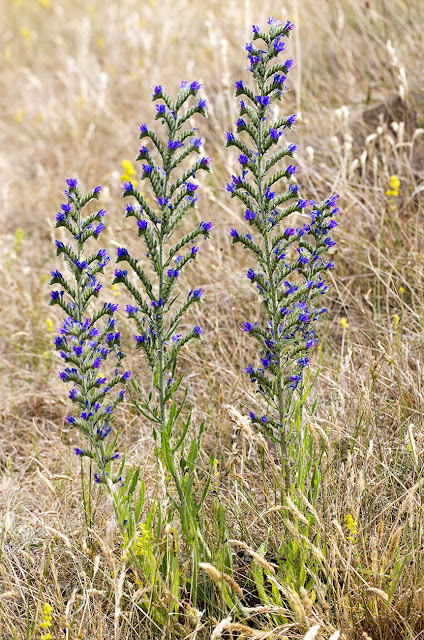
Viper's Bugloss, Echium vulgare.   Sandwich Bay, 4 July 2015.
Viper's Bugloss, Echium vulgare.   Sandwich Bay, 4 July 2015.

Viper's Bugloss, Echium vulgare.   Sandwich Bay, 4 July 2015.
Viper's Bugloss, Echium vulgare.   Sandwich Bay, 4 July 2015.
The red anthers protruding from that mass of deep blue flowers give a startlingly colourful effect.

In the general coastal area, this occurs quite often:

Sea Bindweed, Convolvulus soldanella.   Sandwich Bay, 4 July 2015.
Sea Bindweed, Convolvulus soldanella.   Sandwich Bay, 4 July 2015.
At first glance it looks like a large Field Bindweed, which I see scattered freely around the countryside where I live, but closer up I could see that the leaves are a different shape and the flower is too consistently large.  It's called the Sea Bindweed.  It was also in my friend's lawn!

Sea Sandwort, Honkenya peploides.   Sandwich Bay, 4 July 2015.
Sea Sandwort, Honkenya peploides.   Sandwich Bay, 4 July 2015.
This succulent little thing grows in big healthy mounds right in the shingle at the top of the beach. I had no idea what it was and had to get it identified as Sea Sandwort on the very useful iSpot site.

Also in the shingle is ..

Yellow Horned Poppy, Glaucium flavum.   Sandwich Bay, 4 July 2015.
Yellow Horned Poppy, Glaucium flavum.   Sandwich Bay, 4 July 2015.
Yellow Horned Poppy, Glaucium flavum.   Sandwich Bay, 4 July 2015.
Yellow Horned Poppy, Glaucium flavum.   Sandwich Bay, 4 July 2015.
this Yellow Horned Poppy.  It's the poppy flower that is yellow, not the horns, so the last two words are sometimes hyphenated as Horned-poppy.   The horns are the seed pods.

The last beach flower I saw before turning inland again was this ...
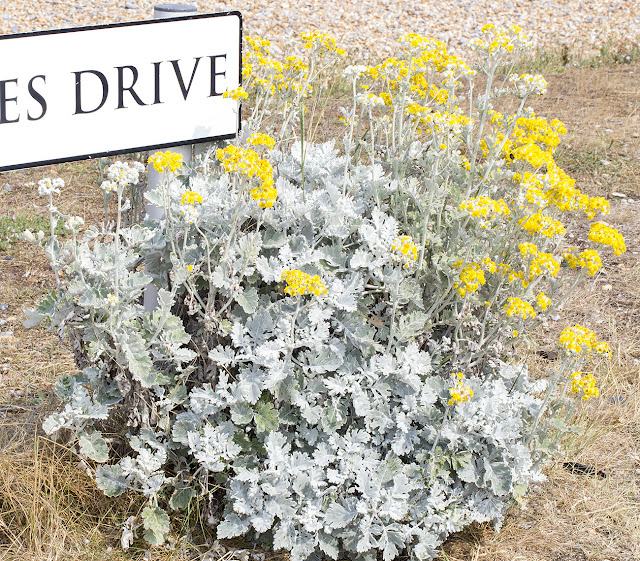
Silver Ragwort, Senecio cinerea.   Sandwich Bay, 4 July 2015.
Silver Ragwort, Senecio cinerea.   Sandwich Bay, 4 July 2015.
Silver Ragwort.  As you can see, it's not actually in the shingle, but in the sand just above it.

Many of these coastal plants are very decorative.  I would have been interested to see them anyway, but I was amazed by what I actually saw.