Showing posts with label animals. Show all posts

Thursday, 19 November 2015

Mice and Voles

Wood Mouse, Apodemus sylvaticus.  Jubilee Country Park, 15 November 2015.
Wood Mouse, Apodemus sylvaticus.  Jubilee Country Park, 15 November 2015.
In mid-November, the Friends of Jubilee Country Park had a "small mammals" morning.  I wrote about one of these small mammal events back in February 2011.  This time, local expert Marcus Jordan and his assistant Steven Lofting did all the hard work. 
Marcus Jordan and Steven Lofting.

Here, they are getting ready to work their way around the traps that had been set the previous evening.  The box is to carry the emptied traps, and the big plastic bag is to empty the traps into.

When the traps are set, they contain some straw, some apple and carrot, some seeds and a few blowfly maggots, to cater for any of the variety of small animals that might be caught.  The maggots are in case of shrews, which need to eat very often or they will starve.  Shrews have a very fast metabolism and react badly to being handled, so they are let go straight away if they are found in a trap.

The whole contents of the trap are emptied into the big plastic bag.  This lets the trappers see and sort out what is in there.  In theory it is easy, but in practice the mice and voles are not keen on being sorted out, and this time two of them managed to be up a trapper's arm and away into the wood before they could be grasped.  They are very quick!

The idea is to corner them so that they can be lifted out by their scruffs, rather like kittens.

Contents of a small mammal trap, including a Wood Mouse.  Jubilee Country Park, 15 November 2015.
Contents of a small mammal trap, including a Wood Mouse.  Jubilee Country Park, 15 November 2015.

Wood Mouse being cornered and grasped.  Jubilee Country Park, 15 November 2015.
Wood Mouse being cornered and grasped.  Jubilee Country Park, 15 November 2015.
The creatures are then identified, sexed and weighed.  To weigh them, they are put into a small plastic bag, and the weight of the bag is subtracted from the figure shown on the scales.  The mouse at the top of this page has just been weighed. Then they are released, having suffered only indignity.

Short-tailed Vole, Microtus agrestis.  Jubilee Country Park, 15 November 2015.
Bank Vole, Myodes glareolus.   Jubilee Country Park, 15 November 2015.
We found Wood Mice and this Bank Vole.  The tail is shorter than that of a Wood Mouse, though I didn't manage to capture the tip of it to demonstrate; and it has much smaller ears.  The vole has just been weighed, and unfortunately for it, the weighing bag by that time contained rather a lot of Wood Mouse urine.  They do tend to wee when alarmed.

Marcus and Steven thought at one point that we might have a Yellow-necked Mouse ..


But although it showed some yellow in the neck area, it was not a complete collar, so this was just a big healthy Wood Mouse.  A male, this time.

Wood Mouse, male.  Hedgerow near Thornton Wood, Jubilee Country Park, 15 November 2015.
Wood Mouse, male.  Hedgerow near Thornton Wood, Jubilee Country Park, 15 November 2015.
(All photos taken with my EOS 5DS and 100mm macro lens, not using the flash so as not to alarm or blind the small mammals.)

Later addition: A mammals expert says it is not so easy to discount the possibility that this mouse might be a Yellow-neck, after all,  so it might be better to consider it an undetermined Apodemus species.

Tuesday, 11 December 2012

Knole Park

A valley in Knole Park, 22 September 2012
These photos go back to September, when a group from the Orpington Field Club went to look for fungi.  But it's a bad year for fungi - odd, given how wet it has been - and we found hardly any.  But I have just a few photos of what we did see.

Knole Park is a deer park surrounding a 15th century country house.  It is quite spacious, and we only saw the house once as we walked past the back of its formal gardens.   We saw some of the deer:

Fallow Deer, Dama dama.  Knole Park, 22 September 2012.
They didn't let us get very close, but they didn't seem to be too alarmed by our presence.

Most of the time we saw hardly any insect life as well as an absence of fungi.  But the scenery was very enjoyable.  Then as we passed by the back of the gardens, there were a few wildflowers with hoverflies and and butterflies.

Hoverfly, Helophilus pendulus.  Knole Park, 22 September 2012.
Hoverfly, Helophilus pendulus.  Knole Park, 22 September 2012.
I didn't record the flower the hoverfly was on, but it looks like an Autumn Hawkbit. 

Two Small Coppers, Lycaena phlaeas, on Ragwort, Senecio jacobaea.  Knole Park, 22 September 2012.
Two Small Coppers, Lycaena phlaeas, on Ragwort, Senecio jacobaea.  Knole Park, 22 September 2012.
There's a variety of the Small Copper that has reflective bluish patches towards the base of its hind wings, at the edge of the dark area, and you can just see a slight glitter of such a thing here.  I saw much more of this last year.

Small Copper, Lycaena phlaeas, on Ragwort, Senecio jacobaea.  Knole Park, 22 September 2012.
Small Copper, Lycaena phlaeas, on Ragwort, Senecio jacobaea.  Knole Park, 22 September 2012.
So we didn't see what we came for, but it was a lovely day for a walk in the park.

Tuesday, 18 September 2012

Roe Deer

Roe Deer, Capreolus capreolus, across Keston bog.  Keston Common, 8 September 2012.
Roe Deer, Capreolus capreolus, across Keston bog.  Keston Common, 8 September 2012.
This scene is five minutes from a busy spot by a small lake, with kids and parents and fishers and an ice-cream van.  I was on a path along the edge of a small bog, one which was studied by Charles Darwin, and on the other side a Roe Deer was picking its way along the edge of the trees.  It's very good to see such large wildlife practically on the edge of suburbia.

This is when it's very useful that the lens I use for close-up macro photographs also works as a normal medium length portrait lens.

Sunday, 22 January 2012

Frog, Hopper

Young common frog, Rana temporaria.  One of many heading towards the lake.  Hayes Street Farm, 13 June 2011.
Young common frog, Rana temporaria, or toad, Bufo bufo.  Hayes Street Farm, 13 June 2011.
Two more photos from last spring. In June, I was walking through Hayes Street Farm past the lake which makes up a trout farm, and saw a whole crowd of these youngsters heading through the grass in the direction of the lake. It's likely that they came from spawn deposited in a nearby ditch.

A month earlier, on a reptile walk led by the Bromley rangers, I had seen the creature below; it's a Froghopper. It's one of a group of true bugs (insects with sucking mouthparts) whose young live in froth deposited on green plants, a phenomenon known as cuckoo-spit. I forgot about this one when I was making up my recent series of posts on bugs!

The top photo was taken with my Canon EOS 450D and 100mm macro lens; the bottom one with my Ixus 100.

Froghopper, Cercopis vulnerata, on bracken on a dry meadow.  Keston Common, 14 May 2011.
Froghopper, Cercopis vulnerata, on bracken on a dry meadow.  Keston Common, 14 May 2011.

Friday, 14 October 2011

Badger Dung Pit

Badger dung pit, Meles meles, on Hayes Common.  28 September 2011.
Badger dung pit, Meles meles, on Hayes Common.  28 September 2011.
I recently posted a photo of fox scat, and here is the badger equivalent. Badgers make communal dung pits to mark the edges of their territory, and I saw this one while walking on Hayes Common.

These badgers have been eating something, maybe cherries, that have round stones. The dark colour suggests that they might also have been snacking on blackberries.

Thursday, 13 October 2011

Cherry Stones

Cherry stones eaten by a vole.  High Elms Country Park, 20 September 2011.
Cherry stones eaten by a vole.  High Elms Country Park, 20 September 2011.
When a small area of grass and wildflowers in High Elms Country Park was mown, this hoard of cherry stones was uncovered. They were a few yards from the tree, and a small pathway between the stones and the tree could be seen (gone by the time I saw it). It was pointed out to me by Nick Hopkins, one of the rangers, who is pretty sure that the creature responsible was a vole, probably a short-tailed vole, Microtus agrestis. They must have been brought here, a spot which was well under cover at the time, and then eaten in safety. It's interesting to see that it's not just the sweet outer part of the cherry that attracts wildlife.

Wednesday, 5 October 2011

Autumn Changes

Walking past horses in a field near Downe.  30 September 2011.
Walking past horses in a field near Downe.  30 September 2011.
This walk, on 30th September, was the last one to be led by Bromley Countryside Services. Their funding has been cut and no more walks or events are planned.

It was placed in the schedule by Ewa Prokop, but as Ewa left some while ago it was actually led by Jenny Price, who used to be the liaison for Jubilee Countryside Park. Jenny didn't know what Ewa had planned, beyond the hints given by the title and the starting point, so she took us around part of the Cudham Circular Walk.

It was hot and sunny, and the countryside was beautiful. I had been around much of this route before, not all at the same time but on various walks in the area, but some of it was new to me. There were some very steep hills ..

At one point we walked through the village of Downe, home of Charles Darwin, and along the path towards Downe Bank, the same path I took earlier with the Orpington Field Club. Two familiar horses were in the field to the right. The foal has grown well. We passed quite close to them, and they were much smaller than I had thought in June when I saw them at a distance.

Of course, there were many signs of Autumn to justify the title of the walk. I have shown several photos of fruits and berries here, and there are more to come. The image below is of Old Man's Beard, the wild hedgerow clematis. I showed clematis flowers in September; then, the plant deserved its other common name of Traveller's Joy.

Old Man's Beard, Clematis vitalba.  Near Cudham, 30 September 3011.
Old Man's Beard, Clematis vitalba.  Near Cudham, 30 September 3011.

Sunday, 26 June 2011

Downe Bank

Horse and foal near Downe.  Orpington Field Club outing to Orchis Bank, Downe.  Taken with EOS 450D and 100mm macro lens.  25 June 2011.
Horse and foal near Downe.  25 June 2011.
The Orpington Field Club met in the middle of Downe. It's full of reminders of Charles Darwin. Interestingly, there is a memorial sundial on the wall of the church where his children and servants are buried. I was browsing around the churchyard when I was met by Irene Palmer and her husband John. Irene is a Darwin enthusiast and was leading our walk to Downe Bank.

Downe Bank is in the middle of a beautiful area of countryside between Downe and Cudham, on the bank of Cudham Valley. It's a nature reserve and a Site of Special Scientific Interest, and part of it is open to the public.  We walked down to Orchis Bank and over the next couple of hours moved slowly along and back.

The walk was planned to look at the flora, but I always photograph any invertebrates and any other things of interest that will hold still long enough. This horse and foal were in a field on the path from Downe.
Bee orchid, Ophrys apifera, on Orchis Bank, taken from the side, showing pollinia.  Orpington Field Club outing to Orchis Bank, Downe.  25 June 2011. Taken with EOS 450D and 100mm macro lens.
Bee orchid, Ophrys apifera, on Orchis Bank, showing pollinia.
25 June 2011.

We went into the area labelled as Orchis Bank, Darwin's name for one of the areas he studied. Naturally, there was a focus on orchids, and even though the weather this year has not encouraged them, there were plenty of common spotted orchids and common twayblades, with pyramidals scattered among them. Several bee orchids were spotted, and later on, some fragrant orchids. But these showy specimens were only the tip of a wealth of plant life.

I was interested to see a lush black bryony, climbing an ash sapling, which had a shoot with dark purple leaves. I wonder if that is a somatic variation or a true reproducible variety. Other shoots of the same plant looked quite normal.

As usual, the group spread out and straggled. I was often at the back, taking photographs. I saw a few Helix pomatia, the large edible snails that were introduced by the Romans. They were sheltering in small hollows which seemed to be just their size. They did not seem to want to emerge from their shells.
Weevil, Apoderus coryli, on my hand, on Orchis Bank.  Orpington Field Club outing to Orchis Bank, Downe.  25 June 2011. Taken with EOS 450D and 100mm macro lens.
Weevil, Apoderus coryli, on my hand, on Orchis Bank.
25 June 2011.

The open area was full of yellow flowers, one of the many local species that resemble dandelions. It is interesting that all the local meadows seem to have one of these species predominent. Often it's cat's-ear, but in this case it was the rough hawkbit, Leontodon hispidus. There were also many specimens of hairy St. John's wort, which added to the general yellowness. Marmalade hoverflies were everywhere, often sitting on the yellow flowers and letting me get close up with the camera.

The line of people wound along the narrow path, singly and in groups, turned round at the end and moved back lower down the hill. A few returned the way they came, and others went on and back a different way. I went along to the track on the lower path and climbed the gate into Musk Orchid Bank, which I had visited once before on Ewa Prokop's primrose walk.

Back in March, the grass was short and primroses stood up above it. Now all the plants stood tall. I saw several marbled white butterflies flitting about, but I didn't want to chase them until they settled because it would have meant trampling down all the plant life. The one I came across that was already settled had lost a piece from both hind wings; perhaps it had a close encounter with a bird and was lucky to get away.

I was following the hint of a track that might have been made by a fox, or by one person going unseen ahead of me. There were a few large skippers and I also saw one large field scabious, its light blue flowers standing above all the rest.
Wandering along Orchis Bank.  The yellow flowers are mostly rough hawkbit, Leontodon hispidus.  Orpington Field Club outing to Orchis Bank, Downe.  25 June 2011.   Taken with EOS 450D and 100mm macro lens.
Wandering along Orchis Bank.  The yellow flowers are mostly rough hawkbit, Leontodon hispidus. 25 June 2011.

 
Ringlet butterfly, Aphantopus hyperantus, basking on Orchis Bank.  Orpington Field Club outing to Orchis Bank, Downe.  25 June 2011.  Taken with EOS 450D and 100mm macro lens.
Ringlet butterfly, Aphantopus hyperantus, basking on Orchis Bank.  25 June 2011.

Marmalade hoverfly, Episyrphus balteatus, on hairy St. John's wort, Hypericum hirsutum, on Orchis Bank.  Orpington Field Club outing to Orchis Bank, Downe.  25 June 2011.  Taken with EOS 450D and 100mm macro lens.
Marmalade hoverfly, Episyrphus balteatus, on hairy St. John's wort, Hypericum hirsutum, on Orchis Bank.  25 June 2011.

Fragrant orchid, Gymnadenia conopsia, on Orchis Bank.  Orpington Field Club outing to Orchis Bank, Downe.  25 June 2011.  Taken with EOS 450D and 100mm macro lens.
Fragrant orchid, Gymnadenia conopsia, on Orchis Bank.  25 June 2011.

Marbled white butterfly, Melanargia galathea, on Musk Orchid Bank; missing some pieces of wing.  Orpington Field Club outing to Orchis Bank, Downe.  25 June 2011.  Taken with EOS 450D and 100mm macro lens.
Marbled white butterfly, Melanargia galathea, missing some pieces of wing, on Musk Orchid Bank.  25 June 2011.

Florets of field scabious, Knautia arvensis, on Musk Orchid Bank.  Orpington Field Club outing to Orchis Bank, Downe.  25 June 2011.  Taken with EOS 450D and 100mm macro lens.
Florets of field scabious, Knautia arvensis, on Musk Orchid Bank.  25 June 2011.

Large skipper, Ochlodes venatus, male, feeding on selfheal, Prunella vulgaris, on Musk Orchid Bank.  Orpington Field Club outing to Orchis Bank, Downe.  25 June 2011.  Taken with EOS 450D and 100mm macro lens.
Large skipper, Ochlodes venatus, male, feeding on selfheal, Prunella vulgaris, on Musk Orchid Bank.  25 June 2011.

All the photos in this post were taken with a Canon EOS 450D and an EF 100mm macro lens. For the closeups I used a ring flash.

If this was interesting, you might like to see Irene Palmer's web presentation on Downe Bank: Darwin's 'Entangled Bank' at Downe, A Warden's Tale.

Friday, 17 June 2011

Keston Grasslands

Greater yellow rattle, Rhinanthus angustifolius.  An invasive species, perhaps imported from Jubilee Country Park like the corky-fruited water dropwort. The other flowers in the photo are common sorrel, meadow buttercup and lesser stitchwort.  Keston Common grassland walk, led by Judy John.  15 June 2011.
Greater yellow rattle, Rhinanthus angustifolius.
Ravensbourne meadow, 15 June 2011.
Even though I had taken part in a study of Keston's meadows quite recently, I was pleased to see them again. Judy John of the BCS led the walk once again. She knows this common very well, especially its botany.

This time we started at a different spot, by Keston Ponds, and looked at some of the acid grassland nearby before moving across the heath, past Keston Bog, and on to the dry and wet Ravensbourne meadows. Naturally I don't want to repeat what I have already covered, so here are some highlights from this trip.

On the dry grassland where Juncus squarrosus grows, on a poor soil made up of Blackheath gravel, I saw a little butterfly, like a meadow brown but smaller, identified by Judy as a small heath. It was very mobile (kept flying off when I got close) and I only got a partial photo of it, but enough to confirm the identification. It was good to see this; the species is in decline.

We had a closer look at the area around the bog than I took last time. Part of it is still full of white fluffy cottongrass. The small yellow flowers of tormentil were scattered around, and Judy says we should soon see bog asphodel. There were several rushes and sedges; Judy pointed out one new to the bog, Carex demissa, common yellow sedge.
The front of a slowworm, Anguis fragilis, and some cast skin.  Cropped part of a rather dark photo.  Keston Common grassland walk, led by Judy John.  15 June 2011.
The front of a slowworm, Anguis fragilis, and some cast skin.
Ravensbourne meadow, 15 June 2011

The bog had suffered after Darwin's time from a misplaced attempt to protect it from trampling and depradation by allowing trees to grow up around it, to conceal it. But bog plants such as sundew need light, which was shaded out; a low nutrient environment, ruined by leaf litter; and plenty of water, which was being sucked up by the trees; so the bog fell into a poor state.

Recently, the nearest trees have been removed, and the leaf litter on the sides of the small depression has been scraped off. The old flora are coming back. There are still no sundews, but now that the wet ground surface is exposed again there are other good things, like the sedge mentioned above. But given our generally drier climate, it might never return to being a true valley bog as Darwin saw it.

In the meadows we looked under two of the small corrugated iron shelters and saw several slowworms — many more than we saw on the reptile walk in May. One of the shelters also had a busy ant's nest. The other contained some cast skin, shown in this photo. It's a cropped corner of a rather dark image, and not very clear; I didn't spot this slowworm until I looked at the photo on my computer.

Walking through the woods between the meadows, Judy pointed out specimens of broad buckler fern and male fern by the path. In the wet meadows were the purple flowers of marsh thistles. To one side, a statuesque Italian black poplar tree, not in the best of health.
An Italian black poplar to one side of a meadow.  Keston Common grassland walk, led by Judy John.  15 June 2011.
An Italian black poplar to one side of a meadow. 15 June 2011.

One of the dry meadows had some patches of greater yellow rattle, probably brought in on the machinery used to cut the grass, as we know happened with the corky-fruited water dropwort that came from Jubilee Country Park. On one of the wet meadows, someone had recently camped overnight and had a camp fire, potentially eradicating the black sedge that Judy had been so pleased to find two weeks ago. It takes a lot of work to keep this common in shape and gradually improve it, and it's not always a forward progression.

Back at the ponds, Judy said goodbye and a few of us went off towards the upper car park. At this point I was thinking: Well, I've got some quite interesting photos, but nothing really special. Then a damselfly landed on Sally's arm. I think it was an emerald damselfly, but it's not quite like any of the illustrations in my books, and I will amend this if I am proved wrong. A little further on, we saw where some of the yellow water lilies had been pulled up by someone. One of the flowers was near the bank, floating free in the water. At last, a chance to test whether they really do smell of alcohol! And indeed they do, quite strongly, justifying their alternative common name of brandybottle. The flower was big and fleshy, and the stem was bulky and weak.

Loosely attached to the side of this flower was the exuvium of a damselfly or dragonfly, the empty skin which it had moulted when emerging as an adult. You really can't go far on this common without seeing interesting things, if you watch out for them. Also interesting was a group of people fishing illegally — these ponds are part of the river Ravensbourne, and it was still the close season for coarse river fishing until the end of the day (15th June). Other groups of fishermen by the middle pond were merely reconnoitring and waiting out the day.
Judy John pointing out a sedge new to Keston Bog, Carex demissa, the common yellow sedge.  Keston Common grassland walk, led by Judy John.  15 June 2011.
Judy John pointing out a sedge new to Keston Bog, Carex demissa, the common yellow sedge.
Keston Bog, 15 June 2011.

Damselfly, possibly an emerald, Lestes sponsa.  Keston middle pond.  Keston Common grassland walk, led by Judy John.  15 June 2011.
Damselfly, possibly an emerald, Lestes sponsa. Keston middle pond, 15 June 2011.

Flower of yellow water lily, Nuphar lutea, aka brandybottle, with damselfly or dragonfly exuvium.  This was floating loose in the water among some damaged plants and roots.  The flower smelt strongly of alcohol.  Keston Common grassland walk, led by Judy John.  15 June 2011.
Flower of yellow water lily, Nuphar lutea, aka brandybottle, with damselfly or dragonfly exuvium.
Keston upper pond, 15 June 2011.

Flower of yellow water lily, Nuphar lutea, aka brandybottle, with damselfly or dragonfly exuvium.  This was floating loose in the water among some damaged plants and roots.  The flower smelt strongly of alcohol.  Keston Common grassland walk, led by Judy John.  15 June 2011.
Flower of yellow water lily, Nuphar lutea, aka brandybottle, with damselfly or dragonfly exuvium.
Keston upper pond, 15 June 2011.

Fishing out of season. The statutory coarse fish close season applies between 15 March and 15 June inclusive. It applies on all rivers, streams and drains in England and Wales, and to some canals and some stillwaters. This is Keston upper pond, part of the Ravensbourne river.   Keston Common grassland walk, led by Judy John.  15 June 2011.
Fishing out of season. The statutory coarse fish close season applies between 15 March and 15 June inclusive.
This is Keston upper pond, part of the Ravensbourne river, on 15 June 2011.

All the photos in this post were taken with my little Ixus 100 camera.

Tuesday, 14 June 2011

Country Lane

Horse and rider in North Pole Lane.   Well Wood field trip with the Orpington Field Club, 11 June 2011.
Horse and rider in North Pole Lane.   Well Wood field trip with the Orpington Field Club, 11 June 2011.
This is a true snapshot taken with my Ixus 100 at waist height.

Sunday, 15 May 2011

Reptiles — And More — In Keston

Keston top pond seen from the Westerham Road car park.  14 May 2011.
Keston top pond seen from the Westerham Road car park.  14 May 2011.
Yesterday, a group met in the Westerham Road car park near the south end of Keston Common to look for reptiles. The walk was led by Judy John of BCS, the Countryside Officer for this area.

Keston Common connects through some wet and dry meadows to the ancient Padmall Wood. Spread around the common and the meadows are small squares of corrugated iron, perfect shelters for snakes and lizards, and Judy aimed to take us around them to see what we could find there today.

Of the six reptiles native to Britain, we might see three today; grass snake, slow-worm, common lizard. There are also adders in the area, living on Hayes Common, but they have not been seen in Keston. Judy showed us some cast-off adders' skins. Grass snakes are present; they have been seen swimming in the top pond, shown in the first photo.
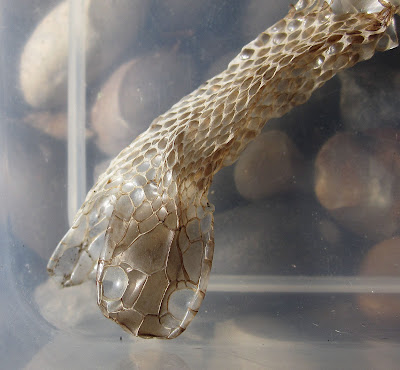
The head end of the cast skin of an adder, Vipera berus. 14 May 2011.
As usual, I was interested to see what plants and insects were around, and Judy was well able to identify almost all of those I asked about. It is wonderful to be walking around with someone who knows so much.

First we went up to the acid-soiled heath. Lizards and snakes can tell when someone is coming by the vibrations caused by footsteps, so we crept up to one of the plates and gathered round as Judy carefully lifted it with a crowbar.

This was needed, not because it was heavy, but just in case there was an adder nearby; unlikely, but best not to take an easily avoidable risk.

There was nothing beneath any of the plates on the heath but for some ants and sometimes some signs that something larger might have been there. Then one of the children saw a lizard under a bush! But it ran off before the rest of us could see it. So far, so elusive.

Cat's ear, Hypochaeris radicata, on Keston Common. 14 May 2011.
Cat's ear, Hypochaeris radicata, on Keston Common.
But there were other things to see on the heath. A startlingly coloured black and red cinnabar moth flew by. There were stretches of wavy hair-grass, with shiny flower heads rippling in the breeze. We saw the yellow-flowered cat's-ear, identified for me by Judy. Unlike a dandelion, which the flower resembles, this plant has branched flower heads with occasional scales.

Sheep's sorrel was widespread; it is an early coloniser of areas which have been scraped to restore the heathland to its former state, as I also saw recently on Hayes Common.

Judy showed us the droppings of a roe deer, distinguishable from round rabbit pellets by their irregular shape and pointed ends. They look like quite small pellets for such a relatively large creature.

We moved on past the sphagnum bog — where cotton grass was visible, common elsewhere but scarce in this area — to a group of meadows, some wet and some dry. These were full of interesting flowers. In the wet meadow we saw pink ragged robin, white milkmaids, and lots of field buttercups. We should look for bog asphodel to flower here in July.

Female slow-worm, Anguis fragilis, under a metal plate at the edge of a dry meadow in Keston. 14 May 2011.  Taken with a Canon EOS 450D and a Canon EF 28-135 f/3.5-5.6 IS USM lens.
Female slow-worm, Anguis fragilis, under a metal plate at the edge of a dry meadow in Keston. 14 May 2011.
Taken with a Canon EOS 450D and a Canon EF 28-135 f/3.5-5.6 IS USM lens.
It was in one of the dry meadows that we saw, at last, a slowworm under one of the plates. That was exciting! It didn't like being exposed and slowly made its way into the grass, apparently undisturbed by spiders and ants scurrying around and over it.

Common blue damselfly, Enallagma cyathigerum.  Male. Dry meadow, Keston, 14 May 2011. Taken with a Canon EOS 450D and a Canon EF 28-135 f/3.5-5.6 IS USM lens.
Common blue damselfly, Enallagma cyathigerum.  Male.
Dry meadow, Keston, 14 May 2011.
Despite its snake-like appearance, this is a lizard. You might read that you can tell it from a snake because it can't protrude its tongue - that's clearly wrong, and here you can see that the tongue is even partially forked. But a lizard it is.

Judy says that she sometimes finds several slowworms under that particular plate. So we didn't see as many reptiles as we might, but I saw more than I ever have while walking round this common in the past. OK, just one more, but one lizard is much better than none.

Also in this meadow we saw a damselfly clinging to a grass stem. Damselflies are like smaller, more delicate dragonflies and they are all quite beautiful, even this common species. I saw a couple of colourful beetles too, including a red-tipped flower beetle.

We saw field wood-rush and the bright blue eyes of germander speedwell. I was interested to see common or lesser stitchwort, after seeing so much of the larger greater stitchwort in the area. There were groups of bluebells still flowering, and some white star of Bethlehem flowers, which Judy told us don't really belong there.

On the way back, Judy pointed out a treetrunk with an orange stain. This was caused by an alga; algae are normally green but this species contains a carotenoid pigment. This alga, Trentepohlia, can combine with a fungus to form a lichen. The fact that it thrives without the fungus shows just which of the partners in a lichen is getting the better of the deal.

Here are some more images from this very interesting and instructive walk.

Ragged robin, Lychnis flos-cuculi, in a wet meadow in Keston. 14 May 2011. Taken with a Canon EOS 450D and a Canon EF 28-135 f/3.5-5.6 IS USM lens.
Ragged robin, Lychnis flos-cuculi, in a wet meadow in Keston. 14 May 2011.
Taken with a Canon EOS 450D and a Canon EF 28-135 f/3.5-5.6 IS USM lens.

Wavy hair-grass, Deschampsia flexuosa, on the acid heath on Keston Common.  14 May 2011. Taken with a Canon EOS 450D and a Canon EF 28-135 f/3.5-5.6 IS USM lens.
Wavy hair-grass, Deschampsia flexuosa, on the acid heath on Keston Common.  14 May 2011.
Taken with a Canon EOS 450D and a Canon EF 28-135 f/3.5-5.6 IS USM lens.

Common or lesser stitchwort, Stellaria graminea, on a dry meadow in Keston.  14 May 2011.
Common or lesser stitchwort, Stellaria graminea, on a dry meadow in Keston.  14 May 2011.

Dropping of a roe deer, Capreolus capreolus. Keston Common acid heath, 14 May 2011.<br>Taken with a Canon EOS 450D and a Canon EF 28-135 f/3.5-5.6 IS USM lens.
Dropping of a roe deer, Capreolus capreolus. Keston Common acid heath, 14 May 2011.
Taken with a Canon EOS 450D and a Canon EF 28-135 f/3.5-5.6 IS USM lens.

Judy John addressing the group in a dry meadow in Keston.  14 May 2011. Taken with a Canon EOS 450D and a Canon EF 28-135 f/3.5-5.6 IS USM lens.
Judy John addressing the group in a dry meadow in Keston.  14 May 2011.
Taken with a Canon EOS 450D and a Canon EF 28-135 f/3.5-5.6 IS USM lens.

Judy John cautiously lifting a metal plate on Keston Common. 14 May 2011. Taken with a Canon EOS 450D and a Canon EF 28-135 f/3.5-5.6 IS USM lens.
Judy John cautiously lifting a metal plate on Keston Common. 14 May 2011.
Taken with a Canon EOS 450D and a Canon EF 28-135 f/3.5-5.6 IS USM lens.

Ash tree stained by an orange alga, Trentepohlia. Keston Common, 14 May 2011. Taken with a Canon EOS 450D and a Canon EF 28-135 f/3.5-5.6 IS USM lens.
Ash tree stained by an orange alga, Trentepohlia. Keston Common, 14 May 2011.
Taken with a Canon EOS 450D and a Canon EF 28-135 f/3.5-5.6 IS USM lens.