Showing posts with label fungi. Show all posts

Monday, 30 October 2017

Some Ashdown Fungi

Marden's Hill from Church Hill car park, Ashdown Forest, 24 October 2017.
The Ashdown is a mixture of woods and moorland.  This spot has a good mixture of trees, and not far away is the stream I showed in my last post.  Now that the fungus season is well under way, I have walked around several areas with them in mind.

I haven't found any woods as stuffed with fungi as some of the best spots I now in Kent, but I did find some very interesting types.  You have to keep a sharp eye out to spot them in the leaf litter.

Hydnum repandum, Wood Hedgehog.  Ashdown Forest, 15 October 2017.
Hydnum repandum, Wood Hedgehog.  Ashdown Forest, 15 October 2017.
The creamy blobs in the foreground are Wood Hedgehog, a fungus that has no gills or pores, but teeth.  Fungi that look like mushrooms or grow as brackets usually have pores or gills, so it's interesting to find the scarcer toothed kinds.

Hydnum repandum, Wood Hedgehog.  Ashdown Forest, 15 October 2017.
Hydnum repandum, Wood Hedgehog.  Ashdown Forest, 15 October 2017.
It doesn't look anything like a hedgehog unless you pick it and turn it upside down.  This fungus is very tasty when cooked, and it's easy to identify, but don't pick any fungi to eat unless you are with an expert. As with all wild picked fungi, this one needs to be quite young and fresh.

On the same day I saw this, I also came across two other less common toothed species.

Hydnellum spongiosipes, Velvet Tooth.  Ashdown Forest, 15 October 2017
Hydnellum spongiosipes, Velvet Tooth.  Ashdown Forest, 15 October 2017
Here's one, called Velvet Tooth.  It is close to the ground and more compact in habit than the Wood Hedgehog.  You have to lift a piece to see the teeth.

Hydnellum spongiosipes, Velvet Tooth.  Ashdown Forest, 15 October 2017
Hydnellum spongiosipes, Velvet Tooth.  Ashdown Forest, 15 October 2017
This was growing on a bank beside the path, underneath some holly, together with another darker species.

Toothed fungi.  Ashdown Forest, 15 October 2017
Toothed fungi.  Ashdown Forest, 15 October 2017
Here you can see one Velvet Tooth at the top right, and many of the better concealed species scattered around.  These might be Hydnellum concrescens, or possibly a Sarcodon species.  I was shown Velvet Tooth and a Sarcodon with yet another toothed species very recently at Hosey Common, near Westerham, and the fungus expert who was with us told us how unusual they were, so I was excited to see a very similar display here.

Sarcodon or Hydnellum species.  Ashdown Forest, 15 October 2017
Sarcodon or Hydnellum species.  Ashdown Forest, 15 October 2017
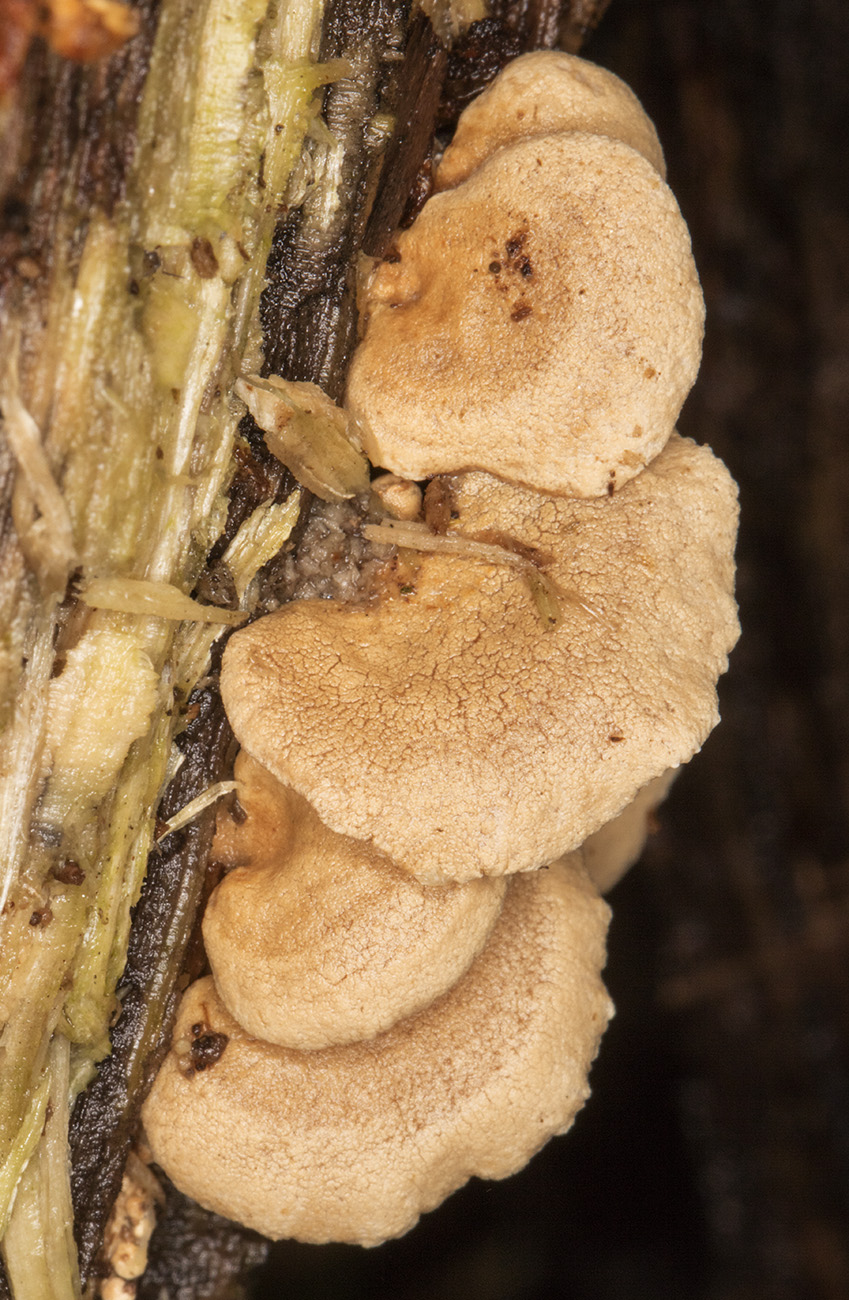
Here's a side view of the one I am vague about, showing the teeth.  The two-tiered appearance is also unusual for a mushroom fungus.  Some were like this, some had the usual one tier, some seemed fused together.

Here's the other species from Hosey Common.

Phellodon tomentosus, Woolly Tooth.  Hosey Common,  8 October 2017
Phellodon tomentosus, Woolly Tooth.  Hosey Common,  8 October 2017
This has a similar habit to my uncertain species from the Ashdown, but I know they are not the same because this one has a distinct curry smell, and the Ashdown specimen does not.


Tuesday, 8 August 2017

The Trees (that were) In The Knoll

Fallen Horse-chestnut in The Knoll, Hayes.  8 June 2017.
Fallen Horse-chestnut in The Knoll, Hayes.  8 June 2017.
Making occasional trips back to Hayes while selling my old house there.  So while there, I have been looking in on The Knoll, my nearest local park, to see how it is getting on.

Here's what I saw early in June.  This is a Horse-chestnut tree that I knew was full of debilitating fungus.  Shown here: Two Weak Horse-chestnuts. It's the tree on the left in the first photo, also shown near the bottom of that post.

Fallen Horse-chestnut in The Knoll, Hayes.  8 June 2017.
Fallen Horse-chestnut in The Knoll, Hayes.  8 June 2017.
Here's a close-up of the torn trunk.  All of the wood is weak.  The colour shows that the lignin has gone, eaten by the fungus.  This is called white rot, and is known to be caused by (among others) the Dryad's Saddle fungus that was growing on the tree and fruiting so profusely.

So what about the other fungus-infested Horse-chestnut, which was under notice of being monolithed?

Horse-chestnut stump in The Knoll, Hayes.  25 July 2017.
Horse-chestnut stump in The Knoll, Hayes.  25 July 2017.
The next time I visited The Knoll, this was it.  This severe treatment is probably just as well.  The Ganoderma that riddled this tree also causes white rot, and so does the Oyster Mushroom that was also growing on it.  And the Silverleaf fungus I saw on it last year is also a serious tree-killer.

Horse-chestnut stump in The Knoll, Hayes.  25 July 2017.
Horse-chestnut stump in The Knoll, Hayes.  25 July 2017.
The fallen tree had also been tidied up, as had the branch of the tree further on that had been knocked off when the Horse-chestnut fell.

This park has a continuing issue with fungus infections in trees.  A big beech fell in 2013; here's an article I wrote for the Orpington Field Club website: The Giant Polypore and its Consequences.  White rot again.  It's not that the park management don't pay attention. It's that they seem to take action just a bit too late! That they have previously got there in time is shown by this monolithed oak tree further down the slope.

Monolithed oak tree in The Knoll, Hayes, 25 July 2017.
That has clearly never blown over.  Also, a fence has recently been built around a veteran pollarded oak nearer the top of the park, probably because people have sometimes set fires in the hollow core of the tree.

Fence around pollarded veteran oak in The Knoll, Hayes, 25 July 2017.
I don't think it's very effective, though.  The school tie on the fence is probably an indication of the cause of that missing paling, which has left a stretch of wire which could easily be climbed over. 

This tree still looks strong, but it has an infection of Laetiporus sulphureus, Chicken of the Woods, which is a tasty edible fungus but which causes a brown cubical rot which can be just as weakening as white rot.  I have photos .. here's one from 2012 ..

Chicken of the Woods, Laetiporus sulphureus, on a veteran oak in The Knoll Hayes.  25 September 2012.
Chicken of the Woods, Laetiporus sulphureus, on a veteran oak in The Knoll Hayes.  25 September 2012.
You can see the brown rot showing where the burnt areas have broken off.  With luck it will only have affected the centre wood, helping to hollow out the tree and leaving the strong outer wood whole.  Trees like this can remain strong and resilient.  But what with this park's history, I think the locals(*) will have to keep an eye on this one ....

(*) Not me any more.

Monday, 16 January 2017

Green and Yellow

Bisporella citrina, Lemon Disco.  High Elms Country Park, 2 January 2017.
Bisporella citrina, Lemon Disco.  High Elms Country Park, 2 January 2017.
This odd little fungus is Lemon Disco, Bisporella citrina.  The individual blobs are very small, but there can be a lot of them.  This orange display drew me to a log by the side of a path through High Elms Country Park.

Log with two fungus species.  High Elms Country Park, 2 January 2017.
Log with two fungus species.  High Elms Country Park, 2 January 2017.
I came for the lemon disco, but stayed for that blue-green stuff on the right .. that is Green Elfcup, a fungus which is quite common, but rarely seen in fruit.  We know it's common because the wood it grows in is stained dark green even when it's not fruiting, and that is found quite often.

Chlorociboria species, Green Elfcup.  High Elms Country Park, 2 January 2017.
Chlorociboria species, Green Elfcup.  High Elms Country Park, 2 January 2017.
Here are the oddly-coloured fruiting bodies.  It's one of two possible species that can't be told apart from a photograph.

That's a great display for a mycologist, though in my opinion, rather an ugly colour ... the wood turns out quite nicely, though.  At one time, it was dried and used to create Tunbridge ware, a form of decorative inlaid woodwork.

(The title of this post, "Green and Yellow" was the title of a folk song I knew as a teenager, a version of the song more commonly known as "Lord Randal."  It did not refer to these fungi, though it could easily have done.)

Thursday, 12 January 2017

Showy and Common

Trametes hirsuta, Hairy Bracket.  High Elms Country Park, 8 January 2017.
Trametes hirsuta, Hairy Bracket.  High Elms Country Park, 8 January 2017.
In this post are two rather similar fungi that produce showy displays when they are fresh.  This first one is Hairy Bracket, Trametes hirsuta.  Similar to, and nearly as common as Turkeytail, Trametes versicolor.  The individual brackets are a couple of inches across and, when young, they are quite hairy.

Trametes hirsuta, Hairy Bracket.  High Elms Country Park, 8 January 2017.
Trametes hirsuta, Hairy Bracket.  High Elms Country Park, 8 January 2017.
They can completely cover a dead log, like this.  The colour forms range from light brown to almost black, and the zoning effect you can see here makes it an easily recognisable species (except that there is another similar one - a common problem for identifiers! - which has larger brackets.)

The second fungus in this post also produces many small brackets, and can also cover dead wood.

Stereum hirsutum, Hairy Curtain Crust.  High Elms Country Park, 2 January 2017.
Stereum hirsutum, Hairy Curtain Crust.  High Elms Country Park, 2 January 2017.
It can even have a similar zoned appearance, as you can see here.

Stereum hirsutum, Hairy Curtain Crust.  High Elms Country Park, 2 January 2017.
Stereum hirsutum, Hairy Curtain Crust.  High Elms Country Park, 2 January 2017.
And, as you might expect from its name, it's hairy!

Stereum hirsutum, Hairy Curtain Crust.  Topside and underside.  High Elms Country Park, 2 January 2017.
Stereum hirsutum, Hairy Curtain Crust.  Topside and underside.  High Elms Country Park, 2 January 2017.
But the hairs last longer.  Old Turkeytail does not look particularly hairy, and the brackets seem quite thin.  And if you are ever in doubt about which one you are looking at, the underside is completely different.  That last photo shows the underside of Hairy Curtain Crust on the right.  Here is the underside of Turkeytail:

Trametes versicolor, Turkeytail.  Underside.  High Elms Country Park, 8 January 2017.
Trametes versicolor, Turkeytail.  Underside.  High Elms Country Park, 8 January 2017.
Very obviously covered with pores. 

Saturday, 31 December 2016

Two Weak Horse-chestnuts

Horse-chestnut trees, Aesculus hippocastanum.  The Knoll, Hayes, 12 November 2016.
Horse-chestnut trees, Aesculus hippocastanum.  The Knoll, Hayes, 12 November 2016.
Two Horse-chestnut trees in my local park, both severely cut back.  Not long ago, we were warned by these signs:

Notice on Horse-chestnut trees.  The Knoll, Hayes, 29 October 2016
Notice on Horse-chestnut trees.  The Knoll, Hayes, 29 October 2016
Well, they have been reduced, though not really to monoliths (which means a standing stone or something that resembles one).  But why?  Well, look at this.

Fungi on a Horse-chestnut tree.  The Knoll, Hayes, 14 December 2016.
Fungi on a Horse-chestnut tree.  The Knoll, Hayes, 14 December 2016.
On the right of this tree you can see a series of bracket fungi, a Ganoderma species, and higher up a cluster of something else.  Those Ganodermas are tough, half corky and half woody.

Ganoderma species on Horse Chestnut, Aesculus hippocastanum. The Knoll, Hayes.  14 December 2016.
Ganoderma species on Horse Chestnut, Aesculus hippocastanum. The Knoll, Hayes.  14 December 2016.
I tried to get a cross-section of one of those brackets.  You can sometimes tell the species by looking at the layer between each year's growth.  And here, you can see just where my hacksaw blade broke.

At the bottom of the tree there are even bigger brackets:

Ganoderma species on Horse Chestnut, Aesculus hippocastanum. The Knoll, Hayes.  14 December 2016.
Ganoderma species on Horse Chestnut, Aesculus hippocastanum. The Knoll, Hayes.  14 December 2016.
Almost hidden by fallen leaves.  Still the same species.  It has penetrated all up and down the tree.  You can jump up and down on those tough brackets without budging them.

The upper cluster looks like this:

Pleurotus ostreatus, Oyster Mushroom, on Horse Chestnut.  The Knoll, Hayes, 10 December 2016.
Pleurotus ostreatus, Oyster Mushroom, on Horse Chestnut.  The Knoll, Hayes, 10 December 2016.
They are Oyster Mushrooms, a quite different species, an annual growth.  You can also see that the tree has a typical woodpecker nest hole and that the dead wood has many beetle holes.  It's not common to see more than one fungus species fruiting on a living tree.  Here there are three, because:

At the base of the tree on the other side:

Chondrostereum purpureum, Silverleaf, on Horse Chestnut.  The Knoll, Hayes.  14 December 2016.
Chondrostereum purpureum, Silverleaf, on Horse Chestnut.  The Knoll, Hayes.  14 December 2016.
Several clumps of a purplish fungus.  It's very pretty close up.

Chondrostereum purpureum, Silverleaf, on Horse Chestnut.  The Knoll, Hayes.  14 December 2016.
Chondrostereum purpureum, Silverleaf, on Horse Chestnut.  The Knoll, Hayes.  14 December 2016.
It's also very bad for the tree.  This is the fungus that causes silverleaf on plum trees.  It's a killer, but usually, healthy trees not related to plums can resist it.

So, three rather nasty fungal infections, plus birds and insects.  This is a weak tree and it's no wonder it was cut back to stop the wind from blowing it over.

What about the other tree?  Well earlier in the year I took this photo:

Dryad's Saddle, Polyporus squamosus, on Horse-chestnut.  The Knoll, Hayes, 4 September 2016.
Dryad's Saddle, Polyporus squamosus, on Horse-chestnut.  The Knoll, Hayes, 4 September 2016.
Large amounts of yet another fungus, Dryad's Saddle.  Here you can also see that the green leaves are turning brown too early.  This is because of an infestation by the Horse-chestnut Leaf-miner moth, whose larvae eat out the insides of the leaves of all our local horse-chestnut trees.  Although the trees survive, it's thought that this must weaken them, and these two examples support that theory.

Dryad's Saddle is an annual growth, and the big brackets drop to the ground in winter.

Horse-chestnut Leaf-miner, Cameraria ohridella.  On the door above my garden light trap in Hayes on 11 August 2015.
Horse-chestnut Leaf-miner, Cameraria ohridella.  On the door above my garden light trap in Hayes on 11 August 2015.
This is the tiny Horse-chestnut Leaf-miner moth - this specimen came to my garden light trap last year.   I have seen clouds of them around horse-chestnut trees in their flight season.  The species was first seen in England in 2002 and has spread rapidly through the south-east.

So the trees are supporting an excellent diversity of life, if they will oblige by not falling over!

p.s.  Here are three local monolithic trees to show what I expected.

Three monolithic trees.  Hayes Common and West Wickham Common, 24 December 2016.
Three monolithic trees.  Hayes Common and West Wickham Common, 24 December 2016.
 The centre tree, a silver birch, has probably reached this state naturally.  The beech on the left, and what I think is an oak on the right, are near paths and were probably reduced to remove the chance that they would fall on someone passing by. 

Of course it's possible that more work will be done on the horse-chestnuts, even though their signs have gone.

Monday, 26 December 2016

Winter Oysterlings

Panellus stipticus, Bitter Oysterling.  Hayes Common, 28 October 2015.
Panellus stipticus, Bitter Oysterling.  Hayes Common, 28 October 2015.
Here are a couple of oysterling fungi that grow on dead wood.  This first one, the Bitter Oysterling, grows in the normal fungus season and well into the winter.  It's easily recognised by the crackle finish of the upper surface.

These ears are only one or two inches across.  The stem of an oysterling, like that of a more normal oyster mushroom, is at one side.

Panellus stipticus, Bitter Oysterling.  Hayes Common, 28 October 2015.
Panellus stipticus, Bitter Oysterling.  Hayes Common, 28 October 2015.
Here's the underside, showing the gills spread out like a fan.  I have seen a few of these in the woods this December, but I only had my iPhone with me and my photos are not as good as these I took last year.

Another oysterling is typically found in the winter.

Panellus serotinus, Olive Oysterling.  Hayes Common, 11 December 2016.
Panellus serotinus, Olive Oysterling.  Hayes Common, 11 December 2016.
I spotted this Olive Oysterling over a week into December, on a dead Silver Birch stump.  It's softer than the Bitter Oysterling, with a slimy cap, and only lasts a couple of weeks in its prime.  It's not scarce, but I have not seen it very often, probably because it doesn't last. 

Panellus serotinus, Olive Oysterling.  Hayes Common, 11 December 2016.
Panellus serotinus, Olive Oysterling.  Hayes Common, 11 December 2016.
The gills are more delicate than those of the Bitter Oysterling, and that mottled band where the stem meets the gills is typical of this species.

There are other Panellus species, but I have yet to encounter them.

Wednesday, 21 December 2016

Frosty Virgins

Hygrocybe virginea, Snowy Waxcap.  Hayes Common, 19 November 2016.
Hygrocybe virginea, Snowy Waxcap.  Hayes Common, 19 November 2016.
"virginea" does mean virgin in Latin, but it also means unworked land, which is more appropriate for this small Snowy Waxcap mushroom.  This photo is from a walk in November just after a frosty night.

Hygrocybe virginea, Snowy Waxcap.  Hayes Common, 19 November 2016.
Hygrocybe virginea, Snowy Waxcap.  Hayes Common, 19 November 2016.
This is what's known as unimproved grassland, meaning no-one has put fertiliser on it.  So you get a range of wild flowers, and the grasses are not the coarse and vigorous types that like lots of nitrates.  Farmers might think that's an improvement .. ecologists, less so.

On the same walk I saw another, even more common fungus.

Woodland leaf litter and a dead stump.  Hayes Common, 22 November 2016.
Woodland leaf litter and a dead stump.  Hayes Common, 22 November 2016.
This is a path through the woods.  You can see holly bushes, and the leaf litter tells you that this is an oak wood.  Holly is a common and vigorous undergrowth.  (I took this shot a couple of days later to set the scene)

Xylaria hypoxylon, Candlesnuff.  Hayes Common, 19 November 2016.
Xylaria hypoxylon, Candlesnuff.  Hayes Common, 19 November 2016.
Candlesnuff is a small fungus that is very often found on moist stumps.  It gets its name from its appearance of a candle wick that has been snuffed out.

Xylaria hypoxylon, Candlesnuff.  Hayes Common, 19 November 2016.
Xylaria hypoxylon, Candlesnuff.  Hayes Common, 19 November 2016.
The white areas are the spore-bearing part, and when they are ripe like this, you can see clouds of spores being dispersed if you tap them.

Also on this walk I saw this Oak Bush-cricket out very late in the season.

Oak Bush-cricket, Meconema thalassinum.  Female.  Hayes Common, 19 November 2016.
Oak Bush-cricket, Meconema thalassinum.  Female.  Hayes Common, 19 November 2016.
It does not look very healthy.  It's probably completely worn out and not happy with the cold weather - it won't survive much longer.  At its rear end is its long curved ovipositor, which it uses to dig under the bark of oak trees to lay its eggs.  That bark is tough stuff and it must be hard work to get in there.

Next I'll post some December fungi.

Friday, 9 December 2016

Small and perhaps a bit Too Colourful

Phlebia radiata, Wrinkled Crust.  Hayes Common, 16 November 2016.
Phlebia radiata, Wrinkled Crust.  Hayes Common, 16 November 2016.
There's a lot of this Wrinkled Crust around this year, on dead broadleaved trees of various species.  If you look at this photo:

Pond on Hayes Common, 23 November 2016.
You can just about see orange markings on that trunk in the foreground.  So despite the bright colour, they are not all that conspicuous.

On the same trunk are some other small, colourful fungi.

Ascocoryne sarcoides or Ascocoryne cylichnium.  Pond on Hayes Common, 23 November 2016.
Ascocoryne sarcoides or Ascocoryne cylichnium.  Pond on Hayes Common, 23 November 2016.
There are two Ascocoryne species that can't be separated without a microscope.  While looking at this photo, you can also see a black "bootlace" of the sort that Honey Fungi (Armillaria species) use to spread - very effectively - from tree to tree and along a trunk.

Calocera cornea, Small Stagshorn.  Dacromyces stillatus, Common Jellyspot, in the background.
Pond on Hayes Common, 25 November 2016.
Also on that trunk, two orange fungi,one small and the other tiny.  Small Stagshorn is easy to see when you get close, but the little orange blobs of Common Jellyspot are harder to see unless they crowd together in bigger clumps than this.

A short distance away, on a stump which was actually in the water, was this:

Unidentified Myxomycete.  Hayes Common, 13 November 2016.
Unidentified Myxomycete.  Hayes Common, 13 November 2016.
Slightly blurred because it was out of reach of a steady hand-held photo.  This is a slime mould or Myxomycete, not a fungus.  They are even more ephemeral than fungi, fruiting and dying back in a couple of days.   I have not been able to identify these purple blobs on stalks.

This is another slime mould:

Myxomycete.  Trichia species.  Hayes Common, 18 November 2016.
Myxomycete.  Trichia species.  Hayes Common, 18 November 2016.
It looks like an immature Trichia.  All these species like it wet - well, damp anyway.  In this particular hollow they certainly have it that way.  If you compare the photo above with the one in the previous post taken a few days earlier, you will see that the water level has risen noticeably.  The Inkcaps featured in that post are now under water, as is the stump on which I saw both of these slime moulds.

In fact .. here is the same hollow in February 2014:

Pond on Hayes Common, 9 February 2014.
Taken from the same angle, but from higher up, for obvious reasons.