Showing posts with label liverworts. Show all posts

Friday, 27 January 2017

Things Grow on Trees.

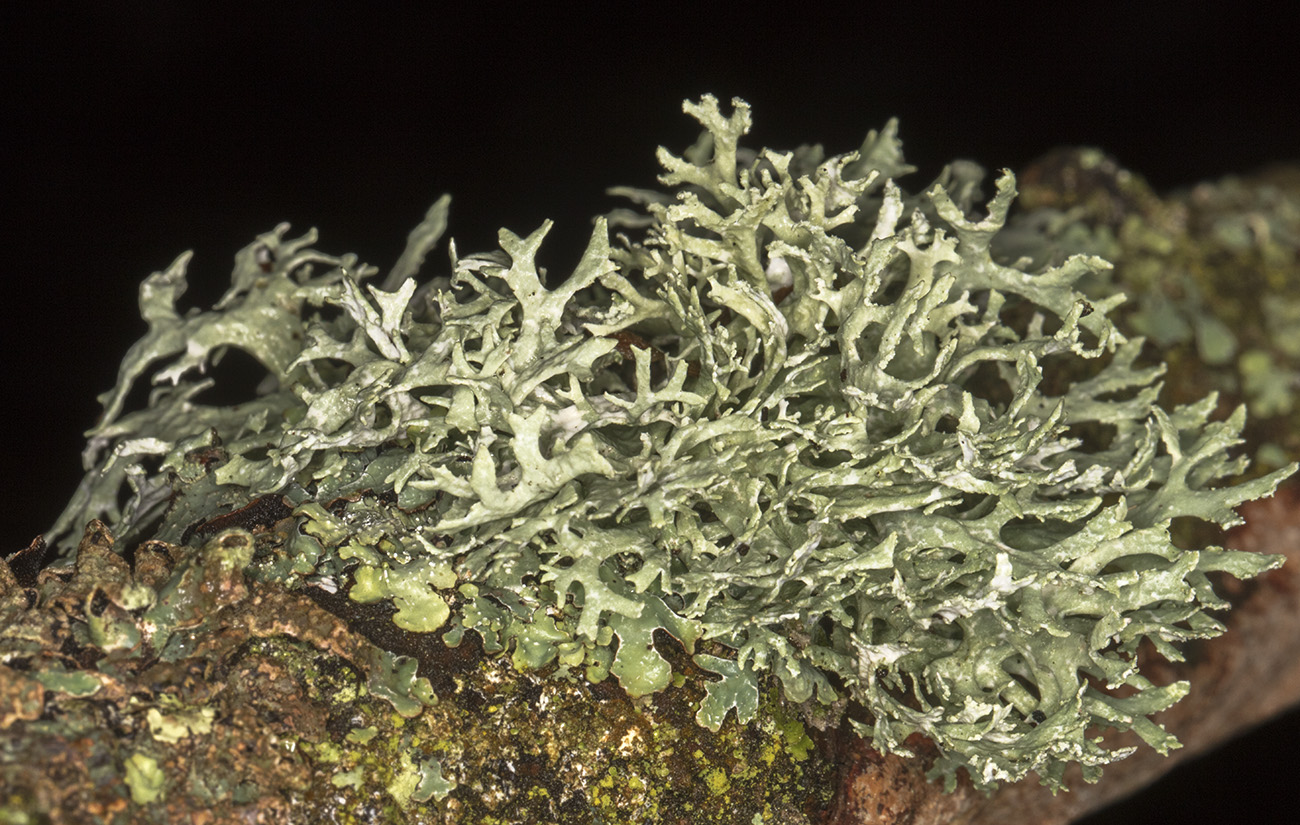
Oak with Flavoparmelia caperata.  Hayes Common, 30 December 2016.
Oak with Flavoparmelia caperata.  Hayes Common, 30 December 2016.
Things grow on trees, and I don't mean just fungi, which grow on trees because they are eating the trees.  I mean things that just use the trees as a place to rest, where they can get some light, and stand less chance of being grazed or trodden on.

In the UK, it's mostly lichens, mosses and liverworts.  Other countries with different biota and climates can have a much more extensive range of plants that behave like this.  The tree in the top photo has some moss and some large patches of a distinctive bluish-green lichen, Flavoparmelia caperata.  As you can see, you don't need to go far from a road to find something like this.

Usually, they are high up in the trees, but it is possible to find spots like this where they are arrayed near the ground where you can get a good look.

Oak branch with a range of mosses and lichens.  Hayes Common, 30 December 2016.
Oak branch with a range of mosses and lichens.  Hayes Common, 30 December 2016.
As here; some of it is high up, but there's also that long, long low branch covered with greenery.

Evernia prunastri, Oakmoss.  On an oak branch on Hayes Common, 2 January 2017.
Evernia prunastri, Oakmoss.  On an oak branch on Hayes Common, 2 January 2017.
In oak woods, there is a great deal of this shrubby Oakmoss, actually a lichen despite its common name.  You can see lots of clumps that have fallen to the ground, perhaps disturbed by squirrels.  It grows on the small branches and twigs.  There are also many other species that are easy to find.

On the trunks you find more of the leafy lichens like the one in the top photo.  Also, things like this:

Metzgeria furcata, Forked Veilwort, on oak.  Hayes Common, 30 December 2016.
Metzgeria furcata, Forked Veilwort, on oak.  Hayes Common, 30 December 2016.
This is on an oak trunk.  You might think it looks mossy, but close up:

Metzgeria furcata, Forked Veilwort, on oak.  Hayes Common, 30 December 2016.
Metzgeria furcata, Forked Veilwort, on oak.  Hayes Common, 30 December 2016.
Those delicate flat forked straps are not moss leaves at all, but the thallus of a common liverwort, Metzgeria furcata. 

You don't need to go into the woods to see this sort of thing.  Here's a local street tree.

Tree on Bourne Vale, Hayes, 13 January 2017.
The marker shows where I spotted a tiny clump of moss.

Syntrichia laevipila, Small Hairy Screw-moss, on the bark of a tree trunk on Bourne Vale, Hayes, 13 January 2017.
I have rotated the photo to put the moss in a more familiar orientation, but you can see it's growing on rough bark.  There are also several lichens nearby.  There are not many records of Syntrichia laevipila in this area, so this was a good find.

From a distance, this tree might look quite bare without its leaves, but if you look at the higher branches from a bit closer:

Lichens on a tree on Bourne Vale, Hayes, 13 January 2017.
You can see that it is absolutely covered with, not only lichens, but there will also be mosses, liverworts and algae.  And that's on a busy suburban street. 

I haven't mentioned algae before, but only because they are so small that I can't produce decent photos of them.  They are there alright.

Tuesday, 6 March 2012

Toys Hill, March

View from Scord's Wood, 3 March 2012.
On another rainy and drizzly day the Orpington Field Club walked some of the trails around Toys Hill, looking in particular for mosses and liverworts.

We saw quite a few. I had seen some of the mosses before, but I was surprised by all the different liverworts, which are so inconspicuous and moss-like that I have probably seen them many times without realising it. I will put about a dozen moss and liverwort photos, as well as these and other photos from the walk, in this folder if anyone wants to see them all: Toys Hill photos.

Here is a sample.

Atrichum undulatum.  Toys Hill, 3 March 2012.
Atrichum undulatum.  Toys Hill, 3 March 2012.
This is one of a group of mosses that grow in clumps with a robust and starry appearance. Some, the Polytrichums, have opaque leaves and have hairy caps over the young spore capsules; these have translucent wavy leaves and hairless caps.

Mnium hornum with capsules.  Toys Hill, 3 March 2012.
Mnium hornum with capsules.  Toys Hill, 3 March 2012.
Mnium hornum is a common moss. This clump is full of spore capsules.

Diplophyllum albicans, a leafy liverwort. Toys Hill, 3 March 2012.
Some liverworts have flat lobes, and some are leafy, like this one, and hard to tell from mosses when they have no spore capsules. When they do, you can see that the capsules are rounded and dark brown or black, and the setae that bear them are fragile and temporary.

Lophocolea species.  A liverwort that smells of disinfectant.  Toys Hill, 3 March 2012.
Lophocolea species.  A liverwort that smells of disinfectant.  Toys Hill, 3 March 2012.
This Lophocolea is spreading over a tree stump, and you can see some of the round capsules and whitish setae. This one is also unlike a moss in that if you drag a fingernail over it, it smells strongly of disinfectant.

We also saw some fungi, including one I had not seen before:

Bitter Oysterling, Panellus stipticus. Toys Hill, 3 March 2012.
This fungus was supposedly once used to stem the flow of blood. We also saw many more of the Scarlet Elfcups that I first saw back in February; some of these were noticeably larger, as much as 5cm across.

Scarlet Elf-cup, Sarcoscypha coccinea (confirmed to be the local species the previous year).  Scord's Wood, 3 March 2012.
Scarlet Elf-cup, Sarcoscypha coccinea.  Scord's Wood, 3 March 2012.
I would not want you to think that we only saw mosses, liverworts and fungi. The woods were full of new growth. There were hillsides covered with bluebells, but only a few scattered plants were in flower. Primroses flowered by the paths, and there were small specimens of the so-called Golden Saxifrage in many places.  I didn't get decent photos of any of them.  There were ferns, including this one, which was on a clay bank:

Hard Fern, Blechnum spicant. Toys Hill, 3 March 2012.
Its fronds are branched once, with simple pinnae, unlike many of our ferns which are branched twice or three times. And Hazel catkins were abundant.  The tree in the centre of the top photo is full of them.  On the way back we passed an old water tower, which has been converted into a bat tower. There is a superb echo if you hoot into the doorway, and few could resist having a go.

Investigating the echo in the Bat Tower. Toys Hill, 3 March 2012.
As we approached the car park, the sun came out! But once again, because of the rain I didn't take my big camera. I wished I had it for a lot of these closeups. The two scenic views were taken with my iPhone, and the rest with my Ixus 100.

Monday, 20 February 2012

A Walk Around Knockholt, Part 1

Orpington Field Club members in the churchyard at Knockholt, with snowdrops. 18 February 2012.
Orpington Field Club members in the churchyard at Knockholt, with snowdrops. 18 February 2012, 10.05 am.
The Orpington Field Club have events arranged for most weekends this year. This one was a walk through fields and woods, following public footpaths, around Knockholt, a village high on the North Downs. I have shown the times of each photo to give the structure of the walk.

I was not expecting to see much botany. We have just had a few cold days and nights, down to under -8C where I live, and some snow, which I expected would kill off anything left from last year and discourage new growth. But there were a few interesting plants, and in general, more to see than I expected.

Rain was forecast, so I took only my small camera, an Ixus 100; it's easier to protect from the wet than a big SLR with a macro lens. It's normally a good camera, but it's less so in poor light conditions, such as in the woods on a cloudy day. Still ...

We started at about 10 am and looked round the churchyard.  Close to the gate was a wooden seat that was so covered with lichens that it must not have been sat on for a long time. The seat itself was just as thickly covered as this back piece.  (I have switched the first two photos around in time so as to put a wide view at the top of this post; I will keep the rest in time order.)

Flavoparmelia caperata on a seat in Knockholt churchyard, covered with lichens. 18 February 2012.
Flavoparmelia caperata on a seat in Knockholt churchyard, covered with lichens. 18 February 2012, 10.02 am.
The churchyard was full of snowdrops. There were thousands in the nearby woods, too; I have never seen so many in one place.

Snowdrops in the churchyard at Knockholt. 18 February 2012.
Snowdrops in the churchyard at Knockholt. 18 February 2012, 10.05 am.
We walked along the road, past a few early Lesser Celandines and some daisies (which seem to flower, if sometimes in small numbers, all year round) and struck off across the fields, at one point coming onto the North Downs Way.  I was in a small group ahead of the others, who were finding Male Ferns and Broad Buckler Ferns.

The North Downs Way near Knockholt.  18 February 2012.
The North Downs Way near Knockholt.  18 February 2012, 10.36 am.
It was good to get past this track into the woods and out of the cold wind.  We started to see a few fungi on felled trees; the usual small brackets, past their best, and a piece of Lumpy Bracket, Trametes gibbosa, which we failed to identify at the time. We passed along the edge of a wood where Douglas Firs were planted.  The coarse texture of their bark made for some fanciful shapes.

Bark of a Douglas Fir, Pseudotsuga species.  18 February 2012.
Bark of a Douglas Fir, Pseudotsuga species.  18 February 2012, 10.56 am.
To one side of the path was a large, dead bracket fungus with a very photogenic texture and appearance.  Where a piece has come away, or been broken off, you can see striations which are the tubes which led to the pores in the lower surface.

Bracket fungus, old and dead. 18 February 2012.
Bracket fungus, old and dead. 18 February 2012, 11.04 am.
There were green things, too. Grasses everywhere, of course, but not in flower.  The trees were covered in mosses, and there were some patches of this liverwort, filmier and flimsier than a moss, which I would expect in damper places.

Metzgeria furcata, a liverwort, on a tree trunk. 18 February 2012.
Metzgeria furcata, a liverwort, on a tree trunk. 18 February 2012, 11.06 am.
I am not really obsessed by fungi, but there are lots around, so it's a good opportunity to learn, and some of them are very photogenic. The small brackets form wonderful patterns. This Turkeytail is very common and makes some lovely shapes.
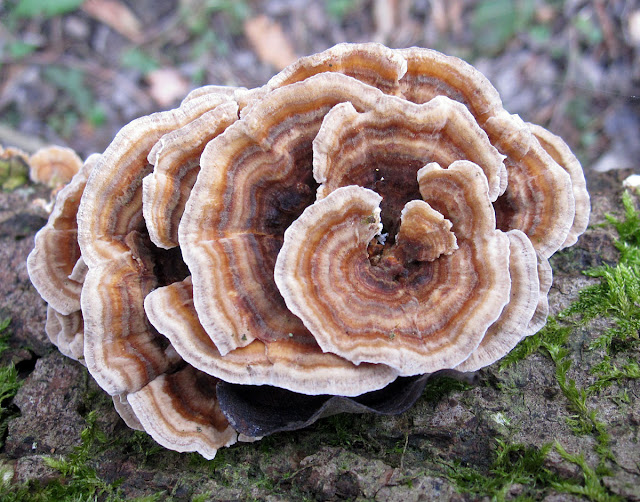
Turkeytail, Trametes versicolor. 18 February 2012.
Turkeytail, Trametes versicolor. 18 February 2012, 11.14 am.
In another section of the woods were several Tutsan specimens; a yellow-flowered Hypericum which is often used as a garden plant. It does also occur as a native, so these are not necessarily garden escapes. These specimens had no flowers, only the dried remains of their black fruits, and the leaves were a bit bedraggled.

Some of the group examining a Tutsan, Hypericum androsaemum. 18 February 2012.
Some of the group examining a Tutsan, Hypericum androsaemum. 18 February 2012, 11.16 am.
Further in, I was intrigued by this rotting branch of what was probably a cherry or a close relative. The outer part of the branches had rotted away almost completely, leaving the inner part surrounded by unbroken bands of bark, which must have been particularly resistant to fungi and beetles.

Decaying branch of a cherry or relative, Prunus species, with the bark still present in strips around the remains of the wood.  18 February 2012.
Decaying branch of a Prunus species, with the bark still present in strips around the remains of the wood.
18 February 2012, 11.36 am.
And later we came upon a group of plants with the unlikely name of Abraham, Isaac and Jacob. Those who had been here before were expecting to see this, and indeed it is spreading though the woods and seems to be thriving. These specimens appear to have been nipped by the frost, and their flower-buds are only just visible among the old and new leaves; they are below and to the right of centre in this photo.  You can also see that these plants are competing with brambles and nettles, so they must be tough.

Abraham, Isaac and Jacob, Trachystemon orientalis.  Flowerbuds look frostbitten.  18 February 2012.
Abraham, Isaac and Jacob, Trachystemon orientalis.  Flowerbuds look frostbitten.  18 February 2012, 11.28 am.
That's about half-way through my photos for this walk, so I will continue next time.