Showing posts with label West Wickham Common. Show all posts

Tuesday, 30 August 2016

Out Come the Tiny Ones

Moths in my garden light trap, 25 August 2016.
The hot weather brings with it some really tiny moths, making identification of a night's catch very tricky.  This photo is from my garden trap.  Bottom right are a couple of big, showy Jersey Tigers.  Above them, left to right, are a Tree-lichen Beauty, a Chequered Fruit-tree Tortrix, a female Light Brown Apple Moth (on the diagonal strut), and an Elbow-striped Grass-veneer.


Those last two are quite small, but very distinctively marked, so I can identify them at a glance.  But the tiny dark thing at top right is also a moth.  It's one of a large family of tiny moths whose caterpillars live inside leaves, between the upper and lower skins, eating out their juicy centres and leaving a passage behind, so that they are known as leaf miners.  It is (I think) in the genus Stigmella.   These can not be identified to species without dissection.

Many of the tiny moths can only be taken to genus.

Parornix and Ectoedemia.  West Wickham Common light trap, 24 August 2016.
Parornix and Ectoedemia.  West Wickham Common light trap, 24 August 2016.
The larger of these two is itself so small that it just looks like a dark fleck to the eye.  The little one, which I think is an Ectodoemia, is something I only see as a moth when I enlarge photos and examine all the tiny imperfections close up.   It belongs to the same family as the Stigmella, the Nepticulidae.

Amateur trappers mostly used to ignore these smaller moths completely until 2012, when a decent field guide to them came out.  (*)  Another guide is also now available (**) which includes photos of all the British moths, and if you know roughly what you are looking at, you can get a lot of help from the UK Moths site.

(*) Field Guide to the Micro Moths of Great Britain and Ireland, by Phil Sterling and Mark Parsons, illustrated by Richard Lewington.  This relies on paintings and includes a key to genera, which is useful if you have a specimen and a low-powered microscope.  Otherwise, go through the pictures!

(**) British Moths, second edition, by Chris Manley.  This is a photographic guide and is enough better than the first edition that I use it a lot. 


Friday, 8 April 2016

Hairy-Footed Flower Bee

Hairy-footed Flower Bee, Anthophora plumipes.   Male.  West Wickham Common, 3 April 2016.
Hairy-footed Flower Bee, Anthophora plumipes.   Male.  West Wickham Common, 3 April 2016.
SOme early bees are out and about, and the one with the best name is the Hairy-footed Flower Bee.  It's about the same size as a bumble-bee worker, but it's too early in the year for the workers to be flying, so if you think you see one it might be this.  This is the male, a furry bee of a light buff colour.  This photo shows off the hairy feet pretty well.

Hairy-footed Flower Bee, Anthophora plumipes.   Female.  West Wickham Common, 3 April 2016.
Hairy-footed Flower Bee, Anthophora plumipes.   Female.  West Wickham Common, 3 April 2016.
The female is much darker, but has a distinctive light tuft on its leg.

Both these bees are working through a patch of Red Dead-nettle, which is currently in full flower.   Other insects also come to these flowers; this one ..

Bombus terrestris, Buff-tailed Bumblebee.   Queen.  West Wickham Common, 3 April 2016.
Bombus terrestris, Buff-tailed Bumblebee.   Queen.  West Wickham Common, 3 April 2016.
is a bumble-bee.  It's a queen Buff-tailed Bumblebee, foraging to feed its first batch of larvae.  It is twice the length of the flower bees and could not be mistaken for one.

There are also some other mid-sized flyers around.  For example, bee-flies; as the name suggests, they are flies, not bees.  I didn't manage to photograph the one I saw on April 3rd, so here is a shot from 2014.

Beefly, Bombylius major.  Churchyard of the Church of St. Mary,  Kemsing, 12 April 2014.
Beefly, Bombylius major.  Churchyard of the Church of St. Mary,  Kemsing, 12 April 2014.
It's the same size as the flower bees, and about the same colour as the male, but those stiffly held wings with the dark band are quite distinctive. 

Friday, 30 October 2015

Stinkhorns

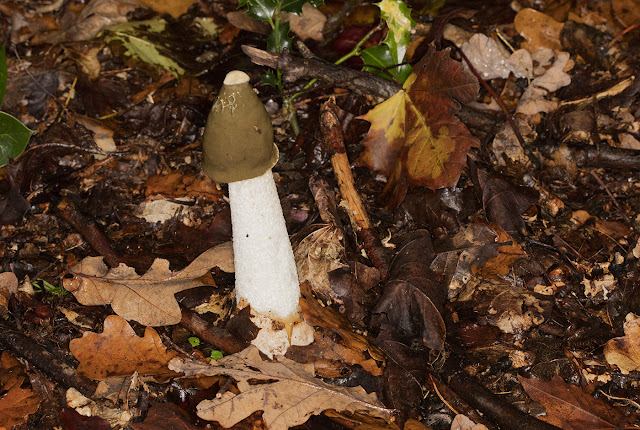
Stinkhorn, Phallus impudicus.  Hayes Common, 28 October 2015.
Stinkhorn, Phallus impudicus.  Hayes Common, 28 October 2015.
Some fungi are smelly.  It's obvious from their name that stinkhorns are prominent among them.

This one is called Phallus impudicus, the unashamed penis.  You can get away with a name like that if you use Latin.  In fact, the word phallus comes originally from Greek, which makes it even more classical and therefore less rude.  Unlike the actual fungus.

This is our commonest stinkhorn, and I came across this lovely specimen on Hayes Common today (as I write).  Stinkhorns emerge from round objects known as eggs, and quickly reach their full size, with a brown cap that smells of excrement.  You can just see the top of the egg at the base of this one.

The brown stuff is called gleba, and contains the spores.  It attracts flies ..

Various flies on a Stinkhorn, Phallus impudicus.  Hayes Common, 28 October 2015.
Various flies on a Stinkhorn, Phallus impudicus.  Hayes Common, 28 October 2015.
Here you can see a dungfly, a flesh fly, a couple of housefly relatives and some smaller flies with red eyes that I don't recognise.  It's clearly popular.  This specimen is quite fresh.  The gleba will be all gone in a day or so, leaving a white skeleton which you can see part of near the top.  The flies will distribute the spores on their legs.  Here's a photo of a stripped one:

Phallus impudicus, Stinkhorn, stripped of its gleba.   Keston Common with the Orpington Field Club, 19 October 2013.
Phallus impudicus, Stinkhorn, stripped of its gleba.   Keston Common with the Orpington Field Club, 19 October 2013.
I have a photo of a similar specimen from Spring Park, West Wickham, but it is being held in the hand of someone who would rather not see that photo on line.

Dog Stinkhorn, Mutinus caninus.  West Wickham Common, 27 October 2015.
Only the day before I saw the beauty in the first photo, I had seen another stinkhorn species on the common next door.  This Dog Stinkhorn has fallen over, and I was actually thinking about it and wishing I could have seen it while it was still upright when I came across the fresh P. impudicus.

You can see that the two are very similar in form, but the Dog Stinkhorn is slimmer, and usually yellower.

Dog Stinkhorn, Mutinus caninus, with two fresh eggs.  Near Ightham Mote, 4 October 2015.
Dog Stinkhorn, Mutinus caninus, with two fresh eggs.  Near Ightham Mote, 4 October 2015.
Here's a rather mangled Dog Stinkhorn I saw when out with the Orpington Field Club near Ightham Mote a couple of weeks ago.  You can see the empty egg it grew from on the right, and there are also two developing eggs in this scene.  This also gives you a good idea of how soft and gooey the gleba is.  If you see a stinkhorn, I suggest you should not touch the smelly gleba.  Just have a cautious sniff and then step back.

Here's one from High Elms in 2013, still fresh and upright:

Mutinus caninus, Dog Stinkhorn.  Orpington Field Club outing to High Elms Country Park, 12 October 2013.
Mutinus caninus, Dog Stinkhorn.  Orpington Field Club outing to High Elms Country Park, 12 October 2013.
I have found stinkhorns before by smelling them first, then looking around.  You might think a thoughtless dog owner has just passed, or paused, at that spot, and indeed it might be so, but on the other hand you might be lucky! 

Stinkhorns are always an interesting find.

Monday, 12 October 2015

Sharp Invertebrates

Volucella zonaria on an ivy bank.  Gates Green Road, Coney Hall, 2 October 2015.
Volucella zonaria on an ivy bank.  Gates Green Road, Coney Hall, 2 October 2015.
These are just a couple of particularly sharp photos that my new camera provided for me.  The first is a large hoverfly, a hornet mimic, eating ivy pollen.  Banks of ivy like this provide the last big feast before the winter for both pollen and nectar lovers.  This hoverfly is going for pollen.  Look at the way her proboscis wraps the ivy's anther.

You don't see how furry these creatures are with the naked eye.  This one looks like a stripy teddy bear.

Garden Spider, Araneus diadematus.  West Wickham Common, 1 October 2015
Garden Spider, Araneus diadematus.  West Wickham Common, 1 October 2015
This Garden Spider does not look like any kind of bear.  It's our commonest orb web spinning spider, and the females are quite large at this time of year.  Here, she is wrapping her prey.  The front legs are spinning it around on an axis formed by the thich nearly-vertical threads.  With one back leg she is guiding a spray of strands from her spinnerets to complete the wrapping.  These spiders always wrap very thoroughly.  The post office would be happy with the result.

EOS 5DS, a camera to enjoy.  Both of these were taken with my normal setup; hand-held with a 100mm macro lens and a ring flash.

Friday, 25 September 2015

Little Oak Tree Creatures

Chalcicoid wasp, family Ormyridae, perhaps genus Ormyrus.  West Wickham Common, 23 September 2015
Chalcicoid wasp, family Ormyridae, perhaps genus Ormyrus.  West Wickham Common, 23 September 2015
Here are three tiny creatures I found on an oak tree on West Wickham Common en route to doing a butterfly transect.  The first photo has a little bit of motion blur because the insect was moving around and feeling the acorn with its antennae; I have now speeded up my standard setting to allow for this sort of thing.

It's a little iridescent wasp.  There are lots of small parasitic wasps, some of which, for example, lay their eggs in creatures that live inside oak galls.  This one doesn't seem to have the right ovipositor for that sort of thing - it would be long and thin - but I don't think it's investigating this acorn in search of a nice vegetarian meal.

It's quite showy, though you can see from the size of the acorn it is walking on that it is really small.

Acorn Weevil (probably), Curculio glandium.  Curculionidae.  West Wickham Common, 23 September 2015
Acorn Weevil (probably), Curculio glandium.  Curculionidae.  West Wickham Common, 23 September 2015
This is a nut weevil.  There are several similar species, and calling this an acorn weevil is just a guess based on it being on an acorn at the time.  Other weevils have also been seen on acorns.  But it's definitely a Curculio species.

These weevils have very weird jointed antennae emerging part way down their proboscis.   Thejoint is mobile, and the arms of the antennae can be brought back to lie parallel to and touching the proboscis.

Araniella species.  Araneidae.  West Wickham Common, 23 September 2015
Araniella species.  Araneidae.  West Wickham Common, 23 September 2015
The third invertebrate is a little green orb web spider, an Arianella. (There are two very similar species.)  Its web is small enough to fit across a single oak leaf and its colour disguises it well.  I think it is a pretty little creature.  Here it was not moving, so I got a sharp image!

Monday, 1 June 2015

Mug Shots

Lunar Marbled Brown.  Drymonia ruficornis.  Notodontidae.  West Wickham Common, 15 April 2015
Lunar Marbled Brown.  Drymonia ruficornis.  Notodontidae.  West Wickham Common, 15 April 2015
Here are a few frontal shots of moths, which can be very characterful.  This Lunar Marbled Brown is the same moth I showed a few posts ago, from the West Wickham Common light trap. 

Marbled Brown, Drymonia dodonaea.  Notodontidae.  West Wickham Common, 15 April 2015
Marbled Brown, Drymonia dodonaea.  Notodontidae.  West Wickham Common, 15 April 2015
And here is a close relative, a Marbled Brown, from the same trap a month later.  And from the same place and time:

Pale Tussock, Calliteara pudibunda.  Lymantriidae.  West Wickham Common, 15 April 2015
Pale Tussock, Calliteara pudibunda.  Lymantriidae.  West Wickham Common, 15 April 2015
A Pale Tussock, a lovely furry creature.  And one which is named after its appearance from this angle ...

Spectacle, Abrostola tripartita.  Noctuidae.  West Wickham Common, 15 April 2015
Spectacle, Abrostola tripartita.  Noctuidae.  West Wickham Common, 15 April 2015
A Spectacle.  Quite a few moths have a tuft of scales just behind the head, as you can see from the previous photos, but on this creature it is rather larger than average.  And then there are the false eyes  ...


Thursday, 23 April 2015

West Wickham April Moths

Lunar Marbled Brown.  In the West Wickham Common light trap on 15 April 2015.
Lunar Marbled Brown.  In the West Wickham Common light trap on 15 April 2015.
Last time we were able to put out the trap in April on West Wickham Common we only caught two moths, both Oak Beauties.  They are nice enough, but that was a meagre catch.  This year we had a second chance and it was a warm night .. there were nearly 100 moths, and ore than 40 of them were this species, the rather pretty Lunar Marbled Brown.  Here it is on measuring paper.

Lunar Marbled Brown.  In the West Wickham Common light trap on 15 April 2015.
Lunar Marbled Brown.  In the West Wickham Common light trap on 15 April 2015.
The lines are at 5mm intervals.  It is of the family Notodontidae, which typically have those beautiful antennae and furry forelegs. 

We picked up one scarce specimen:

Dotted Chestnut, Conistra rubiginea.  In the West Wickham Common light trap on 15 April 2015.
Dotted Chestnut, Conistra rubiginea.  In the West Wickham Common light trap on 15 April 2015.
Not really rare, but nice to see.  It was quite lively and I was only just able to focus and shoot before it scuttled off the edge of the paper. 

This next one looks superficially like the Lunar Marbled Brown, but the antennae are tucked away and the legs are less furry.

Brindled Beauty, Lycia hirtaria.  In the West Wickham Common light trap on 15 April 2015.
Brindled Beauty, Lycia hirtaria.  In the West Wickham Common light trap on 15 April 2015.
The Brindled Beauty is from the large family Geometridae.  We also had one representative of the Nolidae, an Oak Nycteoline, an unremarkable-looking moth except from the front:

Oak Nycteoline, Nycteola revayana.   In the West Wickham Common light trap on 15 April 2015.
Oak Nycteoline, Nycteola revayana.   In the West Wickham Common light trap on 15 April 2015.
When it looks rather menacing.  And there were some micromoths.  This green one is of the family Tortricidae:

Acleris literana.  Near the West Wickham Common light trap on 15 April 2015.
Acleris literana.  Near the West Wickham Common light trap on 15 April 2015.
It is a little aged and worn.  It stood out on the paintwork, but among lichen it would have been invisible.  (Mothers would say "It is a Tortrix," and my rather convoluted phrasing is intended to give the full correct family name.)

And the last one, family Eriocraniidae (yes, two i's together) which can be seen flocking in oak woods in Spring.  The larva feeds as a leaf miner on oaks.

Dyseriocrania subpurpurella.  Near the West Wickham Common light trap on 15 April 2015.
Dyseriocrania subpurpurella.  Near the West Wickham Common light trap on 15 April 2015.
Those vivid purple dots only stand out like that in the camera's flash, but then they are a useful pointer to identification.  Lots of moths are about this size and shape.

Monday, 10 November 2014

Oak Leaf Galls - and a Festoon

Common Spangle Galls, gall wasp Neuroterus quercusbaccarum.  West Wickham Common, 14 September 2014.
Common Spangle Galls, gall wasp Neuroterus quercusbaccarum.  West Wickham Common, 14 September 2014.
Some oak leaf galls from the local commons.  These are fascinating things, created by tiny wasps that somehow cause the oak leaf to grow these shield-like shapes behind which the larvae grow.  At the end of the year, the galls drop off, and just now they can be seen scattered over the woodland floor.

Silk Button Spangle Galls, gall wasp Neuroterus numismalis.  West Wickham Common, 15 September 2014.
Silk Button Spangle Galls, gall wasp Neuroterus numismalis.  West Wickham Common, 15 September 2014.
A different type of gall.  I went back the day after the gall walk to get some better shots, including this one and the next.

Smooth Spangle Galls, gall wasp Neuroterus albipes.  Hayes Common, 15 September 2014.
Smooth Spangle Galls, gall wasp Neuroterus albipes.  Hayes Common, 15 September 2014.
And yet a third, with one of the first type also in the picture at top right.  All these are created by different species of wasp.

And to prove that they drop off:

Fallen oak leaf galls.  Two Common Spangle Galls, gall wasp Neuroterus quercusbaccarum.  One Smooth Spangle Gall, gall wasp Neuroterus albipes.  Keston Common, 30 October 2014.
Fallen oak leaf galls.  Two Common Spangle Galls, one Smooth Spangle Gall.  Keston Common, 30 October 2014.
 Here are some fallen galls photographed in late October.

Larva of a Festoon, Apoda limacodes.  West Wickham Common, 14 September 2014.
Larva of a Festoon, Apoda limacodes.  West Wickham Common, 14 September 2014.
While looking for galls, the walk leader found this, which I was very pleased to see.  It's the odd-looking larva of a Festoon moth.  Festoons are scarce taking the country as a whole, but where they do live, they are often numerous, and there are plenty around here.  There's a good shot of an adult at the bottom of this post showing moths in July, trapped less than 100 yards from where this photo was taken. 

Saturday, 9 August 2014

July Moths at West Wickham

Rhyacionia pinicolana.  Tortricidae. West Wickham Common light trap, 16 July 2014.
Rhyacionia pinicolana.  Tortricidae. West Wickham Common light trap, 16 July 2014.
Let's start with the most colourful moths from West Wickham Common.  These were in July's trap, set on the 15th by Barry Gutteridge, who is now resident there.  I went up at first light on the 16th to photograph the catch.

This one, Rhyacionia pinicolana, is a pine specialist, and a particularly colourful Tortrix.  There are a few mature Scots Pines not far from the trap.

Scarce Silver-lines, Benia bicolorana.  Noctuidae.  West Wickham Common light trap, 16 July 2014.
Scarce Silver-lines, Benia bicolorana.  Noctuidae.  West Wickham Common light trap, 16 July 2014.
This is one of our few truly green moths, a Scarce Silver-lines.  All of our larger moths have English names.  Names have recently been assigned to all the micromoths as well, but they are mostly ridiculous and I tend to ignore them.  (For example, the Rhyaciona at the top has been given the name "Orange-spotted Shoot.")  The older names show a bit more knowledge of the moths they apply to and are often idiosyncratic and interesting, which makes them more memorable, too.

This one is on my measuring paper, marked off in 5mm squares.

Dusky Sallow, Eremobia ochroleuca.  Noctuidae.  West Wickham Common light trap, 16 July 2014.
Dusky Sallow, Eremobia ochroleuca.  Noctuidae.  West Wickham Common light trap, 16 July 2014.
This is one I had not seen before.  The larvae eat grasses, and it's not scarce.  There are many others I have also not seen, which I may come across later.

Gold Triangle, Hypsopygia costalis.  Pyralidae.   West Wickham Common light trap, 16 July 2014.
Small but nicely marked.  This one was on the outside of the trap.  You have to check everywhere nearby when sorting out the catch.

Festoon, Apoda limacodes.  Limacodidae.   West Wickham Common light trap, 16 July 2014.
Festoon, Apoda limacodes.  Limacodidae.   West Wickham Common light trap, 16 July 2014.
This odd, squat little moth is from an unusual family.  The larvae are small oval things that live on oaks.  This one is not common, but where it is found it tends to occur in numbers, so in such places you get the erroneous impression that they are quite common. 

We also had a Yellow Shell and two Tortoiseshell Moths, nice and colourful, but covered elsewhere in this blog recently.

Tuesday, 8 July 2014

Seen During Butterfly Transect

Meadow Brown butterfly, Maniola jurtina.  Nymphalidae.  West Wickham Common, 6 June 2014.
Meadow Brown butterfly, Maniola jurtina.  Nymphalidae.  West Wickham Common, 6 June 2014.
Just a few photos taken during my weekly butterfly transect on West Wickham Common.  It's not actually a great spot for butterflies, but there are always some, and other things to see as well.  There are patches of different sorts of environment, and this Meadow Brown is usually seen among grass, as its name suggests.

Tree Bumblebee, Bombus hypnorum.  West Wickham Common, 6 June 2014.
Tree Bumblebee, Bombus hypnorum.  West Wickham Common, 6 June 2014.
The Tree Bumblebee is a new arrival in Britain, and it is certainly doing well.  There were lots of them on this bramble patch. 

Fly, Broad Centurion, Chloromyia formosa.  West Wickham Common, 6 June 2014.
Fly, Broad Centurion, Chloromyia formosa.  West Wickham Common, 6 June 2014.
This iridescent fly caught my eye.  The photo is a bit blurry because I could not get very close to it.

Oedemera nobilis.  Female.  West Wickham Common, 6 June 2014.
Oedemera nobilis.  Female.  West Wickham Common, 6 June 2014.
 The males of this beetle have large, swollen thighs, but even the females are easy to identify; their green iridescence, and the way their wing-cases don't properly cover their wings, tell you what they are.  There is a similar species with which they might be confused, but that is browner, smaller and doesn't have such a big wing-exposing gap.

Common Blue Butterfly, Polyommatus icarus.  Lycaenidae.  West Wickham Common, 6 June 2014.
Common Blue Butterfly, Polyommatus icarus.  Lycaenidae.  West Wickham Common, 6 June 2014.
It was good to see some blue butterflies on the common.  They turn up occasionally on a patch of heath but I don;t see them every time I visit.

Tuesday, 20 May 2014

West Wickham Moths, May 2014

Light Brocade, Lacanobia w-latinum, and Pale Tussock,  Calliteara pudibunda.  West Wickham Common light trap set on 7 May 2014.
Light Brocade, Lacanobia w-latinum, and Pale Tussock,  Calliteara pudibunda.
West Wickham Common light trap set on 7 May 2014.
The West Wickham Common light trap is going again!  The ranger who used to live there has moved to a new job, and another man, Barry, has moved into the cottage.  So I am pleased that he has been able to find time among sorting everything out to get the moth trap into action in time for the new season.

It's still quite cool, and there was a low count, 20 moths of 13 species.  But this included plenty of enjoyment.  For example, the two above were very pretty, and the Light Brocade was a pristine, fresh specimen.  The Pale Tussock is from a different family that rests with forelegs held out in front, and you can just see an eye peeping out from between its hairy knees.

Pale Tussock, Calliteara pudibunda forma concolor, playing dead after being moved onto the measuring paper.  West Wickham Common light trap set on 7 May 2014.
Pale Tussock, Calliteara pudibunda forma concolor, playing dead after being moved onto the measuring paper.
West Wickham Common light trap set on 7 May 2014.
This is the dark ("melanic") form of the Pale Tussock, and it's in perfect health.  But it has this trick of playing dead when it seems to be in danger.  When I moved it to the marked paper, it exuded a drop of something unpleasant and lay out like this for about five minutes before getting up and carrying on as usual. 

We also had a smattering of tiny moths, a centimeter or less in length.

Parornix species, Phyllonorycter harrisella, Phyllonorycter quercifoliella. Leaf miners.   West Wickham Common light trap set on 7 May 2014.
Parornix species, Phyllonorycter harrisella, Phyllonorycter quercifoliella.  Leaf miners.
West Wickham Common light trap set on 7 May 2014.
Their caterpillars live and grow inside tree leaves, between the top and bottom layers of the leaf, and the adults are sized in proportion.  You can hardly see any of this detail with the naked eye, but the macro lens brings out lots of variation, which is just as well or I'd never be able to identify them without a bit of dissection.  Even with these photos, I can only get some of them down to genus.

I'll finish with a shot that shows what this difference in sizes means in practice.

Ordinary and melanic forms of the Pale Tussock; two Light Brocades; one Phyllonorycter harrisella.
West Wickham Common light trap set on 7 May 2014.
For any sceptics: that melanic Pale Tussock is the same one as in the photo above, and this was taken after it "revived".

Saturday, 3 May 2014

Bramble Bank Goodies


Wasp Beetles, Clytus arietis, on Bramble, Rubus fruticosus agg.  West Wickham Common, 30 April 2014.
Wasp Beetles, Clytus arietis, on Bramble, Rubus fruticosus agg.  West Wickham Common, 30 April 2014.
I was walking my butterfly transect on West Wickham Common and I stopped to look at a bramble bank that often has small wildlife for me to photograph.  I was pleased to see a stripey beetle almost at once.  And even more pleased when I saw that there were two of them, quite oblivious of me and my big camera.  These Wasp Beetles are quite showy and not hard to spot.

Close by was a small swarm of moths with long, long antennae.  Such moths are called Longhorns, and there are a couple of common species.  The males' antennae hold the sense organs that detect the female's pheromones.  They would not hold still long enough for a photo, but the female was there too, resting on a leaf.

Adela reamurella.  Female.  West Wickham Common, 30 April 2014.
Adela reamurella.  Female.  West Wickham Common, 30 April 2014.
This species can look bronze or greenish.  The scales that reflect golden in the camera's flash can seem almost black without it, unless they catch the sun.  It looks hairy and untidy close to, but the dancing swarm of long-horned males is delightful in the sunshine.  In fact, here is a link to part of just such a swarm of Adela reamurella that I caught with a small camera way back in 2011.

Near the swarm, also on a leaf, something just caught my eye ...

Crab Spider, Diaea dorsata.  West Wickham Common, 30 April 2014.
Crab Spider, Diaea dorsata.  West Wickham Common, 30 April 2014.
A crab spider, waiting for something to come close enough to be snatched.  The green colour was a perfect match for the leaf and I wonder why it is not all the same colour.  Other crab spiders can be.  Look at that turret of eyes.  Nothing above or around this creature is going to go unnoticed.

That wasn't all - as I was walking away I saw a small horde of Dock Bugs among the foliage.

Dock Bugs, Coreus marginatus.  West Wickham Common, 30 April 2014.
Dock Bugs, Coreus marginatus.  West Wickham Common, 30 April 2014.
While I am showing a bramble bank, I will add a beetle I saw on the nearby Hayes Common, also on bramble.

Cantharis decipiens. Hayes Common, 27 April 2014.
Like other beetles, Catharis decipiens just looks shiny to the naked eye, yet close to it is quite a hairy beast.

So there is plenty of activity in the undergrowth!