Showing posts with label insects. Show all posts

Saturday, 29 April 2017

Sevenoaks Light Trap

Green Carpet, Colostygia pectinataria.  Sevenoaks Wildlife Reserve, 25 April 2017.
Green Carpet, Colostygia pectinataria.  Sevenoaks Wildlife Reserve, 25 April 2017.
This was the first trap of the year at Sevenoaks Wildlife Reserve.  We have been having cold weather, particularly at night, so I didn't expect to see much, but there were 9 life forms in or around the trap.  Four of them were moths .. including this petty Green Carpet, which was resting on the woodwork near the trap.  It's always worth having a careful look around.  Not everything that has been attracted to the light actually goes in.

As well as the moths there was a dead-looking Parent Bug,

Alder Fly, Sialis species. (There are 3 very similar.)   Sevenoaks Wildlife Reserve, 25 April 2017.
Alder Fly, Sialis species. (There are 3 very similar.)   Sevenoaks Wildlife Reserve, 25 April 2017.
an Alder Fly (a type of Caddis fly),

Honey Bee, Apis mellifera.  Sevenoaks Wildlife Reserve, 25 April 2017.
Honey Bee, Apis mellifera.  Sevenoaks Wildlife Reserve, 25 April 2017.
this handsome honey bee, and

Ichneumonid wasp, Ophion species.  Sevenoaks Wildlife Reserve, 25 April 2017.
Ichneumonid wasp, Ophion species.  Sevenoaks Wildlife Reserve, 25 April 2017.
this scary-looking Ichneumonid wasp.  These can deliver a sting, apparently, though I have never been stung by one nor heard from anyone who has.

The other moths were a Brimstone Moth (which I didn't see but which was spotted behind some wiring when the trap was put away), a Common Quaker, a Clouded Drab and this beauty:

Pale Tussock, Calliteara pudibunda.  Sevenoaks Wildlife Reserve, 25 April 2017.
Pale Tussock, Calliteara pudibunda.  Sevenoaks Wildlife Reserve, 25 April 2017.
A Pale Tussock.  They always rest like this with furry front legs outstretched. 

Wednesday, 21 December 2016

Frosty Virgins

Hygrocybe virginea, Snowy Waxcap.  Hayes Common, 19 November 2016.
Hygrocybe virginea, Snowy Waxcap.  Hayes Common, 19 November 2016.
"virginea" does mean virgin in Latin, but it also means unworked land, which is more appropriate for this small Snowy Waxcap mushroom.  This photo is from a walk in November just after a frosty night.

Hygrocybe virginea, Snowy Waxcap.  Hayes Common, 19 November 2016.
Hygrocybe virginea, Snowy Waxcap.  Hayes Common, 19 November 2016.
This is what's known as unimproved grassland, meaning no-one has put fertiliser on it.  So you get a range of wild flowers, and the grasses are not the coarse and vigorous types that like lots of nitrates.  Farmers might think that's an improvement .. ecologists, less so.

On the same walk I saw another, even more common fungus.

Woodland leaf litter and a dead stump.  Hayes Common, 22 November 2016.
Woodland leaf litter and a dead stump.  Hayes Common, 22 November 2016.
This is a path through the woods.  You can see holly bushes, and the leaf litter tells you that this is an oak wood.  Holly is a common and vigorous undergrowth.  (I took this shot a couple of days later to set the scene)

Xylaria hypoxylon, Candlesnuff.  Hayes Common, 19 November 2016.
Xylaria hypoxylon, Candlesnuff.  Hayes Common, 19 November 2016.
Candlesnuff is a small fungus that is very often found on moist stumps.  It gets its name from its appearance of a candle wick that has been snuffed out.

Xylaria hypoxylon, Candlesnuff.  Hayes Common, 19 November 2016.
Xylaria hypoxylon, Candlesnuff.  Hayes Common, 19 November 2016.
The white areas are the spore-bearing part, and when they are ripe like this, you can see clouds of spores being dispersed if you tap them.

Also on this walk I saw this Oak Bush-cricket out very late in the season.

Oak Bush-cricket, Meconema thalassinum.  Female.  Hayes Common, 19 November 2016.
Oak Bush-cricket, Meconema thalassinum.  Female.  Hayes Common, 19 November 2016.
It does not look very healthy.  It's probably completely worn out and not happy with the cold weather - it won't survive much longer.  At its rear end is its long curved ovipositor, which it uses to dig under the bark of oak trees to lay its eggs.  That bark is tough stuff and it must be hard work to get in there.

Next I'll post some December fungi.

Friday, 29 July 2016

Some Things To See at Keston Common

Bog Asphodel, Narthecium ossifragum.  Keston Common bog, 23 July 2016.
Bog Asphodel, Narthecium ossifragum.  Keston Common bog, 23 July 2016.
Masses of Bog Asphodel, in the bog, naturally enough.

Broad-leaved Helleborine, Epipactis helleborine.  Keston Common, 23 July 2016.
Broad-leaved Helleborine, Epipactis helleborine.  Keston Common, 23 July 2016.
A single small patch of Broad-leaved Helleborine by the roadside.

White Water-lily, Nymphaea alba.  Keston Ponds, 23 July 2016.
White Water-lily, Nymphaea alba.  Keston Ponds, 23 July 2016.
White Water-lily in the ponds, looking pure and beautiful.

Yellow Water-lily, Nuphar lutea.  Keston Ponds, 23 July 2016.
Yellow Water-lily, Nuphar lutea.  Keston Ponds, 23 July 2016.
Yellow Water-lilies in the same ponds.  Sometimes called Brandy-bottle from the shape of the fruit.

Cinnabar caterpillar, Tyria jacobaeae.  Keston Common, 23 July 2016.
Cinnabar caterpillar, Tyria jacobaeae.  Keston Common, 23 July 2016.
The yellow and black caterpillar of the Cinnabar moth, eating up a Ragwort, which makes it poisonous for potential predators to eat.

Water Forget-me-not, Myosotis scorpioides.  Keston Ponds, 23 July 2016.
Water Forget-me-not, Myosotis scorpioides.  Keston Ponds, 23 July 2016.
Water Forget-me-not on the margins of the ponds.

Branched Bur-reed, Sparganium erectum.  Keston Ponds, 23 July 2016.
Branched Bur-reed, Sparganium erectum.  Keston Ponds, 23 July 2016.
The flowers of Branched Bur-reed, also on the margins of the ponds.

Emperor Dragonfly ovipositing.  Anax imperator.  Keston Ponds, 23 July 2016.
Emperor Dragonfly ovipositing.  Anax imperator.  Keston Ponds, 23 July 2016.
And lots of Dragonfiles and Damselflies zooming around the ponds, like this Emperor Dragonfly which is laying its eggs.


Monday, 13 June 2016

Riddlesdown Quarry, Early Summer

Riddlesdown Quarry, 9 June 2016.


Walking into Riddlesdown quarry in summer is a completely different experience from a winter visit. It is a few years since I had seen it in this season.  I was invited to join Andrew, one of the rangers, for a butterfly walk.  My aim was to photograph anything interesting, not just butterflies!  We did see some of the scarce Small Blues, the main reason for this walk, which I managed not to photograph.

Even before the walk I had taken a couple of shots on a nearby bank. This is Crested Dog's-tail, Cynosurus cristatus.  It's a common grass, but very showy.


Burnet Companion, Euclidia glyphica.  Riddlesdown quarry, 9 June 2016.
Burnet Companion, Euclidia glyphica.  Riddlesdown quarry, 9 June 2016. 
Inside the quarry we soon saw lots of these moths, Burnet Companions, common day-fliers in grassland.  I was pleased to get a close photo, which I had not managed before.  

I saw a couple of spiders ..

Crab spiders, Misumena vatia.  Riddlesdown quarry, 9 June 2016
Crab spiders, Misumena vatia.  Riddlesdown quarry, 9 June 2016
In the middle of this Oxeye Daisy is a crab spider, Misumena vatia.  Crab spiders are ambushers.  They wait in a flower until an insect comes along, then pounce.  This species can change its colour to yellow, but I have only ever seen white ones, whatever colour flower they are on.  Of course that might just mean that I have missed some well-camouflaged specimens!

The larger one is a female.  The small striped one is a male, which I found wandering around on a different flower.

Jumping spider, Heliophanus species, with prey. Riddlesdown quarry, 9 June 2016
Jumping spiders creep up on their prey and then jump at them.  They are fast.  This Heliophanus has what looks like a small fly.

Brimstone caterpillar, Gonepteryx rhamni, on Common Buckthorn, Rhamnus cathartica.  Riddlesdown quarry, 9 June 2016
Brimstone caterpillar, Gonepteryx rhamni, on Common Buckthorn, Rhamnus cathartica.  Riddlesdown quarry, 9 June 2016
Andrew pointed this out to us.  It's the caterpillar of a Brimstone butterfly, lying along the leaf of a small Buckthorn.  This and the related Alder Buckthorn are its only food plants.  The caterpillars were hard to see until we were right up close to them.  Soon afterwards, we watched a female Brimstone lay a single egg on a Buckthorn leaf.   That's it inset into this photo.

Weevil, Tychius schneideri.  Riddlesdown quarry, 9 June 2016.
As well as white Oxeye Daisies, the quarry was full of yellow flowers.  All up the slopes were masses of Kidney Vetch, the food plant of the Small Blue butterfly.  

We looked inside a few of the flower heads, searching for caterpillars, but didn't find any.  It was only a quick look, not a proper investigation.  But I did see this little weevil, Tychius schneideri, which is known to favour Kidney Vetch.

There were many yellow-flowered dandelion lookalikes, and the floor of the quarry had a healthy population of Rock Rose.
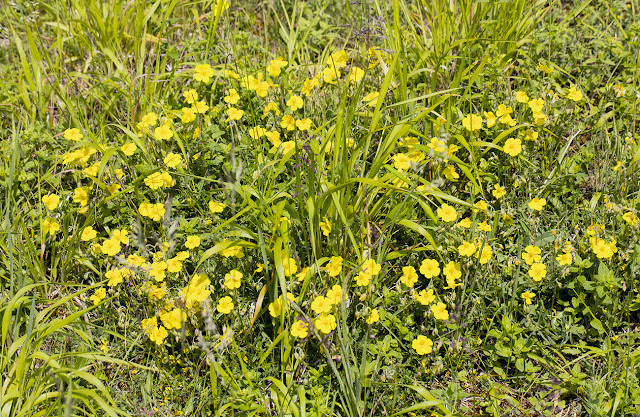

Common Rock-rose, Helianthemum nummularium.   Riddlesdown quarry, 9 June 2016.
Common Rock-rose, Helianthemum nummularium.   Riddlesdown quarry, 9 June 2016.
And, of course, there were many other things.  I have carefully avoided repeating things featured in the previous summertime post linked to at the top.  


Sunday, 29 May 2016

Hutchinson's Bank

Wild Strawberry, Fragaria vesca.  Hutchinson's Bank, 24 May 2016.
Wild Strawberry, Fragaria vesca.  Hutchinson's Bank, 24 May 2016.
As you walk onto Hutchinson's Bank from a convenient parking spot, the sides of the path are lined with wild strawberries.  These should be fruitful later on.  The fruits are small, but tasty.  However, I am wary of eating fruits which are positioned where dogs can be walked.

Beefly, Bombylius major.   Hutchinson's Bank, 24 May 2016.
Beefly, Bombylius major.   Hutchinson's Bank, 24 May 2016.
In the chalk cutting, there is what looks like a discarded piece of concrete, though it might have some purpose; this is a well-cared-for spot and rubbish would have been removed.  This Beefly was basking on it.  It might look a bit like a bee, but closer up it can be seen to have a fly's antennae and only two wings.

Beeflies lay their eggs in the holes made by solitary bees, and their larvae eat the bee larvae when the eggs hatch.   That long proboscis is not a sting.  It is used by the fly to eat pollen while hovering above a flower.

Horseshoe Vetch, Hippocrepis comosa.  Hutchinson's Bank, 24 May 2016.
Horseshoe Vetch, Hippocrepis comosa.  Hutchinson's Bank, 24 May 2016.
Horseshoe Vetch and the rather similar Kidney Vetch grow here.  These are the larval food plants for Chalkhill Blue and Small Blue butterflies.  The butterflies are only found in association with these chalk-loving plants.

Sainfoin, Onobrychis viciifolia.  Hutchinson's Bank, 24 May 2016.
Sainfoin, Onobrychis viciifolia.  Hutchinson's Bank, 24 May 2016.
Along the top path is a stretch rich in Sainfoin, a plant in the pea family that looks similar to a Lupin. 

Woodruff, Galium odoratum.  Hutchinson's Bank, 24 May 2016.
Woodruff, Galium odoratum.  Hutchinson's Bank, 24 May 2016.
A triangle of woodland at one end of the bank has several ancient woodland indicator species, including lots of Woodruff, its white flowers making light patches in the shadier spots.

Wood Sanicle, Sanicula europaea. Chapel Bank, 24 May 2016.
Across the road is another special site, Chapel Bank.  The path leads through an area rich in Sanicle, another ancient woodland indicator species.

Grizzled Skipper, Pyrgus malvae.  Chapel Bank, 24 May 2016.
Grizzled Skipper, Pyrgus malvae.  Chapel Bank, 24 May 2016.
On a chalk slope on Chapel Bank I photographed this Grizzled Skipper, another butterfly with a limited distribution. 

An unusual feature of Chapel Bank is a swathe of Marsh Thistles on one of the slopes.  When mature they can overtop me, and en masse they can be quite imposing.  At the moment they are still quite immature.  There is a much smaller stand of these plants in Beacon Wood, and even they were impressive.

Bank of Marsh Thistles, Cirsium palustre.  Chapel Bank, 24 May 2016.
Bank of Marsh Thistles, Cirsium palustre.  Chapel Bank, 24 May 2016.

Friday, 8 April 2016

Hairy-Footed Flower Bee

Hairy-footed Flower Bee, Anthophora plumipes.   Male.  West Wickham Common, 3 April 2016.
Hairy-footed Flower Bee, Anthophora plumipes.   Male.  West Wickham Common, 3 April 2016.
SOme early bees are out and about, and the one with the best name is the Hairy-footed Flower Bee.  It's about the same size as a bumble-bee worker, but it's too early in the year for the workers to be flying, so if you think you see one it might be this.  This is the male, a furry bee of a light buff colour.  This photo shows off the hairy feet pretty well.

Hairy-footed Flower Bee, Anthophora plumipes.   Female.  West Wickham Common, 3 April 2016.
Hairy-footed Flower Bee, Anthophora plumipes.   Female.  West Wickham Common, 3 April 2016.
The female is much darker, but has a distinctive light tuft on its leg.

Both these bees are working through a patch of Red Dead-nettle, which is currently in full flower.   Other insects also come to these flowers; this one ..

Bombus terrestris, Buff-tailed Bumblebee.   Queen.  West Wickham Common, 3 April 2016.
Bombus terrestris, Buff-tailed Bumblebee.   Queen.  West Wickham Common, 3 April 2016.
is a bumble-bee.  It's a queen Buff-tailed Bumblebee, foraging to feed its first batch of larvae.  It is twice the length of the flower bees and could not be mistaken for one.

There are also some other mid-sized flyers around.  For example, bee-flies; as the name suggests, they are flies, not bees.  I didn't manage to photograph the one I saw on April 3rd, so here is a shot from 2014.

Beefly, Bombylius major.  Churchyard of the Church of St. Mary,  Kemsing, 12 April 2014.
Beefly, Bombylius major.  Churchyard of the Church of St. Mary,  Kemsing, 12 April 2014.
It's the same size as the flower bees, and about the same colour as the male, but those stiffly held wings with the dark band are quite distinctive. 

Saturday, 5 March 2016

Mixed Trap Insects from 2015

Nut Weevil, Curculio species.  In my garden light trap in Hayes on 13 August 2015
Nut Weevil, Curculio species.  In my garden light trap in Hayes on 13 August 2015
All sorts of insects that can fly end up in my garden light trap.  You would not think that this weevil could fly by just looking at it, but it certainly can.  It's probably an Acorn Weevil, but there are a few other nut weevils that look very similar.

Beetle, Dromius quadrimaculatus.  In my garden light trap in Hayes on 9 August 2015
Beetle, Dromius quadrimaculatus.  In my garden light trap in Hayes on 9 August 2015
Beetles in general can fly.  I saw a few of this small spotted one.  Their wings are protected by the tough wing cases, which are normally all you can see.

Hawthorn Shieldbug, Acanthosoma haemorrhoidale.  In my garden light trap in Hayes on 13 June 2015
Hawthorn Shieldbug, Acanthosoma haemorrhoidale.  In my garden light trap in Hayes on 13 June 2015
This is a true bug, from a group called shield bugs or stink bugs.  It has sucking mouthparts and this one lives on Hawthorns.  I have a couple of hawthorns in my tiny garden so I see quite a few of these.  Bugs are a type of beetle, and in this group you can see the ends of the wings, which are not completely covered by the wing cases.

Orange Ladybird, Halyzia sedecimguttata.   In my garden light trap in Hayes on 18 June 2015
Orange Ladybird, Halyzia sedecimguttata.   In my garden light trap in Hayes on 18 June 2015
I also see plenty of ladybirds, including my favourite, this Orange Ladybird.  I like the generally translucent appearance, and the way the white and yellow spots are clearly on the top surface of the transparent shell, looking as though they have been dotted on with a paintbrush.  They feed on mildew and sometimes small aphids, so should be encouraged.

Leafhopper, Ledra aurita.  In my garden light trap in Hayes on 23 August 2015
Leafhopper, Ledra aurita.  In my garden light trap in Hayes on 23 August 2015
I also see leafhoppers, another group that sucks plant sap.  This Ledra aurita is the oddest-looking one, with those big projections on its thorax that make it look like a tiny dinosaur.

Speckled Wood, Pararge aegeria.  In my garden light trap in Hayes on 13 July 2015
Speckled Wood, Pararge aegeria.  In my garden light trap in Hayes on 13 July 2015
This was my biggest surprise of the year - a Speckled Wood butterfly!  I set my trap before it gets dark, so maybe it flew in during the last of the twilight.  But a butterfly attracted to light?  That sounds wrong.  Yet I did see another butterfly come to a light trap at night when out with some mothers on Keston Common.  That was a very bright light trap.  It's unusual, but not unheard of. 

Monday, 12 October 2015

Sharp Invertebrates

Volucella zonaria on an ivy bank.  Gates Green Road, Coney Hall, 2 October 2015.
Volucella zonaria on an ivy bank.  Gates Green Road, Coney Hall, 2 October 2015.
These are just a couple of particularly sharp photos that my new camera provided for me.  The first is a large hoverfly, a hornet mimic, eating ivy pollen.  Banks of ivy like this provide the last big feast before the winter for both pollen and nectar lovers.  This hoverfly is going for pollen.  Look at the way her proboscis wraps the ivy's anther.

You don't see how furry these creatures are with the naked eye.  This one looks like a stripy teddy bear.

Garden Spider, Araneus diadematus.  West Wickham Common, 1 October 2015
Garden Spider, Araneus diadematus.  West Wickham Common, 1 October 2015
This Garden Spider does not look like any kind of bear.  It's our commonest orb web spinning spider, and the females are quite large at this time of year.  Here, she is wrapping her prey.  The front legs are spinning it around on an axis formed by the thich nearly-vertical threads.  With one back leg she is guiding a spray of strands from her spinnerets to complete the wrapping.  These spiders always wrap very thoroughly.  The post office would be happy with the result.

EOS 5DS, a camera to enjoy.  Both of these were taken with my normal setup; hand-held with a 100mm macro lens and a ring flash.

Friday, 25 September 2015

Little Oak Tree Creatures

Chalcicoid wasp, family Ormyridae, perhaps genus Ormyrus.  West Wickham Common, 23 September 2015
Chalcicoid wasp, family Ormyridae, perhaps genus Ormyrus.  West Wickham Common, 23 September 2015
Here are three tiny creatures I found on an oak tree on West Wickham Common en route to doing a butterfly transect.  The first photo has a little bit of motion blur because the insect was moving around and feeling the acorn with its antennae; I have now speeded up my standard setting to allow for this sort of thing.

It's a little iridescent wasp.  There are lots of small parasitic wasps, some of which, for example, lay their eggs in creatures that live inside oak galls.  This one doesn't seem to have the right ovipositor for that sort of thing - it would be long and thin - but I don't think it's investigating this acorn in search of a nice vegetarian meal.

It's quite showy, though you can see from the size of the acorn it is walking on that it is really small.

Acorn Weevil (probably), Curculio glandium.  Curculionidae.  West Wickham Common, 23 September 2015
Acorn Weevil (probably), Curculio glandium.  Curculionidae.  West Wickham Common, 23 September 2015
This is a nut weevil.  There are several similar species, and calling this an acorn weevil is just a guess based on it being on an acorn at the time.  Other weevils have also been seen on acorns.  But it's definitely a Curculio species.

These weevils have very weird jointed antennae emerging part way down their proboscis.   Thejoint is mobile, and the arms of the antennae can be brought back to lie parallel to and touching the proboscis.

Araniella species.  Araneidae.  West Wickham Common, 23 September 2015
Araniella species.  Araneidae.  West Wickham Common, 23 September 2015
The third invertebrate is a little green orb web spider, an Arianella. (There are two very similar species.)  Its web is small enough to fit across a single oak leaf and its colour disguises it well.  I think it is a pretty little creature.  Here it was not moving, so I got a sharp image!