Showing posts with label Scadbury Park. Show all posts

Friday, 3 February 2012

Springtail

Purple Jellydisc, Ascocoryne sarcoides, with Springtail, Dicyrtomina saundersi.  Scadbury Park, 21 January 2012.
Purple Jellydisc, Ascocoryne sarcoides, with Springtail, Dicyrtomina saundersi.  Scadbury Park, 21 January 2012.
This is another shot from the Orpington Field Club trip to Scadbury Park on 21 January. I was photographing the fungus, Purple Jellydisc, the same speies that featured in my last post. At the time I didn't even notice these tiny creatures.

They are Springtails, a group of hexapods closely related to insects. Usually I see more elongated, darker Springtails, so I was quite surprised by these more globular specimens.  Springtails are extremely abundant in damp places, but are rarely noticed because they are so small. The piece of fungus is only about 2 cm across and I didn't even notice the Springtails until I was processing the photo.

There were several in the original photo, but I have cropped this so that the best one shows up well. But there are still two in the shot. Look at the near face of the right-hand blob of fungus. That one is too small for me to be sure it's the same species!

Tuesday, 24 January 2012

Scadbury Park Field Trip

Hard Shield Fern, Polystichum aculeatum, left; Broad Buckler Fern, Dryopteris dilatata, right.  Orpington Field Club trip to Scadbury Park, 21 January 2012.
Hard Shield Fern, Polystichum aculeatum, left; Broad Buckler Fern, Dryopteris dilatata, right.   Scadbury Park, 21 January 2012.

On Saturday 21st January I joined the Orpington Field Club field trip to Scadbury Park, 300 acres of Local Nature Reserve, with woodland, grassland and the ruins of a historically important manor house.

In the middle of winter, I think there were pretty low expectations of interesting natural history. Nine people turned up, quite a small group for the OFC. But I had a good time; I found a dozen species of fungus and was shown some mosses. There were also some ferns in the wood. The top photo shows the difference between the leaflets of the Hard Shield Fern and the Broad Buckler Fern, both still showing plenty of green leaf. The Broad Buckler Fern has a frond which subdivides twice. The Hard Shield Fern does not quite do that; the pinnules have one thumb, more or less distinct, and are otherwise just toothed. It was interesting to see a Hard Shield Fern; two of us had just been shown a sample in our wildflower class the day before, otherwise I would certainly have not known what it was, and even then it had to be pointed out to me. It looks a lot like the much more common Male Fern.

There were some nice examples of fungi that I have either already posted or will soon.

Witches' Butter, Exidia glandulosa. Orpington Field Club trip to Scadbury Park, 21 January 2012.
Witches' Butter, Exidia glandulosa.  Scadbury Park, 21 January 2012.
This uninviting, jelly-textured black growth is Witches' Butter, Exidia glandulosa. It was all over a very large felled oak tree. There was also plenty of this:

Split Porecrust, Schizopora paradoxa. Orpington Field Club trip to Scadbury Park, 21 January 2012.
Split Porecrust, Schizopora paradoxa. Scadbury Park, 21 January 2012.
A pored fungus whose pores are in separate little fingerlets. It is quite common on the lower sides of fallen trees.

This moss was available both wet and dry, which shows that when it dries up it shrinks into little spirals.

Bryum capillare.  Scadbury Park, 21 January 2012.
Bryum capillare.  Scadbury Park, 21 January 2012.
This next one is very common, and there are a few others that look quite similar so you seem to see more of it than you actually do. But it can be quite striking.

Turkeytail, Trametes versicolor. Orpington Field Club trip to Scadbury Park, 21 January 2012.
Turkeytail, Trametes versicolor.  Scadbury Park, 21 January 2012.
The common name Turkeytail seems quite apposite.

Finally for today, one of the group found this plume moth in a little bush. It was hanging on to a branchlet and being blown back and forth in the breeze, and this is the best shot I could get. I think it is a Stenoptilia, but to find the species you need to kill it and examine its genitalia under a microscope, something I do not wish to do. It's interesting to see one around in January.
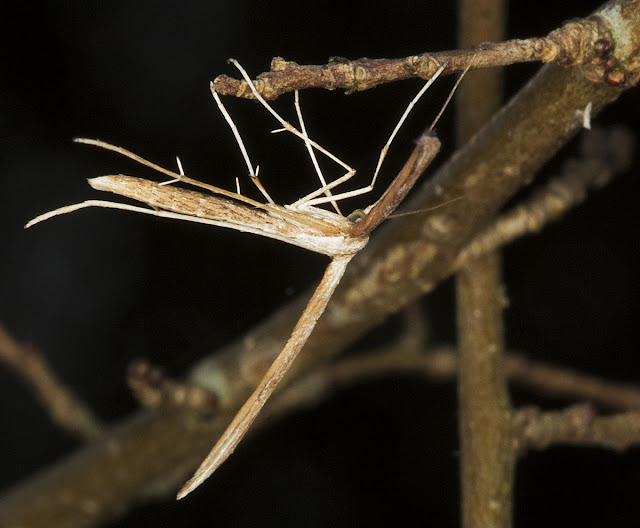
Plume moth, probably Stenoptilia species.  Orpington Field Club trip to Scadbury Park, 21 January 2012.
Plume moth, probably Stenoptilia species.   Scadbury Park, 21 January 2012.
I have some more photos, some of them not properly identified; I'll post them when I have a better idea of what they all are.

Friday, 9 December 2011

The Last of My True Bugs

Bug on Hogweed, Heraclium sphondylium.  Spring Park, 4 July 2011.
Bug on Hogweed, Heraclium sphondylium.  Spring Park, 4 July 2011.
These are the last of my true bug photos for now. I was not able to conclusively identify the one above. I think it is either a Potato Capsid or a Potato Mirid, Closterotomus norvegicus or Calocoris norvegicus.

The one below has actually been posted before, but I am including it for the sake of completeness. It's a Tortoise Bug, and to me it looks similar to the shield bugs except for its odd plastic-looking mouthparts. It was in the bushes at the edge of an insect-rich meadow. And below it is another specimen, this one from a hedge in Scadbury Park.

Tortoise bug, Eurygaster testudinaria. Darrick Wood, 22 May 2011.


Tortoise bug, Eurygaster testudinaria.  Scadbury Park, 20 July 2011.
Tortoise bug, Eurygaster testudinaria.  Scadbury Park, 20 July 2011.

Sunday, 18 September 2011

Prickly Lettuce

Prickly Lettuce, Lactuca seriola.  Scadbury Park, 11 September 2011.
Prickly Lettuce, Lactuca seriola.  Scadbury Park, 11 September 2011.
This is one of a group of plants that grow commonly by the sides of paths and in little scrubby patches of land. Some might say they are weeds, but they are varied and interesting and support wildlife, so I would not say so.

This one, Prickly Lettuce, grows as a single stem. At first, it just has those alternating leaves, plain and green, and then quite quickly it sprouts a many-branched flower-head.

The flowers are composite, and like many other wildflowers, they look a little like dandelions.  Individually they are short-lived and do not stay open all day, so you might not find it easy to see them unless you keep watch.  You can see that although this plant is fully mature, there are no visible flowers.  This shot was taken early in the afternoon.

Below is a photo taken in mid-morning, a flower with a hoverfly taking advantage of it. That is a Marmalade Hoverfly, Episyrphus balteatus, one of the commonest and prettiest of the British hoverflies.

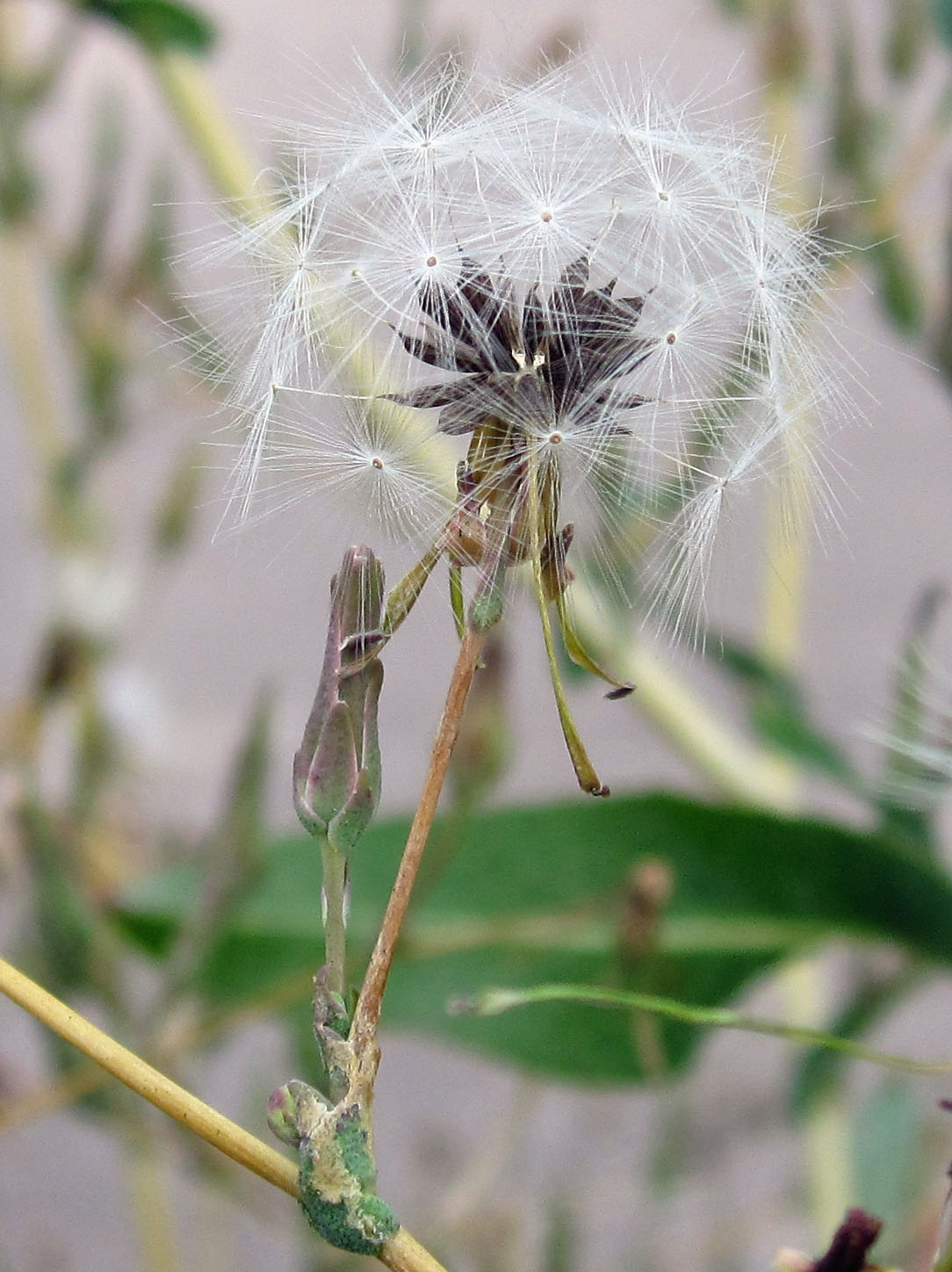
Under that is a shot of the seedhead, and you can see that this, too, is on the same general plan as a dandelion, though the individual parachutes and seeds are larger.

And finally, in case you are wondering why it should be called "prickly," there is a closeup of the underside of a leaf. Even though the prickles are not very strong, this is still not something you would welcome in a plate of salad.

The seed head and the whole plant were taken with my Ixus 100; the leaf and the flower with my EOS 60D and 100mm macro lens.

Marmalade hoverfly, Episyrphus balteatus, on a flower of Prickly Lettuce, Lactuca serriola, at the edge of Hayes Station car park, 26 July 2011.
Marmalade hoverfly, Episyrphus balteatus, on a flower of Prickly Lettuce, Lactuca serriola,
at the edge of Hayes Station car park, 26 July 2011.
Prickly Lettuce, Lactuca serriola. Seed heads by Hayes Station car park.  12 August 2011.
Prickly Lettuce, Lactuca serriola. Seed heads by Hayes Station car park.  12 August 2011.
Prickly Lettuce, Lactuca serriola.  Underside of a leaf.  Scadbury Park, 11 September 2011.
Prickly Lettuce, Lactuca serriola.  Underside of a leaf.  Scadbury Park, 11 September 2011.

Saturday, 17 September 2011

Spindle Berries

Spindle berries, Euonymus europaeus.  Scadbury Park, 11 September 2011.
Spindle berries, Euonymus europaeus.  Scadbury Park, 11 September 2011.
Among the shrubs and plants that I never saw in my childhood is the Spindle. Like many British species, a few degrees of temperature makes all the difference to where it grows.

It's a small, thin-stemmed shrub, with inconspicuous flowers, and it doesn't really stand out in the hedgerows until the fruits appear. These are so vividly and waxily pink, sometimes shading towards red, that it's hard to believe the colours are natural.

When they ripen, the orange seeds squeeze out from the fruits without any prompting.

It is said that the name derives from traditional use of the wood to make spindles for spinning wool. With those delicate branches, this must have meant that a whole plant would have been taken to use the trunk to make just a handful of spindles.

Spindle fruits, Euonymus europaeus.  Scadbury Park, 11 September 2011.
Spindle fruits, Euonymus europaeus.  Scadbury Park, 11 September 2011.

Friday, 16 September 2011

Dogwood, Hawthorn

Berries of Dogwood, Cornus sanguinea, on Burnt Gorse at High Elms Country Park, 22 August 2011.
The countryside is full of berries now. These are on dogwood, a small shrub that is found in ancient woodlands and in hedges. Bushes related to this are often grown as garden plants for their brightly coloured stems.

The hawthorn, below, is a very common shrub or small tree. Its value in a hedgerow is that it grows fast and puts out many thorny branches. These berries, called haws, are everywhere. In fact where I grew up, near Newcastle, countryside berries were generally referred to as hips and haws - fruits of wild rose and hawthorn.

Haws, berries of Hawthorn, Crataegus monogyna. Scadbury Park, 11 September 2011.
Berries of Hawthorn, Crataegus monogyna. Scadbury Park, 11 September 2011.

Thursday, 21 July 2011

Scadbury Park Ladybirds

24-Spot Ladybird, Subcoccinella 24-punctata.  Ladybird walk in Scadbury Park, 20 July 2011.
24-Spot Ladybird, Subcoccinella 24-punctata.  Scadbury Park, 20 July 2011.
This walk in Scadbury Park was supposed to be about ladybirds, and indeed we did look for them, but we looked for any other invertebrates that came up as well.

It was led by a local volunteer, and we walked through a meadow to a hedgerow, where we shook the branches over an upturned umbrella to see what fell in. Mostly, this was small insects, spiders, woodlice and earwigs. This tiny 24-spot ladybird was among them, as was the small spider below, with its interesting reticulated patterning. You can see the umbrella background in the photo of the spider.

But of course there were many more insects around, bigger ones too. There were a few other ladybirds, including several large and healthy 7-spots. Bees, wasps, flies and beetles were visiting the flowers, and also butterflies, of course; Meadow Browns and Gatekeepers, and there were some Commas in the bramble scrub by the hedge.

Ragworts were scattered all through the meadow, and many of them were being thoroughly consumed by vivid (and poisonous) caterpillars of the Cinnabar moth. Back among in the brambles I found some snails and a tortoise bug, a close relation of the shield bugs. A little moth fluttered down and stayed long enough to be photographed. It ooks like a smear of bird dropping if you stand back, but it's colourful close to. I haven't identified it, despite having a good book on macromoths now, so either it's a micromoth species or I am still terrible at moth identification. Either or both of these could be true.
Unidentified bee, looks like an Andrena species, foraging in a thistle flower.  Ladybird walk in Scadbury Park, 20 July 2011.
Unidentified bee, looks like an Andrena species, foraging in a thistle flower.  Ladybird walk in Scadbury Park, 20 July 2011.
Unidentified spider in an umbrella. Ladybird walk in Scadbury Park, 20 July 2011.

Gatekeeper butterfly, Pyronia tithonus.  Ladybird walk in Scadbury Park, 20 July 2011.
Gatekeeper butterfly, Pyronia tithonus.  Ladybird walk in Scadbury Park, 20 July 2011.

Tortoise bug, Eurygaster testudinaria.  Ladybird walk in Scadbury Park, 20 July 2011.
Tortoise bug, Eurygaster testudinaria.  Ladybird walk in Scadbury Park, 20 July 2011.

Unidentified moth imitating a bird dropping.  Ladybird walk in Scadbury Park, 20 July 2011.
Unidentified moth imitating a bird dropping.  Ladybird walk in Scadbury Park, 20 July 2011.

Cinnabar Moth caterpillars, Tyria jacobaeae, an Arctiid, on Common Ragwort, Senecio jacobaea.  Ladybird walk in Scadbury Park, 20 July 2011.
Cinnabar Moth caterpillars, Tyria jacobaeae, an Arctiid, on Common Ragwort,
Senecio jacobaea.  Ladybird walk in Scadbury Park, 20 July 2011.