Showing posts with label Oldbury Hill. Show all posts

Tuesday, 14 October 2014

Fungi are here!

Ochre Brittlegill, Russula ochroleuca. Emmetts Gardens, 14 September 2014.
 Fungi are starting to turn up in the woods again.  These were out a month ago.  Russulas are common woodland toadstools, usually with interesting colours.  This one is easy to find.  Russulas are often called Brittlegills because if you rub the gills, they break up.

Coral Brittlegill, Russula velenovskyi.  Emmetts Gardens, 14 September 2014.
Coral Brittlegill, Russula velenovskyi.  Emmetts Gardens, 14 September 2014.
You can just see on this one that the cap colour extends down the outer edges of the gills.

Russula cyanoxantha, Charcoal Burner.  Oldbury Hill, 27 September 2014.
Russula cyanoxantha, Charcoal Burner.  Oldbury Hill, 27 September 2014.
 This one has a variable cap colour and, to add some unnecessary confusion, it has gills which are not brittle.

Charcoal Burner, Russula cyanoxantha.  Hayes Common, 17 September 2014.
Charcoal Burner, Russula cyanoxantha.  Hayes Common, 17 September 2014.
I'm pretty sure that this, found elsewhere a little earlier, is the same species.

Russula fellea, Geranium Brittlegill.  Oldbury Hill, 27 September 2014.
Russula fellea, Geranium Brittlegill.  Oldbury Hill, 27 September 2014.
This one, though superficially similar to the Ochre Brittlegill, has a yellowish tint to its stipe, and a smell similar  to geranium leaves.  Smell is important when identifying fungi. 

More fungi will certainly follow, if not in the very next post then in later ones.

Saturday, 16 June 2012

The Scorched Wing

Scorched Wing, Plagodis dolabraria.  Geometer.  Kent Butterfly Conservation mothing event at Oldbury Hill, 10 June 2012.
Scorched Wing, Plagodis dolabraria.  Oldbury Hill, 10 June 2012.
This was the most impressive, colourful and beautiful of the moths we saw at Oldbury Hill on 9th June.

The reason for the name is obvious.  Its larvae eat mainly Oaks, sometimes other woodland trees, so you can only expect to find this moth in or near woods.  It looks as though it would be well camouflaged amongst autumn leaves, but it only flies in May and June.

This is a male, as you can tell by the feathery antennae.  Also, the male has this odd habit when at rest:

Scorched Wing, Plagodis dolabraria.  Geometer.  Kent Butterfly Conservation mothing event at Oldbury Hill, 10 June 2012.
Scorched Wing, Plagodis dolabraria.  Oldbury Hill, 10 June 2012.
It tilts up the end of its abdomen.  From this angle you can see that as well as that delicious orange colour, the "scorched" area leads to an almost plum shade that also appears on its face and chest.  This is my favourite photograph of the day.

Here's the underside, seen though the plastic side of the moth trap.  From this angle you can see the colouration better.

Scorched Wing, Plagodis dolabraria.  Geometer.  Kent Butterfly Conservation mothing event at Oldbury Hill, 10 June 2012.
Scorched Wing, Plagodis dolabraria.  Oldbury Hill, 10 June 2012.

Now I'm looking forward to the next mothing event!

Thursday, 14 June 2012

More Oldbury Hill Moths

Kent Butterfly Conservation mothing event at Oldbury Hill, 10 June 2012.
Here's the trap that David Gardner brought to Oldbury Hill.  It's his own design, and it packs flat for transport.  At the far end of that wire is a petrol-powered generator. 

There are no egg-boxes here because the trap is constantly attended, and there is no need to provide somewhere for moths to rest until morning. 

White-pinion Spotted, Lomographa bimaculata.  Geometer.  Larval food plants: Blackthorn, Hawthorn.  Kent Butterfly Conservation mothing event at Oldbury Hill, 10 June 2012.
White-pinion Spotted, Lomographa bimaculata.  Oldbury Hill, 10 June 2012.
Mostly white, but with two dark spots at the edge of each forewing.  The larvae of this moth eat Blackthorn and Hawthorn.  I have a Hawthorn hedge in my garden, but I haven't seen any of these in my garden trap yet.

This White-pinion Spotted is not to be confused with  the much rarer White-spotted Pinion, which makes me wonder just how evil the people were who named them.

Little Thorn, Cepphis advenaria.  Geometer.  Larval food plant: Bilberry.  Kent Butterfly Conservation mothing event at Oldbury Hill, 10 June 2012.
Little Thorn, Cepphis advenaria.  Oldbury Hill, 10 June 2012.
Another small moth, with scalloped wings like its larger relatives - here's a link to an Early Thorn I saw in March.  The larval food plant is Bilberry, and this wood is full of Bilberry plants, so it's surprising that we only saw one.  We also saw another Bilberry eater, a Beautiful Snout, but I didn't get a photo worthy of showing.

Orange Footman, Eilema sororcula.  Arctiid.  Larval food plant: Lichen.  Kent Butterfly Conservation mothing event at Oldbury Hill, 10 June 2012.
Orange Footman, Eilema sororcula.  Oldbury Hill, 10 June 2012. 
This moth looks quite different, and indeed it comes from a different group.  The first two belong to the family Geometridae, and this is one of the Arctiidae. Some of the Footmen are tricky to tell apart, but the orange colour makes this one easy to identify.  Its larvae eat lichens.

Ingrailed Clay, Diarsia mendica mendica.  Noctuid.  Kent Butterfly Conservation mothing event at Oldbury Hill, 10 June 2012.
Ingrailed Clay, Diarsia mendica mendica.  Oldbury Hill, 10 June 2012. 
This pretty creature, different again, belongs to the Noctuidae. There are some general similarities within the Noctuid wing patterns that make most of them easy to place to their family, but that only helps a little in identification because there are many of them, and some, like this one, are very variable in the detail of their markings.  I don't think I would ever have been able to pin down the species of this one by myself.  As with so many things, you need to see a lot of them in various conditions and ages to become any sort of expert.

Last for today:

Brindled White-spot, Parectropis similaria.  Geometer.  Kent Butterfly Conservation mothing event at Oldbury Hill, 10 June 2012.
Brindled White-spot, Parectropis similaria.  Oldbury Hill, 10 June 2012.
Another Geometer.  There are several moths with this general mottled appearance, which you can see would be good for camouflage against, for example, bark.  This moth is distinguished by the white spots near the edges of its forewings.  Its larvae can eat a whole range of woodland trees and shrubs.

Next time, a single moth, the most beautiful of those we saw on 9th June.


Tuesday, 12 June 2012

Oldbury Hill Moths, June

Kent Butterfly Conservation mothing event at Oldbury Hill, 10 June 2012.
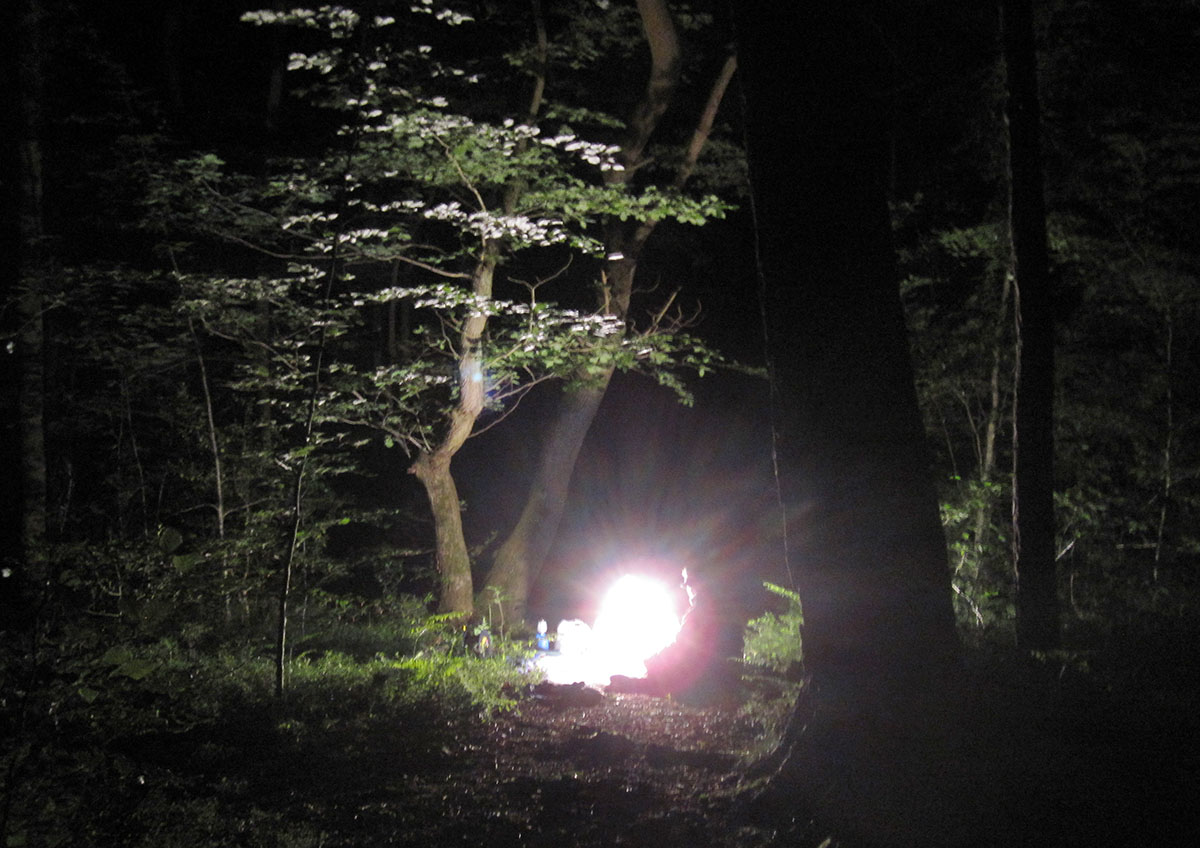
There was a strange light in the woods on the night of 12th June.  Anyone approaching would have seen three people seated around the light, gazing into it in a mysterious way.  I'm sure I saw this on the X-Files.  Mulder to the front .. But no, it was a mothing event!

It was run by David Gardner, the Chairman of the Kent branch of Butterfly Conservation. He brought his ingenious portable trap and generator and set it up in the woods in a likely spot.  It was not particularly warm, so we weren't inundated with moths, though we did get plenty of Ichneumon Wasps and Cockchafers.  The Cockchafers were a particular nuisance.  They kept bombing into us and disturbing interesting moths just as they had settled.  They are big, fast and heavy and arrive like bullets, and if you toss them away they circle back like boomerangs.

But by the time we packed up at midnight, we had seen twenty species of moth, some dowdy, some beautiful.

Clouded Border, Lomaspilis marginata.  Kent Butterfly Conservation mothing event at Oldbury Hill, 10 June 2012.
Clouded Border, Lomaspilis marginata.  Oldbury Hill, 10 June 2012.
I liked this one.  The larvae feed on Aspens, Poplars, Sallows and Willows, none of which were close to us, but there were Sallows somewhere in the woods. 

The left forewing is damaged.  Several of the specimens we saw were damaged or worn, which is quite normal.

Green Carpet, Colostygia pectinataria.  Geometer.  Larval food plant: Bedstraws.  Kent Butterfly Conservation mothing event at Oldbury Hill, 10 June 2012.
Green Carpet, Colostygia pectinataria.   Oldbury Hill, 10 June 2012.
This one is called a Green Carpet, and when it was fresh it would have been a distinct green.  Compare with the moth in the last photo in this post from last August: Farthing Downs August Moths.  But the green colour fades quite fast from moths.  There are several "Emerald" species which are often tricky for the novice (i.e. me) to identify because they find them when they are mostly white. The same goes for at least one micromoth, the Green Oak Tortrix.

The larvae of this moth eat Bedstraws, probably including Cleavers, which is quite common.

Here's one of the Emeralds:

Little Emerald, Jodis lactearia. Male.  Geometer.  Kent Butterfly Conservation mothing event at Oldbury Hill, 10 June 2012.
Little Emerald, Jodis lactearia.  Male. Oldbury Hill, 10 June 2012.
A small moth, this one with only a hint of green.  This photo was taken through the plastic side of the trap and shows the pretty antennae typical of many male moths.  The large surface area helps them to detect the pheromones given off by the females.

Clay Triple-lines, Cyclophora linearia.  Geometer.  Larval food plant: Beech. Kent  Butterfly Conservation mothing event at Oldbury Hill, 10 June 2012.
Clay Triple-lines, Cyclophora linearia.  Oldbury Hill, 10 June 2012.
The larvae of this one feed on Beech.  Again, you can see the feathery antennae.

I will post some more moths from this event next time.