Showing posts with label Downe. Show all posts

Friday, 11 November 2016

Filming at Downe Bank

Irene Palmer and Tony Robinson being filmed on Downe Bank.  6 July 2016.
Irene Palmer and Tony Robinson being filmed on Downe Bank.  6 July 2016.
Back in July I watched Irene Palmer and Tony Robinson being filmed for a section of his "Britain's Ancient Tracks with Tony Robinson" series.  Now it has been broadcast, my photos are out of embargo.

Irene, our local orchid expert and also currently chair of the Orpington Field Club, was showing how Darwin investigated the way orchids are pollinated, and she was able to collect pollinia from a Common Spotted Orchid  using a pencil as Darwin did.  From this distance all you can see is the pencil, and in the film itself the little pollen packet was only just visible.

All the photos I took during the actual filming were taken from a distance – I was warned away so that my camera clicks didn't spoil the sound track.  Absolutely all of my photos suffered from the high contrast caused by the brilliant sunshine.  Look at the cameraman's arm in that first photo.  The sequence was filmed in the shade to avoid this contrast problem, and so that the participants wouldn't squint all the time.

Irene Palmer and Tony Robinson being filmed on Downe Bank.  6 July 2016.
Irene Palmer and Tony Robinson being filmed on Downe Bank.  6 July 2016.
I also took a few shots at the top of the bank before the filming, and there I was able to use Photoshop to tone down a lot of the contrast.  Raw photos taken on a good camera allow a lot of latitude for adjustments.

Irene Palmer and Tony Robinson before filming on Downe Bank.  6 July 2016.
Irene Palmer and Tony Robinson before filming on Downe Bank.  6 July 2016.
Here, Tony Robinson is apparently sorting out some sun-block.

But during the filming I also spent some time looking for butterflies on orchids.  I saw a lot of Marbled Whites on Pyramidal Orchids, which will have disappointed them as those orchids have no nectar.

Marbled White, Melanargia galathea, on Pyramidal Orchid, Anacamptis pyramidalis.  6 July 2016.
Marbled White, Melanargia galathea, on Pyramidal Orchid, Anacamptis pyramidalis.  6 July 2016.
This butterfly, with a golden band along the leading edge of its wings, is a female.

Marbled White, Melanargia galathea, on Pyramidal Orchid, Anacamptis pyramidalis.  6 July 2016.
Marbled White, Melanargia galathea, on Pyramidal Orchid, Anacamptis pyramidalis.  6 July 2016.
This one, browner and without the golden band, is a male.

I also spotted this pretty little Small Skipper on a Bird's-foot Trefoil. Much more rewarding!

Small Skipper, Thymelicus sylvestris, on Common Bird's-foot Trefoil, Lotus corniculatus.  6 July 2016.
Small Skipper, Thymelicus sylvestris, on Common Bird's-foot Trefoil, Lotus corniculatus.  6 July 2016.
That was the second time I have watched Irene being filmed explaining about orchids on Downe Bank.  The last time it was about the pollination of Fly Orchids, and as an assistant I got a whole 3 seconds of screen time (non-speaking) on The One Show!  So I'm a star.  But not as much of one as these butterflies.

Wednesday, 1 July 2015

An Unusual Orchid

Common Spotted Orchid, Dactylorhiza fuchsii, var. rhodochila.  Downe Bank, 27 June 2015.
Common Spotted Orchid, Dactylorhiza fuchsii, var. rhodochila.  Downe Bank, 27 June 2015.
Dactylorhiza fuchsii, var. rhodochila is a scarce, but widespread, variety of the Common Spotted Orchid.

Common Spotted Orchid, Dactylorhiza fuchsii, var. rhodochila.  Downe Bank, 27 June 2015.
Common Spotted Orchid, Dactylorhiza fuchsii, var. rhodochila.  Downe Bank, 27 June 2015.
This one was known to grow in the Downe Bank Nature Reserve, and Irene Palmer was kind enough to show me just where, so that I could take a few photos.  The orchid flowers are quite prolific this year and it is not easy to spot this one.

I also took a few photos in Downe village while waiting for Irene (I was there early). 

Wall Rue, Asplenium ruta-muraria.  On the churchyard wall in Downe, 27 June 2015.
Wall Rue, Asplenium ruta-muraria.  On the churchyard wall in Downe, 27 June 2015.

Wall Rue is a small fern that is happy on dry stone.  Other ferns, on the wall of the church, have frizzled up, but this plant, on the churchyard wall, is bright green and lush.

Barley, Hordeum vulgare.   Downe churchyard.  Downe, 27 June 2015.
Barley, Hordeum vulgare.   Downe churchyard.  Downe, 27 June 2015.
A little bunch of Barley is growing next to the church, perhaps escaped from birdseed.  It's like a giant version of Wall Barley, a common wayside grass, and is from the same genus.

Black Horehound, Ballota nigra.  Downe, 27 June 2015.
Black Horehound, Ballota nigra.  Downe, 27 June 2015.
Over the road, on a tiny patch of grass with a bench, this is Black Horehound.  The leaves are supposed to smell resinous and unpleasant when crushed.  Sometimes they do have a strong smell, but I like it.  It's similar to the smell of Hedge Woundwort, a related plant which you can also find in hedgerows.

Painted Lady, Vanessa cardui.   Fence on the track down to Downe Bank, 26 June 2015.
Painted Lady, Vanessa cardui.   Fence on the track down to Downe Bank, 26 June 2015.
Finally, a Painted Lady found on the track down to the nature reserve.  I was pleased to get a good shot of the underwing, which is less familiar than the top view.  This moth is a regular immigrant to the UK, and we are told that there are hordes of them on the continent just waiting for the right weather to come over.  Clearly, some are already here!

Thursday, 18 June 2015

More Orchids

Flower of a Greater Butterfly-orchid, Plantathera chlorantha.  Orchid Bank, High Elms Country Park, 11 June 2015.
Flower of a Greater Butterfly-orchid, Plantathera chlorantha.  Orchid Bank, High Elms Country Park, 11 June 2015.
I heard of a Greater Butterfly Orchid in High Elms Country Park last year, but was unable to find it.  It turns out I was looking in the wrong place, but this year I had better information.  It's not colourful, but many find the delicate white shapes of its flowers delightful.  I think they are fascinating, but they look to me like wide-open vampire's mouths with long tongues.

Greater Butterfly-orchid, Plantathera chlorantha.  Orchid Bank, High Elms Country Park, 11 June 2015.
Greater Butterfly-orchid, Plantathera chlorantha.  Orchid Bank, High Elms Country Park, 11 June 2015.
(Less so from a distance.)  There seems to be only one specimen in High Elms.  At night, it has a strong scent and is pollinated by large moths.  Those fang-like objects inside the flower are pollinia, clumps of pollen on stalks, and they become attached to the eyes of the moths when they approach for a drink of nectar. 

Fragrant Orchid, Gymnadenia conopsea.  Downe Bank, 11 June 2015.
Fragrant Orchid, Gymnadenia conopsea.  Downe Bank, 11 June 2015.
This Fragrant Orchid is a much more colourful species, but is also pollinated by moths.  Those long, curved nectar tubes are designed for insects with long probiscides.  It has quite a strong floral scent.

Lastly, something unusual:

Variegated Broad-leaved Helleborine, Epipactis helleborine.  Orchid Bank, High Elms Country Park, 11 June 2015.
Variegated Broad-leaved Helleborine, Epipactis helleborine.  Orchid Bank, High Elms Country Park, 11 June 2015.
It's too early for this Broad-leaved Helleborine to be flowering, but it's worth showing because it is naturally variegated, which is scarce.  I saw a normal Broad-leaved Helleborine in the same spot last year and it is possible that this is the same plant, somewhat changed, probably by a virus infection.  Virus infections that produce similar effects are also known among cultivated orchids.

Variegation reduces the viability of plants because they have less of the green chlorophyll that produces the food they need. A virus can also reduce the strength of a plant in other ways, though this one seems to be quite robust. It will be interesting later on to see if the flowers are affected.

Sunday, 14 June 2015

Orchid Time

White Helleborine, Cephalanthera damasonium.  Flower showing yellow throat.  Downe Bank, 11 June 2015.
White Helleborine, Cephalanthera damasonium.  Flower showing yellow throat.  Downe Bank, 11 June 2015.
Wild orchids are flowering profusely on the chalk banks in Bromley (the London Borough Of, not the town).  This is a White Helleborine, one of the more common types, seen in many woods at the edge of pathways, which makes one think that like many plants it prefers the edge habitat.  In a place such as that it can have shelter from winds and the worst of the weather, yet not be completely shaded out.

Seldom do the flowers open widely enough to display this yellow throat.  But this was a particularly large specimen.

White Helleborine, Cephalanthera damasonium.  Downe Bank, 11 June 2015.
White Helleborine, Cephalanthera damasonium.  Downe Bank, 11 June 2015.
Usually the flowers stay closed, as most of these are; the plant is self-pollinating.

Near this plant were groups of Common Twayblades and Fly Orchids, both of which are also quite happy in full sun in the open.  This Fly Orchid was on a grassy bank.

Fly Orchid, Ophrys insectifera.  Downe Bank, 11 June 2015.
Fly Orchid, Ophrys insectifera.  Downe Bank, 11 June 2015.
This one is far from being self-pollinating, and has almost an orchid trademark system.  It is disguised as an insect and puts out pheromones that attract digger wasps.  When they try to mate with the flower, clumps of pollen grains known as pollinia become attached to the genuine insects and are transferred by them.  The plants are quite inconspicuous to the human eye and you need to look carefully to spot them among the grass.

In fact, several of our wild orchids have a disappointing appearance, even close up.  Here is one of the Common Twayblades I mentioned earlier.

Common Twayblade, Neottia ovata.  Downe Bank, 11 June 2015.
Common Twayblade, Neottia ovata.  Downe Bank, 11 June 2015.
A large and healthy specimen, with its single pair of leaves - the "tway blades" - prominently in view, but not exactly a stunner even though it is in full flower.

More orchids next time ...

Tuesday, 23 September 2014

Three insects near Downe

Small Copper, Lycaena phlaeas.  Near Downe, 23 August 2014
Small Copper, Lycaena phlaeas.  Near Downe, 23 August 2014
Botanising near Downe - I showed some plants from this visit earlier - I took these photos of insects.  The Small Copper butterfly is a pretty creature, always nice to see.

Brown Argus, Aricia agestis.  Near Downe, 23 August 2014.
Brown Argus, Aricia agestis.  Near Downe, 23 August 2014.
 This is the Brown Argus whose underwing I showed in the previous post.  It's not showy, but it's good to see a variety of butterflies.

Hornet, Vespa crabro.  Near Downe, 23 August 2014.
Hornet, Vespa crabro.  Near Downe, 23 August 2014.
I have seen several hornets foraging in the undergrowth recently.  People tend to be wary of them because they look like extra big wasps, and that is exactly what they are.  So try not to annoy them.

Sunday, 14 September 2014

Some Wildflowers Near Downe, August

Perennial Sowthistle, Sonchus arvensis.  Near Downe, 23 August 2014.
Perennial Sowthistle, Sonchus arvensis.  Near Downe, 23 August 2014.
Here are a few flowers from the countryside near Downe, Charles Darwin's village.  This area consists mostly of shallow chalky valleys.  This first flower, the Perennial Sowthistle, can be told from many similar types by the orange-tipped glandular hairs on the flower stem and bracts.  This specimen was in a hedgerow at the side of a field.

Dwarf Thistle, Cirsium acaule.  Valley sides near Downe, 23 August 2014.
Dwarf Thistle, Cirsium acaule.  Valley sides near Downe, 23 August 2014.
This one is typical of uncultivated chalk grassland.  It's often called the Picnic Thistlle, because it can be discovered when sat on.  Unlike other thistles, it remains as a rosette at ground level and doesn't put a stem up to flower.

Ploughman's Spikenard, Inula conyzae.  Near Downe, 23 August 2014.
Ploughman's Spikenard, Inula conyzae.  Near Downe, 23 August 2014.
Under the trees was this rather undistinguished plant, a Ploughman's Spikenard, with leaves rather like a Foxglove, whose flowers never open more than this. 

Spear-Leaved Orache, Atriplex prostrata.  Roadside near Downe, 23 August 2014.
Spear-Leaved Orache, Atriplex prostrata.  Roadside near Downe, 23 August 2014.
These flowers are even less showy, and can really only be seen close up.  It's a Spear-leaved Orache.  The feature that distinguishes Oraches from similar plants is their triangular bracts, but you can hardly see the bracts on some of them, including this plant.

This and the next one were growing in a hedgerow by the roadside.

Common Blue Sowthistle, Cicerbita macrophylla.  Roadside near Downe, 23 August 2014.
Common Blue Sowthistle, Cicerbita macrophylla.  Roadside near Downe, 23 August 2014.
I hadn't seen a Common Blue Sowthistle before.  I think "Common" relates them to the Alpine Blue Sowthistle, which grows here only in the east of Scotland, rather than any other sort of plant.  This is rather showy and pretty, not unlike a Chicory, which can be found not too far away at Jubilee Country Park. 

Tuesday, 19 November 2013

Four Beetles From Summer

Red-headed Cardinal Beetle, Pyrochroa serraticornis.  Downe Bank, 14 June 2013.
Red-headed Cardinal Beetle, Pyrochroa serraticornis.  Downe Bank, 14 June 2013.
Here are a few beetles I saw during the year that I don't think I have posted before.  Nothing unusual, but they do look good.  This one is called a Cardinal Beetle because its colour reminded someone of the scarlet dress of a cardinal of the Catholic church.  It's called Red-headed because it has a relative with a black head, known, of course, as a Black-headed Cardinal Beetle.

Black-headed Cardinal Beetle, Pyrochroa coccinea.  Hayes Common, 19 June 2013.
Black-headed Cardinal Beetle, Pyrochroa coccinea.  Hayes Common, 19 June 2013.
I only had my little Ixus 100 with me when I saw that one, so the depth of field is not so good.  Its close focusing is rather erratic, so I was happy to get this shot.

Orchid Beetle, Dascillus cervinus.  Orchid Bank at High Elms Country Park, 27 June 2013.
Orchid Beetle, Dascillus cervinus.  Orchid Bank at High Elms Country Park, 27 June 2013.
This one is more brown, with a hint of muted olive green.  I see it in places where there are lots of orchids, but not actually on orchids, thugh it is supposed to spend most of its time on flowers.

It's covered with short hairs, which helps to show that if you think of beetles as smooth and shiny, you are often mistaken.  At this magnification, the hairs on the plant leaf are also much more apparent than they normally are to the naked eye.

Click Beetle, Denticollis linearis.  Downe Bank, 14 June 2013.
Click Beetle, Denticollis linearis.  Downe Bank, 14 June 2013.
This is one of several click beetles.  When disturbed, they can use those points at the back corner of the thorax to click against the front of their abdomen.  This can make them leap into the air, a good and surprising tactic to escape unwelcome attention.

That's all the beetles for now ...

Monday, 27 August 2012

Downe, August 2012

Hoverfly, Melanostoma scalare, on Field Bindweed, Convolvuus arvensis.  Orpington Field Club outing to Downe on 25 August 2012.
Hoverfly, Melanostoma scalare, on Field Bindweed, Convolvuus arvensis.  Downe, 25 August 2012.

I do still go out on general field trips.  These are a few close-up photos taken in the fields near Downe, quite close to Biggin Hill airport where we occasionally heard small jets taking off.   This first one is a favourite subject of mine; a hoverfly on a flower.  There was some occasional drizzle, hence the small drops on the petals.

Autumn Hawkbit, Leontodon autumnalis.  Orpington Field Club outing to Downe on 25 August 2012.
Autumn Hawkbit, Leontodon autumnalis.  Downe, 25 August 2012.
I was pleased to find some Autumn Hawkbits to add to my collection of photos of flowers that are rather like Dandelions but are not them.   These are not easy to tell from other Hawkbits just from the flowers; the leaves are very helpful, but sometimes hard to find in the grass.  But the red-backed outer petals, and the way the flower head tapers into the stem, and that it's only slightly hairy, are all indicators. 

Lesser Trefoil, Trifolium dubium.  Orpington Field Club outing to Downe on 25 August 2012.
Lesser Trefoil, Trifolium dubium.  Downe, 25 August 2012.
Tiny yellow flowers in the grass, looking rather like clovers, can be several things.  Often it is Black Medick, but that has a minute leaf-point inset at the end of its leaves.  No such points here, and this is a Lesser Trefoil.

Finally ...

Unidentified caterpillar on the stem of Hawkweed Oxtongue, Picris hieracioides.  Orpington Field Club outing to Downe on 25 August 2012.
Unidentified caterpillar on the stem of Hawkweed Oxtongue, Picris hieracioides. Downe, 25 August 2012.
As is often the case, I haven't been able to identify this caterpillar, but we saw several specimens of the plant it seems to be eating.  Unfortunately it's not listed as one of the larvae that eat this plant.  Clearly the list is incomplete!  It is definitely a butterfly or moth larva, not a sawfly which can sometimes look very much like them.  Because of its looping habit, I suspect it is a Geometrid moth, but that's just a guess.

Wednesday, 22 August 2012

Violet Helleborines

Violet Helleborine, Epipactis purpurata, on the Sand Walk at Down House, Downe, on 18 August 2012.  One mature flower and one just going over.
Violet Helleborine, Epipactis purpurata, at Down House on 18 August 2012.  One mature flower and one just going over.
We interrupt the displays of moths for some uncommon wildflowers.  These orchids, Violet Helleborines, are in full flower at Down House, once the home of Charles Darwin and now managed by English Heritage.

While not really rare, it is scarce and getting scarcer, and widely scattered.  It only appears in 73 out of 1450 2-kilometer squares in Kent.  But it seems to be established and spreading in one little spot in the grounds of Down House.

Violet Helleborine, Epipactis purpurata, on the Sand Walk at Down House, Downe, on 18 August 2012.  The largest specimen.  A bumblebee is at one of the flowers on the smaller stem.
Violet Helleborine, Epipactis purpurata, at Down House on 18 August 2012.  The largest specimen.
This is the largest specimen, and it is unusually big and healthy.  I saw six smaller ones, two of which had their tops eaten off, perhaps by deer.  There are almost certainly others that I didn't spot.  A local naturalist told me that they have been here for four years, and are doing well.

Violet Helleborine, Epipactis purpurata, on the Sand Walk at Down House, Downe, on 18 August 2012.    Two fresh flowers.
Violet Helleborine, Epipactis purpurata, at Down House on 18 August 2012.    Two fresh flowers.
Despite being almost all green, they stand out quite well among the other plants in this tree-lined walkway, most of which are not much above ground level.  And like other Helleborines, they seem to prefer the edges of pathways, right where people walk.  There are quite a few plants that like woodland edge conditions, and our paths create that kind of environment artificially.

It's good to see plants like this flourishing.

Wednesday, 5 October 2011

Autumn Changes

Walking past horses in a field near Downe.  30 September 2011.
Walking past horses in a field near Downe.  30 September 2011.
This walk, on 30th September, was the last one to be led by Bromley Countryside Services. Their funding has been cut and no more walks or events are planned.

It was placed in the schedule by Ewa Prokop, but as Ewa left some while ago it was actually led by Jenny Price, who used to be the liaison for Jubilee Countryside Park. Jenny didn't know what Ewa had planned, beyond the hints given by the title and the starting point, so she took us around part of the Cudham Circular Walk.

It was hot and sunny, and the countryside was beautiful. I had been around much of this route before, not all at the same time but on various walks in the area, but some of it was new to me. There were some very steep hills ..

At one point we walked through the village of Downe, home of Charles Darwin, and along the path towards Downe Bank, the same path I took earlier with the Orpington Field Club. Two familiar horses were in the field to the right. The foal has grown well. We passed quite close to them, and they were much smaller than I had thought in June when I saw them at a distance.

Of course, there were many signs of Autumn to justify the title of the walk. I have shown several photos of fruits and berries here, and there are more to come. The image below is of Old Man's Beard, the wild hedgerow clematis. I showed clematis flowers in September; then, the plant deserved its other common name of Traveller's Joy.

Old Man's Beard, Clematis vitalba.  Near Cudham, 30 September 3011.
Old Man's Beard, Clematis vitalba.  Near Cudham, 30 September 3011.

Sunday, 26 June 2011

Downe Bank

Horse and foal near Downe.  Orpington Field Club outing to Orchis Bank, Downe.  Taken with EOS 450D and 100mm macro lens.  25 June 2011.
Horse and foal near Downe.  25 June 2011.
The Orpington Field Club met in the middle of Downe. It's full of reminders of Charles Darwin. Interestingly, there is a memorial sundial on the wall of the church where his children and servants are buried. I was browsing around the churchyard when I was met by Irene Palmer and her husband John. Irene is a Darwin enthusiast and was leading our walk to Downe Bank.

Downe Bank is in the middle of a beautiful area of countryside between Downe and Cudham, on the bank of Cudham Valley. It's a nature reserve and a Site of Special Scientific Interest, and part of it is open to the public.  We walked down to Orchis Bank and over the next couple of hours moved slowly along and back.

The walk was planned to look at the flora, but I always photograph any invertebrates and any other things of interest that will hold still long enough. This horse and foal were in a field on the path from Downe.
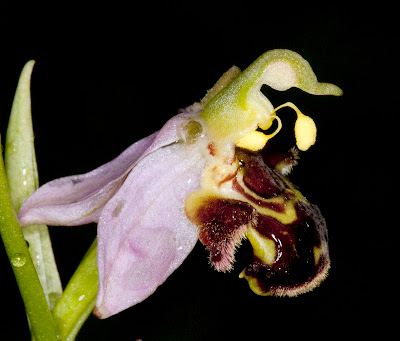
Bee orchid, Ophrys apifera, on Orchis Bank, taken from the side, showing pollinia.  Orpington Field Club outing to Orchis Bank, Downe.  25 June 2011. Taken with EOS 450D and 100mm macro lens.
Bee orchid, Ophrys apifera, on Orchis Bank, showing pollinia.
25 June 2011.

We went into the area labelled as Orchis Bank, Darwin's name for one of the areas he studied. Naturally, there was a focus on orchids, and even though the weather this year has not encouraged them, there were plenty of common spotted orchids and common twayblades, with pyramidals scattered among them. Several bee orchids were spotted, and later on, some fragrant orchids. But these showy specimens were only the tip of a wealth of plant life.

I was interested to see a lush black bryony, climbing an ash sapling, which had a shoot with dark purple leaves. I wonder if that is a somatic variation or a true reproducible variety. Other shoots of the same plant looked quite normal.

As usual, the group spread out and straggled. I was often at the back, taking photographs. I saw a few Helix pomatia, the large edible snails that were introduced by the Romans. They were sheltering in small hollows which seemed to be just their size. They did not seem to want to emerge from their shells.
Weevil, Apoderus coryli, on my hand, on Orchis Bank.  Orpington Field Club outing to Orchis Bank, Downe.  25 June 2011. Taken with EOS 450D and 100mm macro lens.
Weevil, Apoderus coryli, on my hand, on Orchis Bank.
25 June 2011.

The open area was full of yellow flowers, one of the many local species that resemble dandelions. It is interesting that all the local meadows seem to have one of these species predominent. Often it's cat's-ear, but in this case it was the rough hawkbit, Leontodon hispidus. There were also many specimens of hairy St. John's wort, which added to the general yellowness. Marmalade hoverflies were everywhere, often sitting on the yellow flowers and letting me get close up with the camera.

The line of people wound along the narrow path, singly and in groups, turned round at the end and moved back lower down the hill. A few returned the way they came, and others went on and back a different way. I went along to the track on the lower path and climbed the gate into Musk Orchid Bank, which I had visited once before on Ewa Prokop's primrose walk.

Back in March, the grass was short and primroses stood up above it. Now all the plants stood tall. I saw several marbled white butterflies flitting about, but I didn't want to chase them until they settled because it would have meant trampling down all the plant life. The one I came across that was already settled had lost a piece from both hind wings; perhaps it had a close encounter with a bird and was lucky to get away.

I was following the hint of a track that might have been made by a fox, or by one person going unseen ahead of me. There were a few large skippers and I also saw one large field scabious, its light blue flowers standing above all the rest.
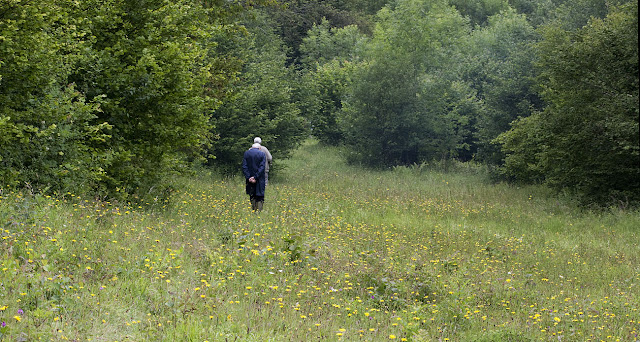
Wandering along Orchis Bank.  The yellow flowers are mostly rough hawkbit, Leontodon hispidus.  Orpington Field Club outing to Orchis Bank, Downe.  25 June 2011.   Taken with EOS 450D and 100mm macro lens.
Wandering along Orchis Bank.  The yellow flowers are mostly rough hawkbit, Leontodon hispidus. 25 June 2011.

 
Ringlet butterfly, Aphantopus hyperantus, basking on Orchis Bank.  Orpington Field Club outing to Orchis Bank, Downe.  25 June 2011.  Taken with EOS 450D and 100mm macro lens.
Ringlet butterfly, Aphantopus hyperantus, basking on Orchis Bank.  25 June 2011.

Marmalade hoverfly, Episyrphus balteatus, on hairy St. John's wort, Hypericum hirsutum, on Orchis Bank.  Orpington Field Club outing to Orchis Bank, Downe.  25 June 2011.  Taken with EOS 450D and 100mm macro lens.
Marmalade hoverfly, Episyrphus balteatus, on hairy St. John's wort, Hypericum hirsutum, on Orchis Bank.  25 June 2011.

Fragrant orchid, Gymnadenia conopsia, on Orchis Bank.  Orpington Field Club outing to Orchis Bank, Downe.  25 June 2011.  Taken with EOS 450D and 100mm macro lens.
Fragrant orchid, Gymnadenia conopsia, on Orchis Bank.  25 June 2011.

Marbled white butterfly, Melanargia galathea, on Musk Orchid Bank; missing some pieces of wing.  Orpington Field Club outing to Orchis Bank, Downe.  25 June 2011.  Taken with EOS 450D and 100mm macro lens.
Marbled white butterfly, Melanargia galathea, missing some pieces of wing, on Musk Orchid Bank.  25 June 2011.

Florets of field scabious, Knautia arvensis, on Musk Orchid Bank.  Orpington Field Club outing to Orchis Bank, Downe.  25 June 2011.  Taken with EOS 450D and 100mm macro lens.
Florets of field scabious, Knautia arvensis, on Musk Orchid Bank.  25 June 2011.

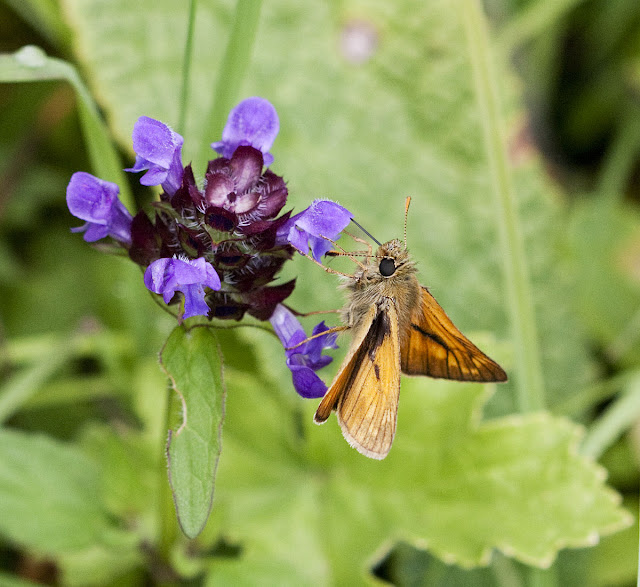
Large skipper, Ochlodes venatus, male, feeding on selfheal, Prunella vulgaris, on Musk Orchid Bank.  Orpington Field Club outing to Orchis Bank, Downe.  25 June 2011.  Taken with EOS 450D and 100mm macro lens.
Large skipper, Ochlodes venatus, male, feeding on selfheal, Prunella vulgaris, on Musk Orchid Bank.  25 June 2011.

All the photos in this post were taken with a Canon EOS 450D and an EF 100mm macro lens. For the closeups I used a ring flash.

If this was interesting, you might like to see Irene Palmer's web presentation on Downe Bank: Darwin's 'Entangled Bank' at Downe, A Warden's Tale.