Showing posts with label mini-beasts. Show all posts

Sunday, 8 January 2012

Wolf Spiders

Unidentified wolf spider, male, in the moth trap in Hayes, 31 October 2011.
Wolf spiders have yet another method of catching prey; they run after and catch it, like their namesakes. I haven't managed to identify the species of these examples, despite the fact that they look very smart and distinctive.

Like the jumping spiders, they have big eyes on the front of their heads and a couple of smaller ones on the top. Jumping spiders move in small jerky bursts; these creatures also run fast. They don't stay still for long.

Unidentified wolf spider.  Fungus day at Farningham Wood with the Orpington Field Club.  2 October 2011.
Unidentified wolf spider.  Farningham Wood,  2 October 2011.
You can find them in many environments, including my garden, like the top specimen, which was in my moth trap one morning. I saw the second one in Farningham Wood during a snack break on a fungus-finding trip. It is conveniently perched on a dried leaf of exquisite beauty, in an alert posture. The last photo is one I have posted before; a wolf spider with its young on its back running under the grass on Riddlesdown Common.

Wolf spider hunting under the grass, carrying her young on her back, in the meadow above Riddlesdown quarry. 2 July 2011.
Wolf spider hunting under the grass, carrying her young on her back, in the meadow above Riddlesdown quarry.
2 July 2011.

Tuesday, 27 December 2011

Jumping Spider

Jumping spider, Marpissa muscosa, in my back garden in Hayes.  1 June 2011.
Jumping spider, Marpissa muscosa, in my back garden in Hayes.  1 June 2011.
Unlike the Garden Spider in my last post, this beast is a hunter, and relies on good eyesight to see its prey. When it gets close, it makes a sudden leap and catches the victim that way. There is an amazing variety of food-catching techniques among spiders.

Small jumping spiders often turn up in the house on hot days. They explore vertical surfaces, moving up and down frmces and walls, and can easily come through open windows without an awareness of the consequences.

So, huge eyes, nimbleness and sturdy legs are its main characteristics; it also has camouflaging markings, as does another common jumping spider, the aptly named Zebrina, though they don't work very well on this unnaturally plain background.

You can see in the poto below that this Marpissa has two of its eyes set further back, so that it can see if anything is creeping up on it. This one actually stopped and looked up at me when I got close; pity I didn't get a good shot of that!

Jumping spider, Marpissa muscosa, on a fence in my back garden in Hayes.  1 June 2011.
Jumping spider, Marpissa muscosa, on a fence in my back garden in Hayes.  1 June 2011.

Monday, 19 December 2011

Garden Spider

Garden Spider, Araneus diadematus, in front of my house in Hayes.  10 September 2011.
Garden Spider, Araneus diadematus, in front of my house in Hayes.  10 September 2011.
I have already posted some spiders this year; Tegenaria gigantea and Pholcus phalangoides among others. But those aren't the only ones I photographed. I got some good shots of this Garden Spider, probably our commonest orb web spinner. The specimen above lived at the bottom of my front steps. Here's another photo that shows the cross-shaped pattern on its abdomen more clearly.

Garden Spider, Araneus diadematus, in front of my house in Hayes.  10 September 2011.
Garden Spider, Araneus diadematus, in front of my house in Hayes.  10 September 2011.
It's really a beautiful creature, and of course it is carnivorous. In the next shot, a different specimen I saw in a nearby wood, you see it has been wrapping a victim, which might have been another spider. You can see from the web and the way its claws are placed that it has been spinning the creature to wrap it in the silk from its spinnerets, which you can't see but which are at the tip of its abdomen.

Garden Spider, Araneus diadematus, wrapping a victim, perhaps another spider!  On an oak tree.  West Wickham Common, 22 September 2011.
Garden Spider, Araneus diadematus, wrapping a victim.  West Wickham Common, 22 September 2011.
Orb web spiders rely on their sense of touch to detect prey in their webs, so do not need large eyes. You can see that although it has eight eyes, they are all quite small. It only has two mandibles, but they are quite large!

I will post some more spiders soon.

Tuesday, 13 December 2011

Lady's Bedstraw

Fairy-ring Longhorn Beetle, Pseudovadonia livida, on Lady's Bedstraw, Galium verum.  Keston Common, 29 June 2011.
Fairy-ring Longhorn Beetle, Pseudovadonia livida, on Lady's Bedstraw, Galium verum.  Keston Common, 29 June 2011.
Two more photos from earlier in the year. Lady's Bedstraw (apparently it serves as bedding to only one lady) grows freely among the grass in this area, adding a pleasant fresh yellow to the scene. The photo below, from a neighbouring common, shows it among grasses, with Red Clover and Ribwort Plantain also visible. There are always several, sometimes many, plant species among uncultivated grass; this grass is cut once a year, in autumn.

The Fairy-ring Longhorn Beetle is common, and is often found on flowers.

Lady's Bedstraw, Galium verum.  Hayes Common, Keston Countryside Day, 26 June 2011.
Lady's bedstraw, Galium verum.  Hayes Common, Keston Countryside Day, 26 June 2011.

Friday, 9 December 2011

The Last of My True Bugs

Bug on Hogweed, Heraclium sphondylium.  Spring Park, 4 July 2011.
Bug on Hogweed, Heraclium sphondylium.  Spring Park, 4 July 2011.
These are the last of my true bug photos for now. I was not able to conclusively identify the one above. I think it is either a Potato Capsid or a Potato Mirid, Closterotomus norvegicus or Calocoris norvegicus.

The one below has actually been posted before, but I am including it for the sake of completeness. It's a Tortoise Bug, and to me it looks similar to the shield bugs except for its odd plastic-looking mouthparts. It was in the bushes at the edge of an insect-rich meadow. And below it is another specimen, this one from a hedge in Scadbury Park.

Tortoise bug, Eurygaster testudinaria. Darrick Wood, 22 May 2011.


Tortoise bug, Eurygaster testudinaria.  Scadbury Park, 20 July 2011.
Tortoise bug, Eurygaster testudinaria.  Scadbury Park, 20 July 2011.

Saturday, 3 December 2011

Green Shield and Pied Shield

Green Shield Bug, Palomena prasina, 4th instar nymph.  Orchid Bank, High Elms Country Park, 30 July 2011.
Green Shield Bug, Palomena prasina, 4th instar nymph.  Orchid Bank, High Elms Country Park, 30 July 2011.
I didn't see the adult forms of either of these two, though the first at least should be pretty common. It looks rather plain compared to the other shield bugs, and particularly the bright creature below, but at least it has a good disguise.

I saw the second one by accident whan I was photographing the plant it was crawling on, which is a Black Horehound, related to the dead-nettles. This plant is said to have a strong and unpleasant smell, so I have picked and crushed a lot of leaves this year to test this, but I don't find it unpleasant. Perhaps I have only come across weak specimens. (Late correction: The creature below is a final instar nymph of the Brassica Bug, not the Pied Shieldbug. Learning continues!).

One of the tricky things about insects is the way their younger forms often look very different from the adults.

Final instar nymph of the Brassica Bug, Eurydema oleracea, on Black Horehound, Ballota nigra.  Gates Green Road, Coney Hall, 5 September 2011..
Final instar nymph of the Brassica Bug, Eurydema oleracea, on Black Horehound, Ballota nigra.
Gates Green Road, Coney Hall, 5 September 2011.

Thursday, 1 December 2011

Forest Bug and Gorse Shield Bug

Forest Bug, Pentatoma rufipes.  Moth morning on Sevenoaks Wildlife Reserve, 14 August 2011.
Forest Bug, Pentatoma rufipes.  Moth morning on Sevenoaks Wildlife Reserve, 14 August 2011.
Above, another shield bug. I posted some photos of Forest Bug instars and an adult earlier. The woods around Hayes were full of these earlier in the year, mostly on oak trees but also on beech, but from August onwards I only saw this one, which came to the moth trap at Sevenoaks Nature Reserve.

Below, a Gorse Shield Bug. It has yellow legs and yellow stripes along its sides, and matches its food plants quite well. I only had this one glimpse of this species, and it quickly retreated into the prickly depths.  It's supposed to feed on Broom (Cytisus scoparius) as well as Gorse (Ulex europaeus); it would have been easier to chase on a Broom, as they aren't as prickly as this bush.

Gorse Shield Bug, Piezodorus lituratus.  Hayes Common, 18 May 2011.
Gorse Shield Bug, Piezodorus lituratus.  Hayes Common, 18 May 2011.

Tuesday, 29 November 2011

Sloe Bug

Sloe bug, Dolycoris baccarum.  Adult.  Orchid Bank, High Elms Country Park, 30 July 2011.
Sloe bug, Dolycoris baccarum.  Adult.  Orchid Bank, High Elms Country Park, 30 July 2011.
Another true bug, also a shield bug. This sloe bug is sometimes called the hairy bug; it is the only one of our shield bugs to be hairy. Even the adult has a fringe of hairs, hard to see without a lens.

The hairs are much more noticeable in the earlier stages of its growth. Below are two earlier instars.

Despite the name, these bugs don't feed on Sloe bushes (aka Blackthorns). I read on-line: "It really loves berries, especially Honeysuckle and Raspberries. It walks all over them, leaving behind an awful stinking substance. This makes all berries it walked over inedible."  Shame - it looks rather smart!

Sloe bug, Dolycoris baccarum.  Late instar nymph.  Orchid Bank, High Elms Country Park, 30 July 2011.
Sloe bug, Dolycoris baccarum.  Late instar nymph.  Orchid Bank, High Elms Country Park, 30 July 2011.


Late instar nymph of the sloe bug, Dolycoris baccarum.  Hayes Common, 24 June 2011.
Late instar nymph of the sloe bug, Dolycoris baccarum.  Hayes Common, 24 June 2011.

Sunday, 27 November 2011

Scarce Umber

Scarce Umber, Agriops aurantiaria. Male. Geometer. Moth trap in Hayes, 18 November 2011.
Scarce Umber, Agriops aurantiaria. Male. Geometer.  Moth trap in Hayes, 18 November 2011.
Soon after I saw the Feathered Thorn shown in the previous post, this Scarce Umber turned up. (Despite its name, it is reasonably common.)  Like the Thorn, it wasn't actually in the trap; it was resting against the outside, in an unusual pose with its wings fully open.

The Feathered Thorn was a lively creature; I tried to calm it down by putting it into the fridge for a couple of hours, but it was still flapping, so I couldn't persuade it to pose and I only got the single position, on the bench where it was when I found it. It was in danger of damaging its wings, so I let it go.

This moth, on the other hand, was quite suggestible, and I took half a dozen different pics, including one on a fern which is close to the trap.

The open wing is shown below. You might also see that I have painted the moth trap white. This will serve several purposes. It will last longer, and survive being caught in the rain; it will be easier to see small creatures resting or crawling on it; it might reflect more light and be more attractive to insects; and I won't be bringing a horde of almost invisible beetles back into the garage (see the Feathered Thorn post)!

I will also add a head-on view that shows the antennae (and has the usual effect of making it look cross-eyed. That's an illusion, of course). The female of this species is wingless and stays on the tree; it is the feathery-antennaed male that does the flying around.


Friday, 25 November 2011

Feathered Thorn

Feathered Thorn, Colotois pennaria.  Geometer. On the side of a seat next to the moth trap in Hayes, 13 November 2011.
Feathered Thorn, Colotois pennaria.  Geometer.  By the moth trap in Hayes, 13 November 2011.
I am still putting out my moth trap every few days. Sometimes there is nothing, but there is always the possibility of finding a winter-flying moth (not to be confused with the actual Winter Moth, Operophtera brumata).

The Feathered Thorn is particularly pretty. I saw one at Farthing Downs only a couple of days before this one turned up; this is fresher and prettier.  Only the male has those feathery antennae.  It was on the side of my garden seat, next the moth trap, rather than in it, but was certainly attracted by the light of the trap.  It's quite a common moth, which turns out often to be the case with these creatures that fly unseen. The caterpillar can eat the leaves of almost all the local trees, including the hawthorns I have planted in my tiny garden, and the adult moth flies from mid-September to early December.

Only when I was processing the photo did I notice the minute beetles crawling around the cracks in the wood! They are visible in this photo only as shiny almost-black specks, some alone, some grouped in the crevices.

The photo below is the specimen I saw at Farthing Downs.

Feathered Thorn, Colotois pennaria.  Geometer.  Moth trap at Farthing Downs, 10 November 2011.
Feathered Thorn, Colotois pennaria.  Geometer.  Moth trap at Farthing Downs, 10 November 2011.

Saturday, 19 November 2011

Hawthorn Shield Bug

Hawthorn shield bug, Acanthosoma haemorrhoidale, in Saville Row, Hayes.  18 May 2011.
Hawthorn shield bug, Acanthosoma haemorrhoidale, in Saville Row, Hayes.  18 May 2011.
Two more pics from earlier in the year. These are true bugs, Hemiptera, and belong to the group known as shield bugs or stink bugs.

The one at the top was in a hedge opposite my house. The specimen shown below came to the moth trap at Sevenoaks Wildlife Reserve.  As the name suggests, they inhabit hawthorn bushes, and I have seen them on the hawthorns in my garden.  They seem to be quite common.

Hawthorn Shield Bug, Acanthosoma haemorrhoidale.  Moth morning at Sevenoaks Wildlife Reserve, 14 August 2011.
Hawthorn Shield Bug, Acanthosoma haemorrhoidale.  Moth morning at Sevenoaks Wildlife Reserve, 14 August 2011.

Tuesday, 15 November 2011

Sprawler

Sprawler, Asteroscopus sphinx, left; Blair's Shoulder-knot, Lithophane leutieri ssp. hesperica, right.
At Farthing Downs on the morning of 10th November there were only six moths in the trap, and two of them were small micromoths, much more difficult than the macros to identify. One of the macros is shown to the left above.

At first I thought it was a Blair's Shoulder-knot, one of which is shown on the right, but if you're not completely cartain it's worth checking it out against the books, and this one didn't seem to be resting in the expected narrow formation. Gill Peachey, with 10 years' mothing experience, agreed it looked similar, but wasn't happy with the pattern. And Gill soon found the right match; it's a Sprawler.

I thought it might be named for the way it spread its legs out, but the book says it's because its caterpillar rears up with its head back - not what I would have thought of as sprawling, but there it is. The book also says that this moth is unmistakeable; thanks for telling us!

This male, with feathered antennae, looks very smart seen from in front.

Sprawler, Asteroscopus sphinx.  Noctuid.  Moth trap at Farthing Downs, 10 November 2011.
Sprawler, Asteroscopus sphinx.  Male.  A Noctuid.  Moth trap at Farthing Downs, 10 November 2011.

Thursday, 3 November 2011

Green-Brindled Crescent

Green-Brindled Crescent, Allophyes oxyacanthae.  Noctuid.  Moth trap at Sevenoaks Wildlife Reserve, 23 October 2011.
Green-Brindled Crescent, Allophyes oxyacanthae.  A Noctuid.
Moth trap at Sevenoaks Wildlife Reserve, 23 October 2011.
A late Autumn moth, flying from September to November, after which it overwinters as an egg laid on twigs of scrubby trees and shrubs.  I saw this one at Sevenoaks Wildlife Reserve, where Susanna Clerici, one of the wardens, sometimes puts out a trap.

The scattering of metallic green scales is an obvious feature. Less obvious to me, until the book pointed it out, is the way the bright crescents on the inner sides of the forewings make a shape like a recurved bow. The book describes it as a crossbow, but it makes me think of something used by a Parthian horseman; a small but powerful bow made of horn and sinew.

After I had taken photos on gridded paper for my record, I took a shot on my hand, from a low angle, showing the antennae and the ruff at its neck.  I then put it on the ground, where it looks magnificent among the autumnal litter.

Green-Brindled Crescent, Allophyes oxyacanthae.  Noctuid.  Moth trap at Sevenoaks Wildlife Reserve, 23 October 2011.
Green-Brindled Crescent, Allophyes oxyacanthae.  Noctuid.  Moth trap at Sevenoaks Wildlife Reserve, 23 October 2011.

Tuesday, 1 November 2011

Satellite

Satellite, Eupsila transversa.  Noctuid.  Left: Moth trap in Hayes, 22 October 2011.  Right: Moth trap at Sevenoaks Wildlife Reserve, 23 October 2011.
Satellite, Eupsila transversa.  A Noctuid.  Left: Hayes, 22 October 2011.  Right: Sevenoaks, 23 October 2011.
As it gets closer to winter, I am catching many fewer moths in my trap; sometimes none at all. But those I do catch include some different species.

This one, the Satellite, is so called because of the two small dots to either side of the clear wing marking. It is a winter moth; it feeds between September and April, emerging only on milder nights to look for sugary berries and ivy flowers.  Its caterpillar is omnivorous, and among other things, will eat smaller caterpillars of other moth species.

My Hayes specimen is on the left. It is fresh, with clear markings, and the appearance of a fur stole. I saw another the next day, at Sevenoaks Wildlife Reserve, shown on the right. Both are resting on the paper I prepared for such photos, grey, with a 5mm grid so that I can tell the size of the moth even when looking at a photo. While editing these, I moved them around to match up the grids, so I know that the Sevenoaks specimen is genuinely slightly smaller.

The light spots on its wings can vary in colour from white to tawny brown.

Sunday, 30 October 2011

Vine Weevil

Vine Weevil, Otiorhynchus sulcatus, found just inside my window in Hayes and photographed on the Guardian, 28 September 2011.
Vine Weevil, Otiorhynchus sulcatus, photographed on the Guardian, 28 September 2011.
I found one of these in my moth trap recently, and thought it looked interesting. Then I discovered as soon as I identified it that they are actually quite a harmful pest; they eat leaves, and their grubs eat roots. Luckily I only saw one .. but then this one appeared in my house. I hope they are not attracted to my pot plants.

Friday, 28 October 2011

Two Garden Slugs

Large Black Slug, Arion ater, going for a chunk of mango in my back garden in Hayes, 7 September 2011.
I used to pick up the big slugs in my garden and throw them over the back fence into a patch of scrub and trees, but then I read that some of them eat the smaller slugs that do most damage to garden plants. Since then I have let them be, and there does seem to be a lot less slug damage.

The creature in the top photo is called the Large Black Slug, but actually varies in colour. Back in Newcastle, they were all jet black. Here, they are mostly this mid-brown, though some are more yellow.

You can clearly see its mantle, its breathing pore and the stripy fringe. At the end of the tail is a little lump of mucus that picks up bits of the environment; bits of grit and plant debris in this case. This slug eats vegetation and carrion, but will not actually attack living prey.

Below is a Leopard Slug, so-called because of its appearance, but this one is also an active predator and goes after the little slugs as well as carrion. A group of these spend the day under the rim of my rainwater butt, cool and wet. Welcome to the garden, Limax!

Leopard Slug, Limax maximus, in my back garden in Hayes.  25 September 2011.
Leopard Slug, Limax maximus, in my back garden in Hayes.  25 September 2011.

Monday, 24 October 2011

Twenty-Plume Moth

Twenty-plume Moth, Alucita hexadactyla.  Micromoth.  2 October 2011.
Twenty-plume Moth, Alucita hexadactyla.  Micromoth.  2 October 2011.
This strange small moth appeared on the outside of an upstairs window one evening. After some wild manipulations with a plastic coffee cup I managed to catch it, and I left it in the fridge overnight hoping it would be subdued in the morning and ready to be photographed. But it was still lively; in this shot it is crawling up some paintwork. After this I caught it again and let it out.

As you can see, its wings are split into spines or plumes which are covered with fine hairs. Each wing has six plumes, so there are actually 24 altogether. Whoever named it was distressingly inaccurate, and I do not know why whoever gave it its Linnaic name referred to the plumes as fingers.

It's one of many moths that the books say are common, and yet I do not recall having seen it before. Perhaps because you need to look closely to see the plumes.

Saturday, 22 October 2011

Bumblebee on Greater Knapweed

Bumblebee, Bombus pascuorum, on Greater Knapweed, Centaurea scabiosa.  Lullingstone Country Park, 14 October 2011.
Bumblebee, Bombus pascuorum, on Greater Knapweed, Centaurea scabiosa.  Lullingstone Country Park, 14 October 2011.
Another shot taken during my wild flower course at Lullingstone.

Saturday, 15 October 2011

November Moth

November Moth, Epirrita dilutata.  Geometer.  Moth trap at Farthing Downs with Gill Peachey, 4 October 2011.
November Moth, Epirrita dilutata. Farthing Downs, 4 October 2011.
This is one of the moths I photographed at Farthing Downs on 4 October. It posed in several positions and I was able to catch it from all angles. Despite their name, it is common enough to see them in October.

It is most unusual for moths to stand with their wings up in butterfly fashion, but here it is. They do not normally rest with their hind wings visible either, so the second shot below is an unusual photo.

November Moths belong to a small group that all look very similar, and the field guide has diagrams of their genitalia, always a bad sign. But we are pretty sure of this one without resorting to a microscope.

They are not spectacular, but I like these photos.

November Moth, Epirrita dilutata.  Geometer.  Moth trap at Farthing Downs with Gill Peachey, 4 October 2011.
November Moth, Epirrita dilutata, on a 5mm grid.  Moth trap at Farthing Downs with Gill Peachey, 4 October 2011.
November Moth, Epirrita dilutata.  Geometer.  Moth trap at Farthing Downs with Gill Peachey, 4 October 2011.
November Moth, Epirrita dilutata.  Geometer.  Moth trap at Farthing Downs with Gill Peachey, 4 October 2011.

Wednesday, 12 October 2011

More Farthing Downs Moths

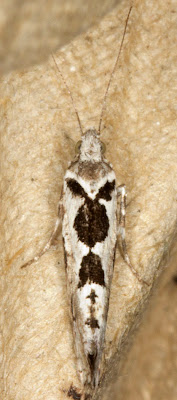
Ypsolopha sequella (with bunny ears).  Micromoth.  Moth trap at Farthing Downs with Gill Peachey, 4 October 2011.
Ypsolopha sequella .  Micromoth.
Farthing Downs, 4 October 2011.
Here are some more of the moths we caught at Farthing Downs on the morning of 4 October. I showed some of them on 6 October.

The small moth on the right is a micromoth, quite distinctive with that Bugs Bunny outline on its back. Gill Peachey, my informal tutor, does not work with micromoths, but even so, she knew it straight away.

We are starting to see the moths that really belong to the Autumn. I think that the two next down make a good contrasting pair; the Black Rustic does look quite black in normal light, with white pips on its wings, and it's only the strong light of the flash that brings out some detail. It has white underwings.

Further down is the Deep-Brown Dart, on which detail can be seen in normal light if you look carefully.

The Snout is impossible to mistake, even with a faded specimen like this, with its delta-wing shape and pointed facial outline.

The Barred Sallow and a normal Sallow would make a good pair, but the Sallow would not settle down and I couldn't get a photo.

And the last moth on this page is a Red-Green Carpet, quite showy in a dark sort of way. I like the way its eyes match the overall body and wing colour.

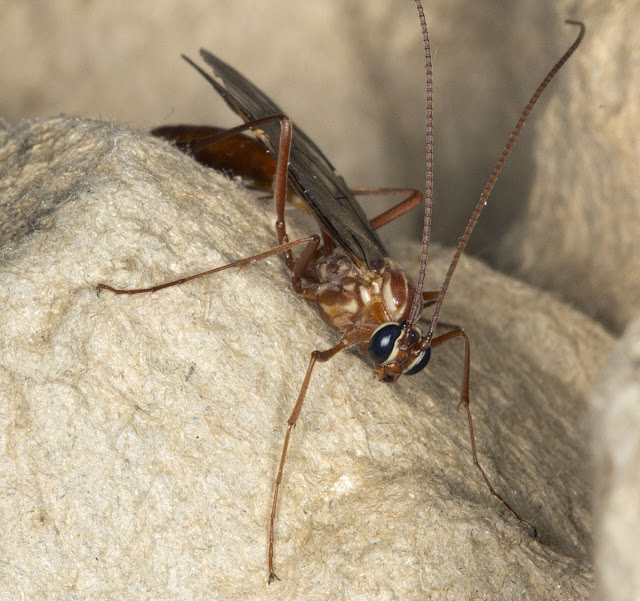
Finally, there were lots big ichneumon flies in the trap this time. I don't know the species, but they look quite dramatic.

Black Rustic, Aporophyla nigra (left) and Autumnal Rustic, Eugnorisma glareosa (right)  Noctuids.  Moth trap at Farthing Downs with Gill Peachey, 4 October 2011.
Black Rustic, Aporophyla nigra (left) and Autumnal Rustic, Eugnorisma glareosa (right)  Noctuids.
Moth trap at Farthing Downs with Gill Peachey, 4 October 2011.
Deep-Brown Dart, Aporophyla lutulenta.  Noctuid.  Moth trap at Farthing Downs with Gill Peachey, 4 October 2011.
Deep-Brown Dart, Aporophyla lutulenta.  Noctuid.
Moth trap at Farthing Downs with Gill Peachey, 4 October 2011.
Snout, Hypena proboscidialis.  Noctuid.  Moth trap at Farthing Downs with Gill Peachey, 4 October 2011.
Snout, Hypena proboscidialis.  Noctuid.  Moth trap at Farthing Downs with Gill Peachey, 4 October 2011.
Barred Sallow, Xanthia aurago.  Noctuid.  Moth trap at Farthing Downs with Gill Peachey, 4 October 2011.
Barred Sallow, Xanthia aurago.  Noctuid.  Moth trap at Farthing Downs with Gill Peachey, 4 October 2011.
Red-Green Carpet, Chloroclysta siterata.  Geometer.  Moth trap at Farthing Downs with Gill Peachey, 4 October 2011.
Red-Green Carpet, Chloroclysta siterata.  Geometer.  Moth trap at Farthing Downs with Gill Peachey, 4 October 2011.
Unidentified ichneumon fly.  Moth trap at Farthing Downs with Gill Peachey, 4 October 2011.
Unidentified ichneumon fly.  Moth trap at Farthing Downs with Gill Peachey, 4 October 2011.