Thursday, 7 July 2011

Garden Snail

Garden snail, Helix aspersa, hurrying across the front step of my house in Hayes.  6 June 2011.
Garden snail, Helix aspersa, hurrying across the front step of my house in Hayes.  6 June 2011.

Wednesday, 6 July 2011

Green Oak Tortrix

Moth, Green Oak Tortrix, Tortrix viridiana, on an oak tree on West Wickham Common, 2 June 2011.
Green Oak Tortrix moth, Tortrix viridiana, on an oak tree on West Wickham Common, 2 June 2011.

Tuesday, 5 July 2011

Keston Moths

Moth trapping on Keston Common, 2 July 2011.  Sitting around the trap.
Moth trapping on Keston Common, 2 July 2011.  Sitting around the trap.
After a trip out to Riddlesdown on Saturday morning, at sunset I went to Keston Common, where a group of experts were setting up some portable moth traps. This exercise was run jointly by Butterfly Conservation and Bromley Countryside Services, represented by Judy John. The chief moth expert was Paul Sokoloff, whom I last saw giving an illustrated talk on moths at BEECHE.

A moth trap is very simple. It consists of a light over a box, with something to slow the exit of the moths and some egg-boxes for them to rest on at the bottom.  Away from civilisation, a generator powers the light, and this is usually put at the end of a long cable because it is noisy. (If you put one in your back garden you can use the mains supply.)  Ultraviolet light attract insects best, and white light lets the trappers see the moths.  You need both, and they can be separate or combined in one bulb.  The whole thing is usually put on top of a white sheet, so that if any moths land outside the box they can be seen and won't be accidentally trampled.

Non-biting midge, Chironomus luridus.  Keston Common moth trap, 2 July 2011.
Midge, Chironomus luridus.  Keston Common moth trap, 2 July 2011.
Not a moth.
I was pleased to find when I looked this up later that it doesn't bite
As darkness fell, bats began to swoop around, and soon afterwards insects began to arrive at the traps. The photo at the top is blurry, but captures the atmosphere quite well. There were not only moths, but midges, caddis flies, wasps and craneflies. Small groups of people moved through the darkness from trap to trap, checking out the arrivals.

There was some coughing during the session.  Apparently this is not uncommon, and is caused by all the wing scales in the air, too small to be seen but big enough to be an irritant. They come off quite easily.  "If there's lots of coughing, it's a good night for moths," say the experts.

I took plenty of photos, and sometimes I managed to scribble down what I was photographing.  The traps and groundcloths make pretty messy backgrounds, but I was in too much of a hurry to capture all the insects to do a better job. Next time I might take fewer photos but make them look more aesthetic. I also think that the camera's flash makes them look more bright and shiny than they do in life, and perhaps more colourful, but I can't see how to get round that without kidnapping them and keeping them until the light of the next day. But here are some that came out reasonably well. All taken with an EOS 60D and 100mm macro lens.

Moth, Buff Arches, Habrosyne pyritoides.  Keston Common moth trap, 2 July 2011.
Buff Arches, Habrosyne pyritoides; almost under a clipboard.  Keston Common moth trap, 2 July 2011.

Moth, Mottled Beauty, Alcis repandata.  Keston Common moth trap, 2 July 2011.
Mottled Beauty, Alcis repandata.  Keston Common moth trap, 2 July 2011.

Moth, Treble Brown Spot, Idaea trigeminata.  Keston Common moth trap, 2 July 2011.
Treble Brown Spot, Idaea trigeminata.  Keston Common moth trap, 2 July 2011.

Moth, Common Emerald, Hemithea aestivaria.  Keston Common moth trap, 2 July 2011.
Common Emerald, Hemithea aestivaria.  Keston Common moth trap, 2 July 2011.

Moth, Buff Footman, Eilema depressa.  Keston Common moth trap, 2 July 2011.
Buff Footman, Eilema depressa.  Keston Common moth trap, 2 July 2011.

Moth, July Highflier, Hydriomena furcata.  Keston Common moth trap, 2 July 2011.
July Highflier, Hydriomena furcata.  Keston Common moth trap, 2 July 2011.

Stenoptilia pterodactyla, a plume moth.  Keston Common moth trap, 2 July 2011.
Stenoptilia pterodactyla, a plume moth.  Keston Common moth trap, 2 July 2011.

Moth, Udea prunalis.  The antennae are typically held over its back like this.  Keston Common moth trap, 2 July 2011.
Udea prunalis.  The antennae are typically held over its back like this.  Keston Common moth trap, 2 July 2011.

Moth, Common White Wave, Cabera pusaria.  Keston Common moth trap, 2 July 2011.
Common White Wave, Cabera pusaria.  Keston Common moth trap, 2 July 2011.

Norwegian Wasp, Dolichovespula norwegica.  Keston Common moth trap, 2 July 2011.
Norwegian Wasp, Dolichovespula norwegica.  Keston Common moth trap, 2 July 2011.
Another non-moth to finish. One of the group was stung by one of these when moth trapping last year.

Monday, 4 July 2011

Riddlesdown Quarry

Riddlesdown Quarry from within the security fence.  City of London Commons outing to Riddlesdown Quarry, 2 July 2011.
Riddlesdown Quarry from within the security fence, 2 July 2011.
It's not one of my local commons, but it was recommended, so I booked for the summer flower and butterfly walk to Riddlesdown Quarry on July 2nd. It's a City of London common like West Wickham Common and Spring Park, which I visit often as they are within walking distance of my house, but I had never been to Riddlesdown before. The warden there is Matt Johnson, and he led the walk with the assistance of one Frances, a local volunteer, who knew the quarry and its flora in detail.

Both the common and the quarry are spectacular. First, a long straight path through open grassland, thought to be on the route of a Roman road. Excavation is needed to confirm this. Grassland, and some trees and scrub off to the sides; the common is being actively managed to increase the open grassland. The wildflowers were profuse. I saw several which were new to me, or if I had seen them before I didn't know at the time what they were. Vervain, Dropwort, Tufted Vetch, Rest Harrow. Spear Thistle and Welted Thistle. The Mignonette looked very much like the garden plant of the same name that I remember from my childhood.

Long-headed poppy, Papaver dubium subspecies dubium, in Riddlesdown Quarry.  City of London Commons outing to Riddlesdown Quarry, 2 July 2011.
Long-headed poppy, Papaver dubium subspecies dubium,
in Riddlesdown Quarry. 2 July 2011.
Some plants that I did know grew here in great numbers. We followed a track that verged away from the Roman road and saw hundreds of Pyramidal Orchids, by the path and under a tree. Then we walked up a slope and came to the top of the quarry.

The common is open to all, but the quarry is surrounded by a tall metal security fence, and there are two locked gates to get through before reaching the edge of the excavation. It is a spectacular sight. Geologists would love it. Until 1996 it belonged to Blue Circle, a company that sold cement, but they had not taken chalk for some while before that.

There were a few butterflies around on the grass plateau outside, but when we went in we were suddenly surrounded by them; Meadow Browns, Ringlets, Marbled Whites and some Skippers, fluttering around, disturbed by our passing. And there were more plants, different again. Some were vivid, with strong colours, like the Everlasting Pea and the Long-Headed Poppy; others had clear pastel shades like Centaury and Restharrow.

Kidney Vetch, the food of the caterpillar of the scarce Small Blue butterfly, was all around, but we did not see the butterfly, though it is known to live here. Hop Trefoil, Eyebright, Rosebay Willowherb, many plants with beautiful and evocative names. And I discovered from one of the walkers that Bird's-Foot Trefoil, sometimes called eggs-and-bacon here, is called "old women's teeth" in Sweden.

Hop trefoil, Trifolium campestre, in Riddlesdown Quarry.  City of London Commons outing to Riddlesdown Quarry, 2 July 2011.
Hop trefoil, Trifolium campestre, in Riddlesdown Quarry. 2 July 2011.
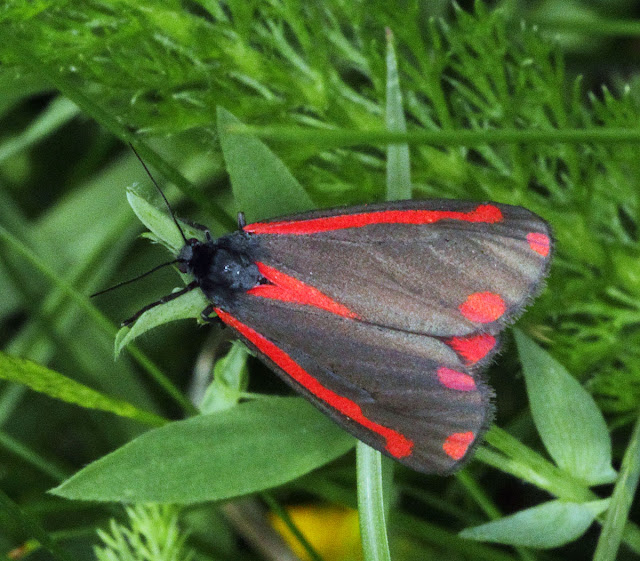
I thought I might see some of the day-flying Burnet moths, as those teeth are what the caterpillars eat. But no, though there are said to be plenty of them. I did see a Cinnabar, another brightly coloured day-flier, whose caterpillars eat only Ragwort. One of the group pointed out a Peregrine Falcon, rather larger but a lot further away, circling around the trees at the top of the quarry.

The path winds down into the centre of the quarry, where we looked around for a while, and then back up and home again. The walk was advertised as three hours. We started off at 10 a.m. and got back to the car park at 1:30 p.m. It did not seem a long time. There is only one chance each summer to visit the quarry, and I will definitely book early next year.

This was a good chance to try out my new camera, a Canon EOD 60D, and all the closeup photos were taken with that and my 100mm macro lens. The wide view of the quarry, and the view of the group, were taken with my little Canon Ixus 100. As usual, these photos show only a tiny fraction of the good things there were to be seen.
Matt Johnson addressing the group at the top of the quarry.  City of London Commons outing to Riddlesdown Quarry, 2 July 2011.
Matt Johnson addressing the group at the top of Riddlesdown quarry. 2 July 2011.
One of the group remembered when that table was new; it was quite flat then.

Common centaury, Centaureum erythraea, in Riddlesdown Quarry.  City of London Commons outing to Riddlesdown Quarry, 2 July 2011.
Common centaury, Centaureum erythraea, in Riddlesdown Quarry. 2 July 2011.

Cinnabar moth, Tyria jacobaeae, in Riddlesdown Quarry.  City of London Commons outing to Riddlesdown Quarry, 2 July 2011.
Cinnabar moth, Tyria jacobaeae, in Riddlesdown Quarry. 2 July 2011.

Round-leaved wintergreen, Pyrola rotundifolia, in Riddlesdown Quarry.  City of London Commons outing to Riddlesdown Quarry, 2 July 2011.
Round-leaved wintergreen, Pyrola rotundifolia, in Riddlesdown Quarry. 2 July 2011.

Wolf spider carrying her young on her back, in the meadow above the quarry.  City of London Commons outing to Riddlesdown Quarry, 2 July 2011.
Wolf spider hunting under the grass, carrying her young on her back, in the meadow above Riddlesdown quarry.
2 July 2011.

These spiders are quick-moving hunters and they don't hang around and pose for the camera. I have seen lots of wolf spiders this summer, but I have very few photos.
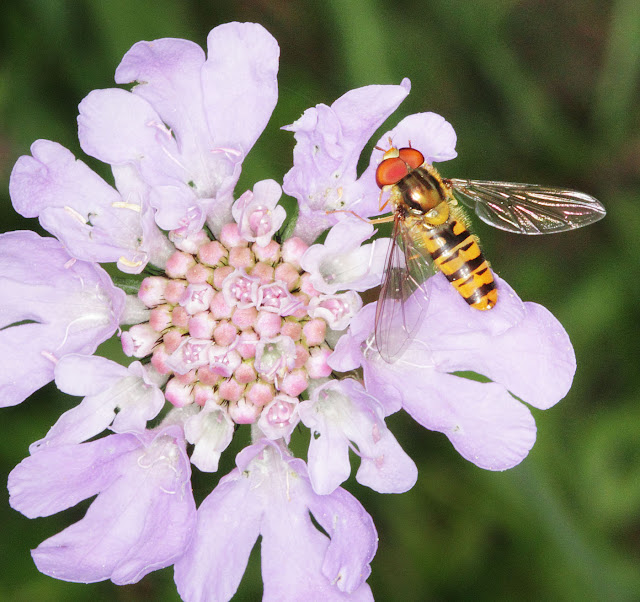
Marmalade hoverfly, Episyrphus balteatus, on a small scabious, Scabiosa columbaria, on Riddlesdown Common.  City of London Commons outing to Riddlesdown Quarry, 2 July 2011.
Marmalade hoverfly, Episyrphus balteatus, on a small scabious, Scabiosa columbaria,
on Riddlesdown Common.  2 July 2011.


Sunday, 3 July 2011

Hoverfly and Chicory

Hoverfly, Sphaerophoria scripta, male, eating pollen from a chicory, Cichorium intybus.  Jubilee Country Park, 1 July 2011.  Taken with an EOS 60D and 100mm macro lens.
Hoverfly, Sphaerophoria scripta, male, eating pollen from a chicory, Cichorium intybus.  Jubilee Country Park, 1 July 2011.
Taken with an EOS 60D and 100mm macro lens.

Saturday, 2 July 2011

Fat Hen

Fat hen, Chenopodium album.  Hayes Street Farm, Hayes.  10 June 2011.
Fat hen, Chenopodium album.  Hayes Street Farm, Hayes.  10 June 2011.

Friday, 1 July 2011

Unripe Foxglove

Foxglove, Digitalis purpurea.  Unripe fruits.  Keston Common, 29 June 2011. Taken with an EOS 450D and EF 100mm macro lens, with ring flash.
Foxglove, Digitalis purpurea.  Unripe fruits.  Keston Common, 29 June 2011.