Monday, 28 February 2011

London Loop Fragment

Along the edge of Hayes Common towards Keston
Along the edge of Hayes Common towards Keston.
On Monday 28th February Sarah Adams led a walk around a small section of the London Loop, a series of paths circling the capital. We were going the wrong way round, apparently; the Loop leafets all describe a clockwise journey. But we were walking widdershins instead of deasil.

We started at Hayes Station and walked through West Wickham Common, Keston Common, the Holwood estate, a few roads and paths, and High Elms, ending up in Farnborough Village. It was an overcast day with occasional drizzly rain, but not particularly windy, so not too cold - just.

I expected mud, but I was not prepared for just how slippery it was going to be. Sometimes, it was excessively so. As we walked down the hill from the Wilberforce Oak, down a path which must be just a water chute whan it is actually raining, we were slipping and sliding. Though Sarah, who was wearing green wellies, seemed to go through the muddy puddles by preference. You can see this happening in the first photo, which is on the edge of Hayes Common on the way to Keston. We thought this was muddy, but we hadn't yet seen Bogey Lane ...
Caesar's Well, Keston common.

The second photo is of the so-called Caesar's Well, on Keston Common. There is also a Caesar's Camp nearby. One would think that this was one of Caesar's favourite haunts, though in fact he never came anywhere near Keston.

This "well" is a natural spring, the source of the river Ravensbourne. There is a story that Caesar saw a raven pecking at the ground here; he ordered his men to dig, and the spring appeared. How likely this is to be true, you will already have seen.

People used to bathe at this spring, which was then a much more private place. The road which runs just above it used to run nearer to Holwood House. But the road was diverted to give more privacy to Holwood, and less to the spring, after which public bathing soon ceased.

After this, the path runs through an old gravel pit, part of the Blackeath Gravel layer which is so prominent locally. It was gradually excavated by the public over many years, leaving this path in a hollow, with the road above to the left and heathland above to the right.
Permissive footpath on the Holwood Estate. Holwood House in the background, far right
Permissive footpath on the Holwood Estate. Holwood House in the background.

The path through the main part of the Holwood estate is a right of way, but the section at the bottom of the hill is a permissive footpath, one where the public are allowed passage by the landowners but there is no right of way. There are a number of these in Bromley borough, and the landowners' generosity is much appreciated.

This one cuts past some tricky roads, narrow and with fast traffic. The photo above is of this footpath, with Holwood House just visible on the hillside in the background. Click on the photo to see it enlarged.

This is not the Holwood House that William Pitt the Younger lived in, but another which was built just next to the site of the original.
The state of the footpath along Bogey Lane in February 2011.

The photo on the left is of Bogey Lane, an ancient highway which is in theory a Byway Open to All Traffic, though access to vehicles is now restricted because of fly-tipping. Here is a Bromley press release about Bogey Lane fly-tipping.

In practice, after the recent rainy weather it was hardly passable even on foot. (Here I am considering, and rejecting, a pun about a BOAT.) Luckily we could parallel this section along the edge of a field. Elsewhere in the lane, tracks of horses and deer could be seen, but nothing with wheels has been there, at least not recently.

We had a short break at High Elms, at the wardens' base of operations in the old stable buildings, and then on for about half a mile to Farnborough village through the churchyard, where I briefly noticed interesting old gravestones, one mentioning a "Gypsy King", and a big old yew, as we zoomed past. From the village we were offered a lift back to Hayes station.

The Yew Walk at High Elms. Even this was pretty slippery.
This Yew Walk felt just like walking up a tilted slab of wet clay. How can grass grow in something like that, being walked on every day?

Saturday, 26 February 2011

Butcher's Broom

Butcher's Broom growing through a fence at the edge of West Wickham Common
There are some species of plant that indicate that a woodland is ancient; that it is likely to have been in place since at least 1600 CE.

West Wickham Common has some of those species, though there are other indications that it is not truly ancient. One of those is Butcher's Broom, a small prickly shrub. There are only a few specimens on the common, and in fact most of them are just off the actual common, on private ground, visible over the fence.

Most of these local plants are not very healthy. In fact, its scarcity around here and the poor condition of most of these specimens made me think that Butcher's Broom must be quite rare. (And, of course, it doesn't grow at all in the north of England where I came from.) But then, I read on line that it is widely planted in gardens, is a florist's plant, and is often used in weddings - so there must be a lot in cultivation.
Butcher's Broom in flower at the edge of West Wickham Common

The plant in the top photo is one of the best in West Wickham, and you can see it is actually growing through the fence. It likes shade and grows under trees where you will not find many other shrubs, except perhaps holly.

Butcher's Broom is a real oddity. It doesn't have actual leaves; instead, specalised branches called cladodes or cladophylls are flat and leaf-shaped. You can tell they are not true leaves because the flowers grow directly from them; flowers always grow from stems or branches, never from leaves.

This is a female plant. The photo on the right shows a flower, and the lower photo shows a juicy-looking red fruit. These grow from the undersides of the cladodes.

Butcher's Broom in fruit at the edge of West Wickham Common

The stiff and spiny cladodes are supposed to be difficult for animals to eat, but something clearly loves these. Nearly all of them have been nibbled, and the fruit also has some damage. But these fruits are big, red and shiny to attract birds, which spread the seeds, so a damaged fruit is no problem for the plant.

These flowers and fruit are both on the plant at the same time; late February.

Tuesday, 22 February 2011

Fallen Deadwood

Fallen tree on West Wickham common

This is a case of standing deadwood becoming fallen deadwood on West Wickham Common.

It was a tall, long-dead tree, looks like a beech, serving as a home and food for many sorts of fungus and beetle, and as shelter and nesting sites for birds and possibly also bats, for there are several species of bat on the common. Behind it, you can see one of the common's old oaks, unfortunately not looking very healthy.

You can see from where the fallen tree has broken at the base that the interior has lost all strength. It is light and spongy. Fungi have eaten away all the hard, supportive material. A large fan of bracket fungus, its fruiting body, is right there at the base.

But look also at the photos below. There are some suprisingly big holes where beetle larvae have bored through and fed, as well as a number of smaller holes. The big ones are nearly a centimetre across.

Soft wood in the centre of a fallen tree on West Wickham common

Holes made by beetle larvae in the outer layers of a fallen tree on West Wickham common
Holes made by beetle larvae in a fallen tree on West Wickham common

You can also see, on the bottom photo which is of the outer layers of the tree, some dark strands that seem to delve into and through the wood. These are the edges of zones of mycelium, the strands of fungus that grow inside the tree. The beetle holes seem not to cross over those dark zones, so perhaps the beetle larvae preferred the taste of one sort of fungus, or didn't like the taste of those edge zones. Or, perhaps it's the other way round, and the fungi started to grow in the beetle tunnels and spread out from there.

Friday, 18 February 2011

Crowborough House Names

House names in Crowborough

Walking around Crowborough, the streets on the edge of the Ashdown Forest, I saw that the houses don't have numbers. Instead, they all have names and name signs.

In a situation like this, it is clearly a good idea that your house name stands out and can't be confused with anyone else's. But even so, along with the creative, the twee and the silly ones, there are plenty of houses with traditional country names relating to trees, houses and even lodges.

How they make them distinctive is in the shape and form of the house signs. No two are identical.

I was going to make a list, but instead I started to photograph them as I walked along. If my companion had not been somewhat embarrassed by this I would have taken lots more .. these are in the order I took them as I walked along, and they are only a tiny sample of the riches available.

Thursday, 17 February 2011

Two River Gods

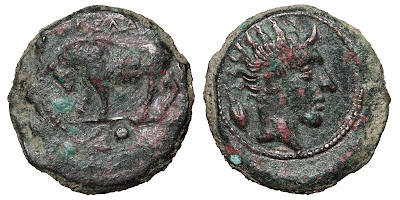
Bronze onkia of Gela in Sicily, c. 420-405 BCE
Bronze onkia of Gela in Sicily
To the ancient Greeks, religion was an inherent part of life and of their surroundings. Deities, great and small, were everywhere. They were certainly tied up with the forces of nature, and that included the great rivers.

The river gods bore the same names as their rivers. These two coins show examples. On the right is a small coin from Gela in Sicily, still an important town situated on the river of the same name. The coin dates from the end of the 5th century BCE. It illustrates a common conception of rivers and their gods; that they had the unstoppable force of a charging bull. A butting bull is on one side of this coin.

The other side shows the youthful river god Gela, and you can see two unusual things about him. First, he has horns — this gives him personally some bull-like attributes. In fact, sometimes the river gods were shown as bulls with human heads. And second, his strange hair. This spikiness is a representation of the way hair floats up when you are under water. The river-god Gela is in his element.

The second coin is from Hieropolis-Kastabala in Cilicia, now southern Turkey. It sat on the river Pyramos, now called the Ceyhan River. It is a little later than the coin from Gela, dating from the 2nd or 1st century BCE.
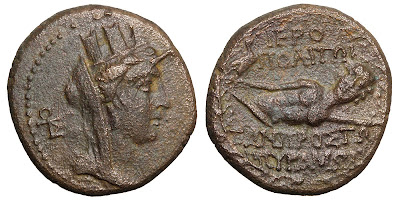
Bronze AE22 of Hieropolis-Kastabala in Cilicia.  Civic issue, c. 2nd-1st Century BCE
Bronze AE22 of Hieropolis-Kastabala in Cilicia

On the obverse of this coin is Tyche, the city goddess. This was a common way of representing a deity specific to a city. Although these city goddesses looked similar, they were not the same goddess; each city had its own. She is wearing a mural crown, a crown that represents the walls of the city. Numismatists say she is "turreted" — an odd bit of jargon.

The reverse shows the river god of the Pyramos. He is swimming to the right, and holding an eagle in one hand. (It is definitely supposed to be an eagle, even if it does look more like a duck.) This coin has a longish Greek legend; IEPOΠOΛITΩN TΩN ΠPOΣ TΩI ΠYPAMΩI. It means "(Coin of) Hieropolis of the people who dwell on the Pyramos." It was probably put this way to distinguish it from other towns also called Hieropolis.

One reason I like ancient coins is that so much is going on on them.

This second coin has been stripped of its patina, probably by electrolysis. The exposed surface is somewhat irregular and pitted. This is a shame; it would probably have looked much better if it had been cleaned more carefully, leaving the patina in place.

I have a web page about river god coins here: River Gods on Ancient Coins.

Tuesday, 15 February 2011

Mesh Fence as Environment

Railway path between West Wickham and Hayes: mesh fence being stripped out
Railway path between West Wickham and Hayes
Between Tiepigs Lane in Hayes and Hawes Lane in West Wickham there is a footpath which runs alongside the railway cutting. Wire mesh fencing encloses the path on the railway side, and part of the other side too. This provides a great support for climbing plants like ivy and bryony, and even such a narrow fence allows all sorts of other plants to grow up around it and through the meshes. These in their turn will be shelter and food for insects and birds.

But last spring, the old fencing along the railway was torn out and replaced by new, taller fenceposts and shiny green mesh. This amounted to the destruction of a whole environment; it was depressing to see the ivy being torn out, rolled up and thrown away. It's not as though the old fencing was in too bad a condition. It was old and saggy, but still in one piece with no signs that anyone had broken through or climbed over it.

Taking down the fence also involved cutting down many shrubs and scrubby small trees that were in the way of the work.

Railway path between West Wickham and Hayes: mesh fence being stripped out

Railway path between West Wickham and Hayes: new mesh fence in place

The new green fencing looked sterile in comparison with the old overgrown stuff. I was surprised to see that although the new mesh came in rolls, you can't see the joins; the workmen must have done a very good job of linking the sections together.

During the year some new growth has begun to take hold, particularly fast growing plants like brambles and elder. It didn't take long for something, probably foxes, to dig passageways beneath it. The glossy green colour is fading back to silvery white. So the environment will regenerate, but the removal of a whole length at one time, at least half a mile, looked extreme.

The greater height has not stopped people from throwing rubbish over onto the railway land, but today I saw some men clearing that up at one end. If they clean up the whole length, it will be a great improvement.

(Added later:) No, they didn't. They just cleared up at one end

Sunday, 13 February 2011

Small Mammals

Opening a humane small mammal trap in Jubilee Country Park
Opening a humane small mammal trap
On 13th February was a roundup of small mammals in Jubilee Country Park. It was led by Jenny Price, with most of the work being done by Tony and Marcus, the park's in-house surveyors. They were very familiar with small mammals and their handling.

The evening before, some traps had been left around the park in likely spots, containing some hay and various types of food to keep any caught creatures alive overnight. So at 9 a.m. a group of people, including several small children, assembled, to go and see what had arrived.

The park is much used by dog owners, and we saw several enter the park as we gathered - including a three-legged greyhound! - so there are not many creatures to be found in the easily accessible areas. Of the dozen or so traps, most were in the woods, and these contained wood mice. A few were in hedgerows in the meadow areas, and in one of those traps there was a field vole. These are both common species, but it is reassuring to see a good population of them. It suggests that the park is being managed well.
A wood mouse being held firmly but gently in Jubilee Country Park
A wood mouse being held firmly but gently

There were also a few corrugated iron shelters, where sometimes you can find small mammals, lizards and snakes, but there were none on this cold and wet morning.

So, I took quite a few photos. In the shaded woods on an overcast morning, it was not at all easy to get an unblurred picture; they needed too long an exposure. That's a wood mouse on the left. But I got some nice sharp shots of the field vole, out in the open; they are at the bottom of this post.

The process of checking the traps was this. If the trap's door was open, they were just collected up. If closed, the traps were carefully put into a big transparent plastic bag, disassembled and emptied.

The creatures were extremely fast and lively, and were quite able to shoot up unguarded arms and escape; they had to be cornered inside the bag and then grasped firmly by the scruff of the neck. A couple of wood mice got away from unwary graspers, including even Jenny, so real care was needed. The photo at the top shows a trap being emptied.

I volunteered to pick up the creature that was turned out of the last trap, and when I took it from the plastic bag it promtly urinated on me. A pity there are no photos of that! I couldn't take photos at the same time as holding what turned out to be the field vole, also called a short-tailed vole, but I got some good closeups after that. The animal experts were very pleased with this vole; they had seen one under the corrugated iron before, but never had one in a trap.

Here's the park's Friends site: Friends of Jubilee Country Park.

A short-tailed vole being inspected in Jubilee Country Park
A short-tailed vole being inspected

A short-tailed vole being held for its photograph in Jubilee Country Park
A short-tailed vole being held for its photograph

A short-tailed vole being held for a closeup in Jubilee Country Park
A short-tailed vole being held for a closeup