Tuesday, 30 October 2012

Grey Herons in Kelsey Park

Young Grey Heron, Ardea cinerea, in Kelsey Park on 27 October 2012
I am not a bird-watcher, but occasionally they present themselves to be photogpaphed, like this young Grey Heron.  There are several heron nests in Kelsey Park and the young ones seem to be less concerned about people than their more experienced elders.

The bird below seems to be going for a stroll.

Young Grey Heron, Ardea cinerea, in Kelsey Park on 27 October 2012

Saturday, 27 October 2012

Shaggy Inkcap

Coprinus comatus (Shaggy Inkcap or Lawyer's Wig). Beacon Wood Country Park, 20 October 2012.
This little group, standing about 8 inches tall, was right at the entrance to Beacon Wood near a rubbish bin.  They like disturbed ground. Last year I saw a clump growing through the gravel of a friend's driveway.

They grow fast, and you can see clumps of earth on top that have been raised out of the soil.  The skin of the cap breaks up into shaggy scales as the fungus grows, revealing the fibrous hair-like understructure which gives it its species name.

Originally they are quite white, and the cap is attached to the stipe by a membrane called a partial veil, which protects the immature spores.  At the stage shown here, the only remaining trace of the veil is the loose ring which has fallen down the stem.  (Not all fungus stipe rings are mobile like this.)

As the fungus matures and black spores ripen, the edges of the cap liquefy and drip as a black liquid. You can see this clearly in a related species I showed last year: Magpie Ink Cap.

Here's a closer shot of the largest cap from a different angle.  I am reluctant to pay a lot of heed to those amber-coloured droplets on the caps; they are not mentioned in my books, and for all I know they might be dog urine. 

Coprinus comatus (Shaggy Inkcap or Lawyer's Wig). Beacon Wood Country Park, 20 October 2012.

Wednesday, 24 October 2012

Amanita Muscaria


Amanita muscaria (Fly Agaric).   Beacon Wood Country Park, 20 October 2012.
Amanita muscaria (Fly Agaric).   Beacon Wood Country Park, 20 October 2012.
This is not what you expect to see under this name.  That's because it's a baby, just pushing out of the ground, and is still covered with its universal veil.  We found these in Beacon Wood Country Park, near Bean.  There is an extensive area of Silver Birch woodland on what used to be the bottom of a commercial clay pit, and there were hundreds of these startling fungi in clusters and in long crescents.

Amanita muscaria (Fly Agaric).   Beacon Wood Country Park, 20 October 2012.
Amanita muscaria (Fly Agaric).   Beacon Wood Country Park, 20 October 2012.
The red cap starts to push through the scaly yellow veil.

Amanita muscaria (Fly Agaric).   Beacon Wood Country Park, 20 October 2012.
Amanita muscaria (Fly Agaric).   Beacon Wood Country Park, 20 October 2012.
You probably see it most often like this, with a white stipe, domed scarlet cap and yellow scales.  It's not fully mature yet, but often it doesn't get much further because slugs just love it.  In fact you can see that the one on the left has lost a chunk of the stipe.  If there were not so many of them all at once I would probably not have got to see this ...

Amanita muscaria (Fly Agaric).   Beacon Wood Country Park, 20 October 2012.
Amanita muscaria (Fly Agaric).   Beacon Wood Country Park, 20 October 2012.
A fully mature specimen nearly a foot across, quite a giant for this species.

Sunday, 21 October 2012

Some Myxomycetes

Lycogala epidendrum var. terrestre.
I mentioned Myxomycetes a couple of posts ago.  They are also called Slime Moulds, and have a life cycle in which they grow from spores into little amoeba-like creatures, come together into a larger and still mobile slime, then put up spore cases and spread their spores again.  (I have omitted much detail.)   Their slimy stage, called a plasmodium, can be small or quite large.  Most of those you can find in the UK are small.

There was a Myxo foray at Sevenoaks on the 14th of October, and at the start we were shown some examples by one of the group who had brought them along from elsewhere.  The first photo is a group of fruiting bodies, and you can see the small scale from the part of my thumbnail visible on the left.
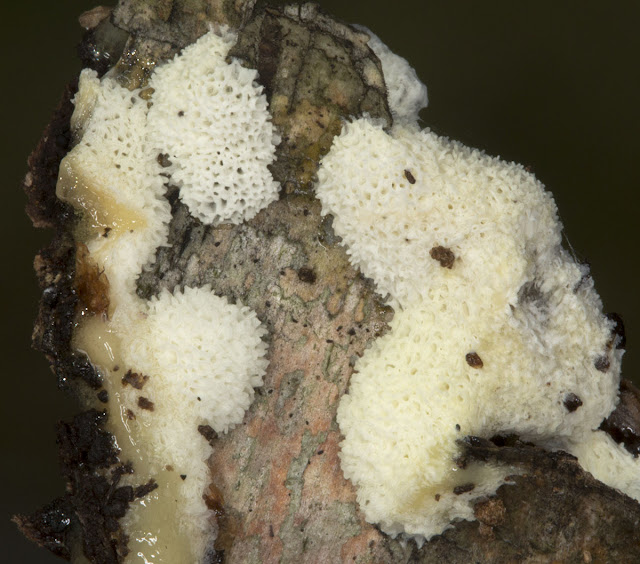
Ceratiomyxa fruticulosa var. poroides
Here's another, a slightly smaller specimen.  You can see some plasmodium on the left, and some patches of a honeycomb-like fruiting structure.

Tubifera ferruginosa
Another of about the same size, on which you can see plasmodium and both young and mature fruiting bodies.

Ceratiomyxa fruticulosa.  Sevenoaks Wildlife Reserve, 14 October 2012.
Ceratiomyxa fruticulosa.  Sevenoaks Wildlife Reserve, 14 October 2012.
This is one we found on the day, and is a fruiting structure.  It's a different variety of the second one, apparently - I can only repeat what I am told about Myxomycetes.  But they do look fascinating.

Thursday, 18 October 2012

A Parasitic Fungus

Pseudoboletus parasiticus on Scleroderma citrina.   Keston Common, 7 October 2012.
Pseudoboletus parasiticus on Scleroderma citrina, a Common Earth Ball.   Keston Common, 7 October 2012.
It's not only people and slugs who like eating fungi.  Other fungi do, too.  There are quite a few parasitic species, and while it's often not easy to tell what is going on, in this case it is obvious.  This bolete is growing out of the side of the Earth Ball it is parasitising.

The Earth Ball still looks healthy enough and will be full of spores, so it must have a good supply of nutrition if it is feeding that big mushroom as well as itself.

Monday, 15 October 2012

Identification Answers

Fungi and Other Goodies
OK!  Quiz answers!  The fungi in this group are numbers 1, 2 and 6.  1 is a Small Stag's-horn Fungus, Calocera cornea; rather immature.  2 has the delightful common name of Crystal Brain, and can also be called Exidia nucleata.  6 is a Pale Staghorn,  Calocera pallidospathulata.

Number 3 had me excited when I saw it in wet rotting wood.  But on closer examination it turned out to be two holly berries that had fallen from the bush above.

I found Number 4 by turning over a piece of fallen wood.  It is a cluster of slug's eggs.  I don't know what species.  They will be familiar to most gardeners.

Number 5 is probably a bit of a trick question.  It's a Myxomycete, or Slime Mould, most likely a species of Trichia; it would take an expert with a microscope to determine which species.  Although Slime Moulds are often lumped in with fungi, because they have a lot of superficial similarities and they grow in the same places, many biologists think that they actually belong to a different kingdom and are related to Amoebas.  Some of them are quite mobile for part of their life cycles.  But they also reproduce by disseminating airborne spores, like fungi.  They are truly odd.

Saturday, 13 October 2012

Identification Quiz

What are they?
Three of these are fungi.  I am not asking you to say what species of fungi, just to pick them out and tell me, if you can, what the others are.  They were all found in woodland, either on rotting wood or in the damp leaf litter, on Keston Common on 7th October.  I will reveal all, or at any rate all that I know, next time.