 |
| Lycogala epidendrum var. terrestre. |
I mentioned Myxomycetes a couple of posts ago. They are also called Slime Moulds, and have a life cycle in which they grow from spores into little amoeba-like creatures, come together into a larger and still mobile slime, then put up spore cases and spread their spores again. (I have omitted much detail.) Their slimy stage, called a plasmodium, can be small or quite large. Most of those you can find in the UK are small.
There was a Myxo foray at Sevenoaks on the 14th of October, and at the start we were shown some examples by one of the group who had brought them along from elsewhere. The first photo is a group of fruiting bodies, and you can see the small scale from the part of my thumbnail visible on the left.
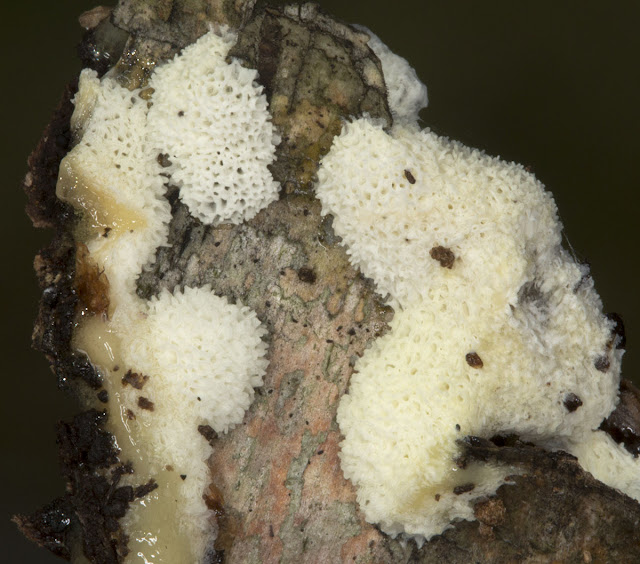 |
| Ceratiomyxa fruticulosa var. poroides |
Here's another, a slightly smaller specimen. You can see some plasmodium on the left, and some patches of a honeycomb-like fruiting structure.
 |
| Tubifera ferruginosa |
Another of about the same size, on which you can see plasmodium and both young and mature fruiting bodies.
 |
| Ceratiomyxa fruticulosa. Sevenoaks Wildlife Reserve, 14 October 2012. |
This is one we found on the day, and is a fruiting structure. It's a different variety of the second one, apparently - I can only repeat what I am told about Myxomycetes. But they do look fascinating.


