Monday, 18 March 2013

Blackthorn Again

Blackthorn flowering in a hedge on Bourne Way, Hayes.  16 March 2013.
Blackthorn flowering in a hedge on Bourne Way, Hayes.  16 March 2013.
I have been spending most of my recent computer time on the Orpington Field Club website.  But meanwhile, even though this flower has been on my blog before, it's such a great sign of spring that I can't resist it.

You can tell from the house behind that this is a garden hedge, and behind me is the main road.  I do like countryside hedges in suburbia.

Tuesday, 12 March 2013

Tree Felling on Hayes Common

Felled Beech on Hayes Common, 3 March 2013.
One of the management jobs on the local commons is to make sure that none of the trees bordering the paths are likely to fall on visitors, or drop limbs onto them.  Today I saw evidence that the rangers had been at work.

This was a large Beech, and I could see why it had been felled.  A fungus infestation had weakened its heart considerably.  You can see that the two main trunks have fallen apart during the felling, most likely because of this weakening.

Felled Beech on Hayes Common, 3 March 2013.
This closeup shows the punky, diseased heartwood next to the remaining strong and healthy wood, and the difference is evident.  The dark line at the border shows the tree's defences at work, too late!

Felled Oak on Hayes Common, 3 March 2013.
Further on I saw this recently felled Oak.  This was more of a puzzle.  I can't see any obvious weakening, but there is that blue stain.  It is on both sides of the cut, so can't be an attempt to poison the stump.  It must have been introduced to find something out about the tree, and if I ever find out what has been going on here, I will add a note!


Saturday, 9 March 2013

Scarlet Elfcups

Sarcoscypha austriaca (Scarlet Elfcup).  Sevenoaks Wildlife Reserve, 27 February 2013.
Sarcoscypha austriaca (Scarlet Elfcup).  Sevenoaks Wildlife Reserve, 27 February 2013.
Irene Palmer offered to show me a flood of these charming fungi at Sevenoaks Wildlife Reserve, for which I offer my thanks.  They are a pretty sight when there are few flowers about, and Irene is expert at putting together good material for a photo.

They grow on fallen deadwood which stays wet enough to become mossy.  You can't normally see this, but they have a small stalk which gives them a goblet shape.

Sarcoscypha austriaca (Scarlet Elfcup).  Sevenoaks Wildlife Reserve, 27 February 2013.
Sarcoscypha austriaca (Scarlet Elfcup).  Sevenoaks Wildlife Reserve, 27 February 2013.
This was taken by lifting the branch and photographing the parts that normally never see the light. 

The same day I saw these, I received an email saying they were also out in Jubilee Country Park, and indeed I found half a dozen patches there on the 28th.  As they were a little past their best, I am not showing any photos of those specimens here.  But it's good to see them popping up in different places.

Wednesday, 6 March 2013

Herald and Twenty-plume


This is the entrance to a set of caves which might once have been a sandstone mine. They were definitely used as an air-raid shelter in the second world war.  Now, they are in someone's back garden!  I want one of these.

We looked around as part of a bat survey.  This time, we didn't find any bats here, but there were a couple of overwintering moths. 

Herald, Scoliopteryx libatrix.  Chipstead Caves, 24 February 2013.
Herald, Scoliopteryx libatrix.  Chipstead Caves, 24 February 2013.
Quite a few insects overwinter in caves, and the Herald is rather spectacular.  Last year was not very good for moths, so perhaps we were lucky to find this one.  There was only one other, and that was dead and mouldy.

There were smaller moths as well, two specimens of the interesting Twenty-plume Moth:

Twenty-plume Moth, Alucita hexadactyla.  Chipstead Caves, 24 February 2013.
Twenty-plume Moth, Alucita hexadactyla.  Chipstead Caves, 24 February 2013.
Its wings are not continuous planes, but consist of 24 plumes covered with backwards-pointing hairs.  These were both alive and healthy.

It was good to see some summer moths in the middle of winter!

Sunday, 3 March 2013

To The Batcave!


Actually, more than one bat cave.  I was with a small group doing a bat survey.  You need a bat conservator's license for this, so I was lucky to be invited along.  This is one of a small group of caves at Combe Bank.  I am carefully not saying exactly where they are, and the GPS on the photos isn't accurate either, as there was no signal inside the caves.

I was not allowed to photograph the bats, even without a flash.  Apparently you need a license for that too .. but we did see several.  Some Natterer's, a Daubenton's and a Long-eared, tucked right into tiny crevices with just noses, wingtips and ears showing.  We also saw some cave spiders, which don't need a license ...
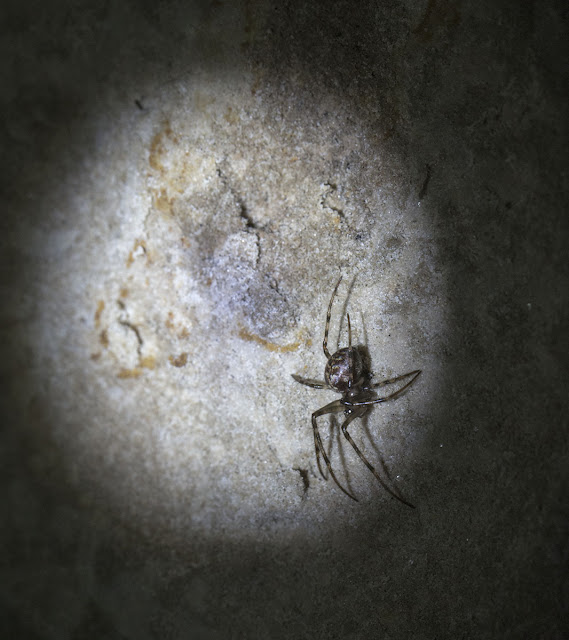
Cave Spider, perhaps Meta merianae, at Combe Bank on 24 February 2013.
I actually have some better record shots than this, but this one, taken by torchlight, is the most atmospheric.  And quite tricky to take, with torch in one hand and large camera in the other.

There was also a beetle, some mosquitos, some woodlice and lots of Ichneumon Wasps, probably Ambyletes species, but so far unidentified.
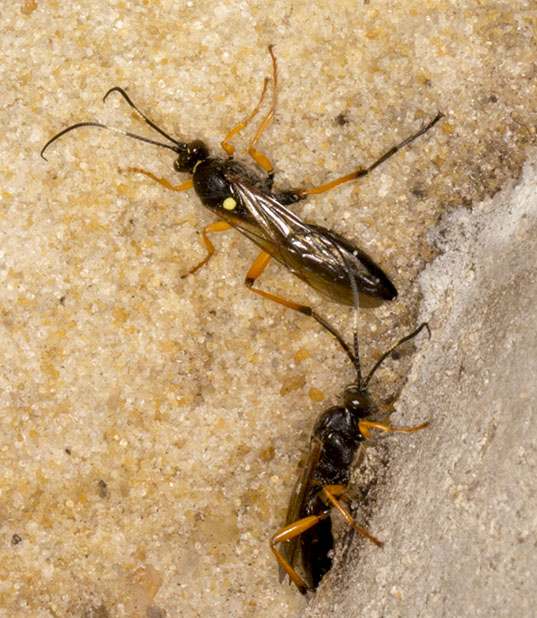
Unidentified Ichneumon Wasp at Combe Bank, 24 February 2013.
There are several similar species and this doesn't quite match any in my rather limited insect book.

There were several of these; they are the spiders' egg-cases, well wrapped in silk and hanging by a thread from the roof of the cave.

Cave spider egg sac.  Probably Meta merianae.  Combe Bank, 24 February 2013.
Cave spider egg sac.  Probably Meta merianae.  Combe Bank, 24 February 2013.
And this was just one site - though there are several small caves here.  It was a very interesting day!


Thursday, 28 February 2013

Jubilee Country Park, February.

Butcher's Broom, Ruscus aculeatus.  Jubilee Country Park, 23 February 2013.
Butcher's Broom, Ruscus aculeatus.  Jubilee Country Park, 23 February 2013.
A few of the Orpington Field Club had a stroll around Jubilee Country Park on a cold and windy day with light snow.  Mostly we were looking for birds, which are not my speciality, so I was on the lookout for anything else of interest too. I was pleased to find that, having made the basic settings, I could operate my camera wearing thick gloves.

There were some snowdrops in bud, and cherry trees just coming into flower.  This bush was probably the best sighting, in Thornet Wood.  Butcher's Broom is a good indicator of ancient woodland, and here you can see the buds and flowers and a big fruit emerging from the middle of the leaf-like cladodes.

We did see some birds too, mostly Magpies, Gulls, Pigeons and Crows.  There were a few others, and I made an attempt at photographing them.  I make no claims for the quality of these.  This bird was the prettiest; a tiny one, too fast-moving for me to get a proper shot.  By the time I had focused on it, it was somewhere else.

Goldcrest, Regulus regulus.  Jubilee Country Park, 23 February 2013.
Goldcrest, Regulus regulus.  Jubilee Country Park, 23 February 2013.
And another bird with a golden name:

Goldfinch, Carduelis carduelis.  Jubilee Country Park, 23 February 2013.
Goldfinch, Carduelis carduelis.  Jubilee Country Park, 23 February 2013.
Robins are easy to photograph in gardens.  They are well-known for following gardeners around, watching for worms turned up by the digging.  Here, they stayed a bit further away.

European Robin, Erithacus rubecula.  Jubilee Country Park, 23 February 2013.
European Robin, Erithacus rubecula.  Jubilee Country Park, 23 February 2013.
But my favourite photo is this one, one of the magpies taking off from its perch in a tree, missing a twig by a tiny margin.

Magpie, Pica pica.  Jubilee Country Park, 23 February 2013.
Magpie, Pica pica.  Jubilee Country Park, 23 February 2013.

Sunday, 24 February 2013

Two Common Mosses

Bryum capillare on a wall in Bourne Way, Hayes.  9 February 2013
Bryum capillare on a wall in Bourne Way, Hayes.  9 February 2013.

Early spring is a good season to observe mosses and lichens.  Here are two which are common and widespread, growing on garden walls in my neighbourood.

It's useful for anyone interested in mosses to catch them when they are fruiting, as many are in this season.  It's not easy to catch a good photo because of the limited depth of field in macro closeups, so that often only a few of the leaves and capsules are sharp and well-defined.  But that is where brick walls can be useful; some of the mosses grow on the mortar between the bricks, and are lined up in neat rows.  

Grimmia pulvinata on a wall in Lennard Avenue, Hayes. 9 February 2013
Grimmia pulvinata on a wall in Lennard Avenue, Hayes. 9 February 2013.
Of course, others don't do that, but instead grow in cushions on top of the bricks.